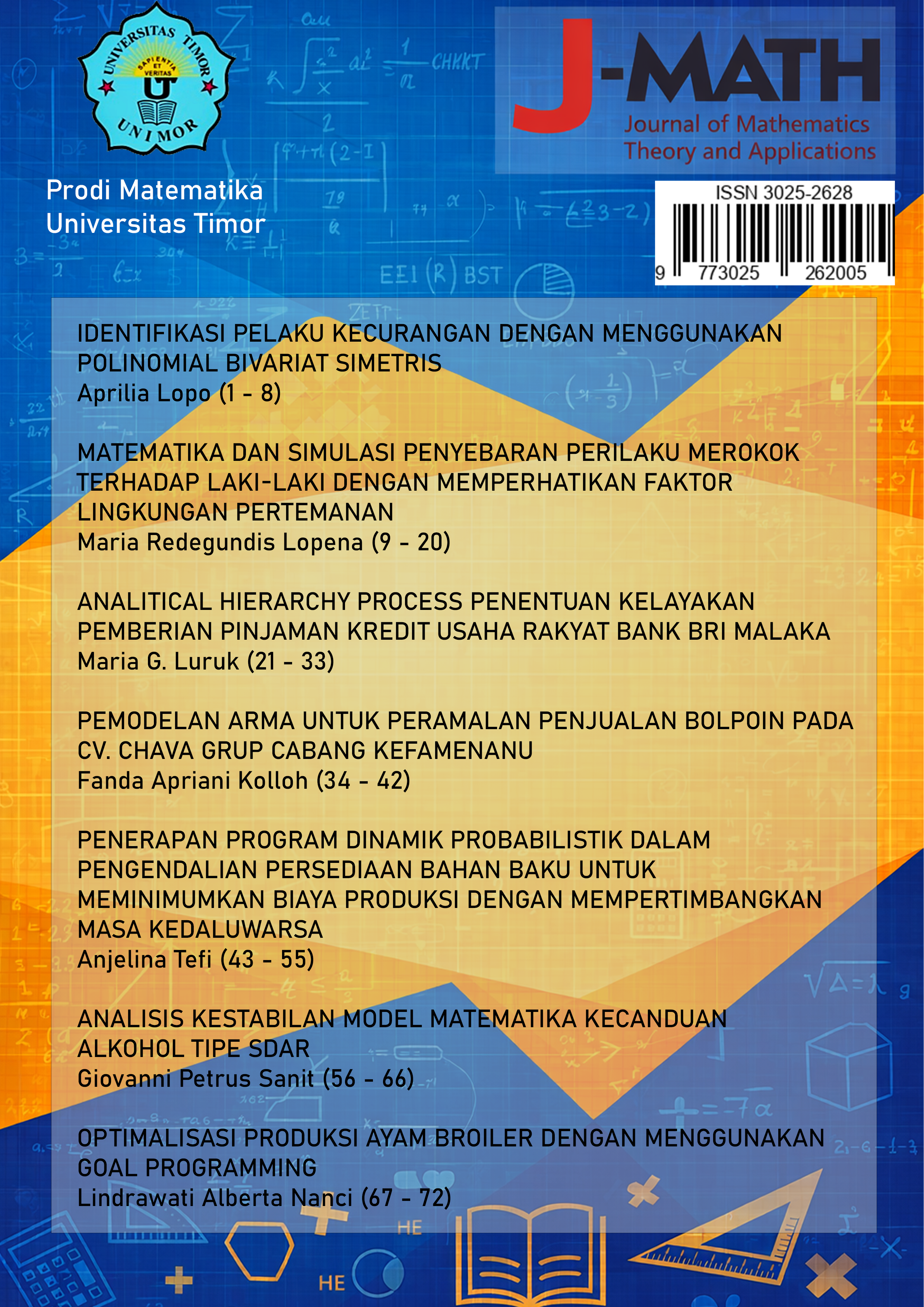
ANALISIS KESTABILAN MODEL MATEMATIKA KECANDUAN ALKOHOL TIPE SDAR
Keywords:
Alkohol, Mathematical Model, Basic Reproduction Number, AddictionAbstract
Alcohol is a psychoactive substance that is addictive. Psychoactive substances are a class of substances that act selectively, especially on the brain, which can cause changes in a person's behavior, emotions, cognition, perception and consciousness. Alcohol is an addictive substance that can cause addiction and dependence. Alcohol addiction is a condition when a person experiences an addiction to alcohol and is difficult to control until he becomes dependent. Alcohol addiction occurs due to consuming too much alcohol so that the level is sufficient to cause mental changes and experience a sensation of satisfaction when consumed. The habit of consuming alcohol for teenagers begins due to a lack of knowledge and invitations, persuasion and seduction from friends which make a teenager want to try consuming alcohol. After getting to know and feel the sensation of consuming alcohol, a teenager gradually begins to fall into the world of alcohol and begins to increase his consumption due to the free social environment among teenagers. This research aims to build a mathematical model of SDAR type alcohol addiction. Based on the research results, two equilibrium points were obtained, namely the equilibrium point free from alcohol addiction and will be stable when and the equilibrium point where there is alcohol addiction and will be stable when . The simulation results were observed in two conditions, namely when and the value was obtained, meaning that the rate of movement from the population of teenagers who tried to consume alcohol to alcohol addiction was still small, so that teenagers who Alcohol addiction will decrease until alcoholics will disappear from the population over time. Then when and the value is obtained, meaning that the rate of movement from the population of teenagers who try to consume alcohol to alcohol addiction is increasing until there will be more and more alcoholics and will increase in the population as along the time.
References
Akbar, R. oktiana. (2023). Albajar Linear (O. Rit riyanto (ed.)). https://books.google.co.id/books?id=v8ilEAAAQBAJ&pg=PA169&dq=akbar+2023+nilai+eigen+dan+vektor+eigen&hl=id&newbks=1&newbks_redir=0&source=gb_mobile_search&ovdme=1&sa=X&ved=2ahUKEwjL2OCOqp-IAxUbTGwGHasLAyMQ6wF6BAgFEAU#v=onepage&q=akbar 2023 nilai eigen dan
Azizah, M. (2020). Model Matematika Penyebaran Penyakit Coronavirus Disease 2019 (Covid-19) Dengan Vaksinasi, Isolasi Mandiri, Dan Karantina Di Rumah Sakit. Jurnal Sains Dan Matematika, 2019, 97. https://repository.uinjkt.ac.id/dspace/handle/123456789/56206
AZIZAH, N., & RUDIANTO, B. (2021). Penyelesaian Sistem Persamaan Diferensial Fraksional Linier Orde Berbeda Menggunakan Transformasi Laplace. Jurnal Matematika UNAND, 9(4), 318. https://doi.org/10.25077/jmu.9.4.318-329.2020
Fadhilah, J., & Maulana, D. A. (2022). Model Dinamika Kecanduan Rokok Pada Pria Dan Wanita. MATHunesa: Jurnal Ilmiah Matematika, 10(1), 180–189. https://doi.org/10.26740/mathunesa.v10n1.p180-189
Hakim, L. (2013). Model Matematika Tentang Pengaruh Alkohol Terhadap Kesehatan dan Perkembangan Sosial (Vol. 2, Issue 1).
Irmayanti, D. (2017). ANALISIS KESTABILAN MODEL SDILR (SUSCEPTIBLE- DANGEROUS-INFECTIVE-LATENT-RECOVERED) DENGAN ADANYA PENGULANGAN RUMOR PADA MEDIA SOSIAL. Journal of Chemical Information and Modeling, 21(2), 1689–1699. https://www.oecd.org/dac/accountable-effective-institutions/Governance Notebook 2.6 Smoke.pdf
Isty Nursani, I., Alisa, N., Latifah, I., & Dewi Rosita, M. (2023). Dinamika Perkembangan Hiv/Aids Di Kabupaten Kudus Menggunakan Model Persamaan Diferensial Nonlinear Sir (Susceptible, Infectious and Recovered). Jurnal Ilmu Komputer Dan Matemtika, 4(2), 63–68. https://ejr.umku.ac.id/index.php/jikoma/article/view/1982
Ndii, M. Z. (2022). Pemodelan Matematika (M. Nasrudin (ed.); Pertama). PT. Nasya Expanding Management. https://books.google.co.id/books?id=7ExhEAAAQBAJ&pg=PA68&dq=Kriteria+Routh+hurwitz&hl=id&newbks=1&newbks_redir=0&source=gb_mobile_search&ovdme=1&sa=X&ved=2ahUKEwjZv8yzup-IAxUSS2wGHXBDAoUQ6wF6BAgFEAU#v=onepage&q=Kriteria Routh hurwitz&f=false
Priangguna, C. (2014). Perilaku Mengkonsumsi Minuman beralkohol pada Mahasiswa Fakultas Ilmu Pendidikan UNESA PERILAKU MENGKONSUMSI MINUMAN BERALKOHOL PADA MAHASISWA FAKULTAS ILMU PENDIDIKAN UNIVERSITAS NEGERI SURABAYA CONSUME ALCOHOL BEHAVIOR STUDENTS FACULTY OF EDUCATION SURA. Jurnal BK UNESA, 4(3), 1–7. http://batam.tribunnews.com
Richard Bronson, G. C. (2007). Persamaan Diferensial (Ketiga). Erlangga. https://books.google.co.id/books?id=kc5fasNFCqwC&pg=PP1&dq=Bronson+dan+costa&hl=id&newbks=1&newbks_redir=0&source=gb_mobile_search&ovdme=1&sa=X&authuser=0&pli=1#v=onepage&q&f=false
Sukri, F. (2020). ANALISA KADAR TRIGLISERIDA PADA PENGKONSUMSI MINUMAN BERALKOHOL USIA 15-18 TAHUN DI DESA LOBUK BANGKALAN. 157.
Sulaiman, A. (2019). Faktor-Faktor Penyebab Remaja Di Desa Purwaraja Kabupaten Kutai Kartanegara. Journal Sosiatri-Sosiologi, 7(4), 231–245. https://ejournal.sos.fisip-unmul.ac.id/site/wp-content/uploads/2019/12/01_format_artikel_ejournal_mulai_hlm_Ganjil (12-17-19-09-48-55).pdf
Taroreh dkk dalam Deshpande, S. (2013). Hubungan Pengetahuan dengan Sikap Masyarakat dalam Mengkonsumsi Minuman Beralkohol di Desa Lomaya Kabupaten Bone Bolango. Journal of the American Chemical Society, 123(10), 2176–2181. https://shodhganga.inflibnet.ac.in/jspui/handle/10603/7385
Tjahjana, D. R. H. (2022). Kestabilan Sistem Dengan Banyak Agen (I. Esteti (ed.); Pertama). Jejak Pustaka. https://books.google.co.id/books?id=hu9-EAAAQBAJ&pg=PA4&dq=Kestabilan+titik+kesetimbangan&hl=id&newbks=1&newbks_redir=0&source=gb_mobile_search&ovdme=1&sa=X&ved=2ahUKEwiG2dXFwp-IAxU2SGcHHcIELZUQ6wF6BAgNEAU#v=onepage&q=Kestabilan titik kesetimbangan&f=fals
Downloads
Published
How to Cite
Issue
Section
License
Pemberitahuan Hak Cipta Penulis yang menerbitkan naskah pada jurnal ini, menyetujui persyaratan berikut:
- Penulis mempertahankan hak cipta dan memberikan jurnal hak publikasi pertama dengan karya yang secara bersamaan dilisensikan di bawah Creative Commons Attribution License yang memungkinkan orang lain untuk berbagi dengan pengakuan kepenulisan karya dan publikasi awal dalam jurnal ini.
- Aspek formal legal aksesibilitas publikasi jurnal mengacu pada Creative Commons Attribution 4.0 (CC-BY 4.0). Anda bebas untuk berbagi—menyalin dan mendistribusikan ulang materi dalam media atau format apa pun—meracik ulang, mengubah, dan membangun materi untuk tujuan apa pun, bahkan secara komersial.
- Setiap publikasi (cetak/elektronik) bersifat open access untuk kepentingan pendidikan, penelitian, dan perpustakaan. Selain tujuan yang disebutkan di atas, dewan redaksi tidak bertanggung jawab atas pelanggaran hak cipta. Karya ini dilisensikan di bawah Creative Commons Attribution 4.0 (CC-BY 4.0)