
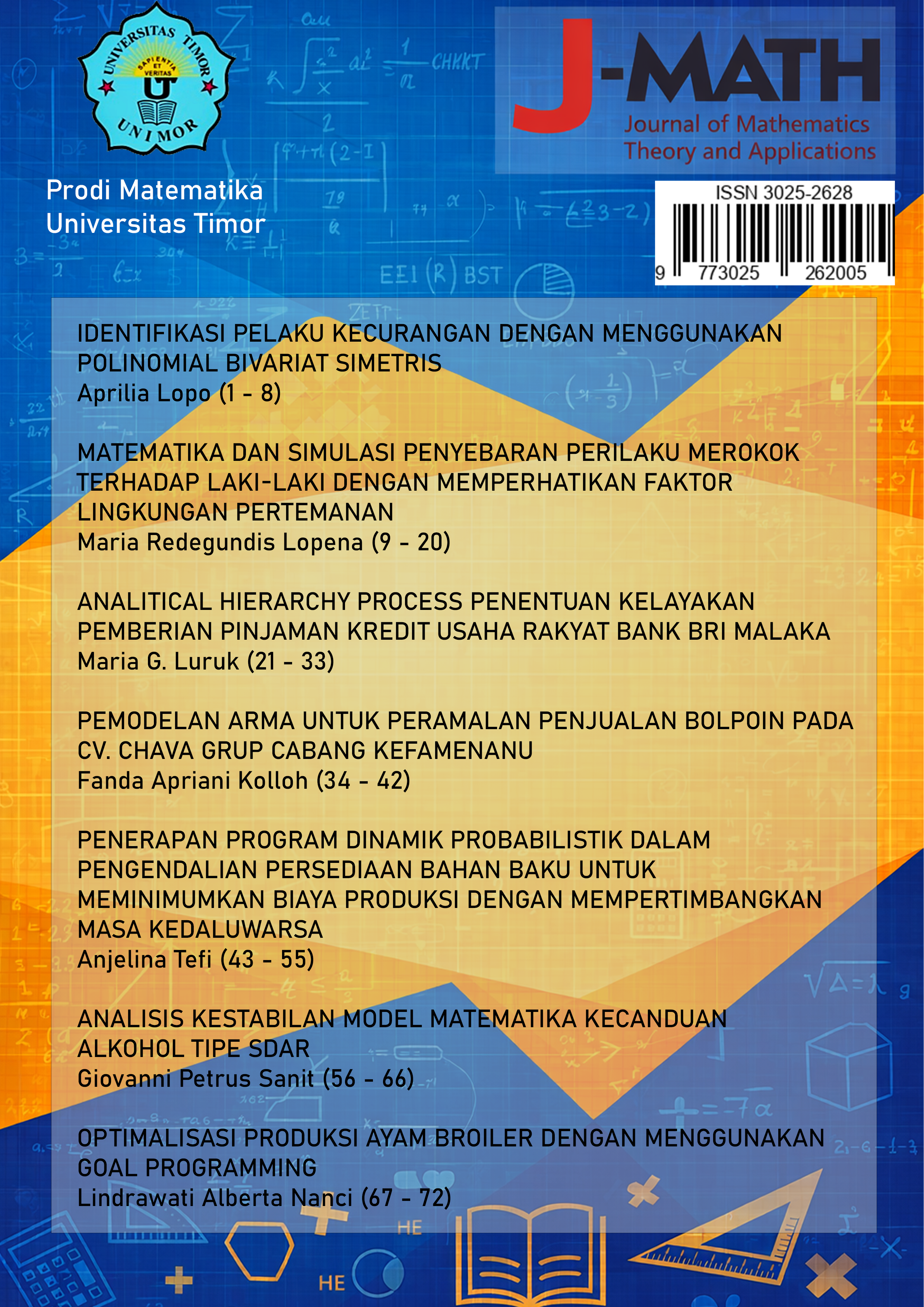
IDENTIFIKASI PELAKU KECURANGAN DENGAN MENGGUNAKAN POLINOMIAL BIVARIAT SIMETRIS
Universitas Timor
Keywords:
Symmetrical Bivariate Polinomial, Fraud Identification SchemeAbstract
The purpose of this study is to identify fraudsters using Symmetric Bivariate Polynomials with one share detecion. This type of research is quantitative using the method Secret Sharing Scheme (SPR). Where in this study combines several schemes, one of which is Scheme Liu et al. (2018). The scheme Liu et al. (2018) is a Symmetric Bivariate Polynomial scheme, in the writing of the Liu et al. (2018) scheme they identy fraudsters using two share detections. In the study, researchers also use Symmetric Bivariate Polynomials to identify fraudsters, so that the results are obtained, namely at the secret shering stage using Symmetric Bivariate Polynomials, at the reconstruction stage using Lagrange interpolation and using Symmetric Bivariate Polynimials with one share detection where is a random integer. Thus it can be concluded that the identification of fraudsters using Symmetric Bivariate Polynimoials is able to identify fraudsters and by using one share detection is faster in the computation process.
References
Ahzan, Z. N., Guritman, S., & Silalahi, B. P. (2020). Deteksi dan Identifikasi Pelaku Kecurangan Skema Pembagian Rahasia Linear Berbasis Skema Shamir. Jurnal Karya Pendidikan Matematika Universitas Muhammadiyah Semarang, 27–41.
Barbeau, E. . (2003). Polynomials. Springer- Verlag.
Blakley, G. R. (1979). Safeuardin cryptoraphic keys. National Computer Conference.
Cheney, W., & Kincaid, D. (2008). Numerical Mathematics And Computing (6th ed.).
Harn, L., & Lin, C. (2009). Detection and identification of cheaters in (t, n) secret sharing scheme. Designs, Codes, and Cryptography, 52(1), 15–24.
Liu, Y., Yang, C., Wang, Y., Zhu, L., & Ji, W. (2018). Cheating identifiable secret sharing scheme using symmetric bivariate polynomial. Information Sciences, 453, 21–29.
Menezes, A. J., Oorschot, P. C. Van, & Vanstone, S. A. (1996). Handbook Of Applied Cryptoraphy. CRC Press.
Sukirman. (2006). Penantar Teori Bilangan. Hanggar Kreator : yoyakarta.
Surianty, S. (2017). Teori Grup (Struktur Aljabar 1). UGM Press.
Wu, S., Hsu, C., Xia, Z., Zhang, J., & Wu, D. (2020). Symmetric-bivariate-polynomial-based lightweight authenticated group key agreement for industrial internet of things. Journal of Internet Technology, 21(7), 1969–1979.
Downloads
Published
How to Cite
Issue
Section
License
Pemberitahuan Hak Cipta Penulis yang menerbitkan naskah pada jurnal ini, menyetujui persyaratan berikut:
- Penulis mempertahankan hak cipta dan memberikan jurnal hak publikasi pertama dengan karya yang secara bersamaan dilisensikan di bawah Creative Commons Attribution License yang memungkinkan orang lain untuk berbagi dengan pengakuan kepenulisan karya dan publikasi awal dalam jurnal ini.
- Aspek formal legal aksesibilitas publikasi jurnal mengacu pada Creative Commons Attribution 4.0 (CC-BY 4.0). Anda bebas untuk berbagi—menyalin dan mendistribusikan ulang materi dalam media atau format apa pun—meracik ulang, mengubah, dan membangun materi untuk tujuan apa pun, bahkan secara komersial.
- Setiap publikasi (cetak/elektronik) bersifat open access untuk kepentingan pendidikan, penelitian, dan perpustakaan. Selain tujuan yang disebutkan di atas, dewan redaksi tidak bertanggung jawab atas pelanggaran hak cipta. Karya ini dilisensikan di bawah Creative Commons Attribution 4.0 (CC-BY 4.0)