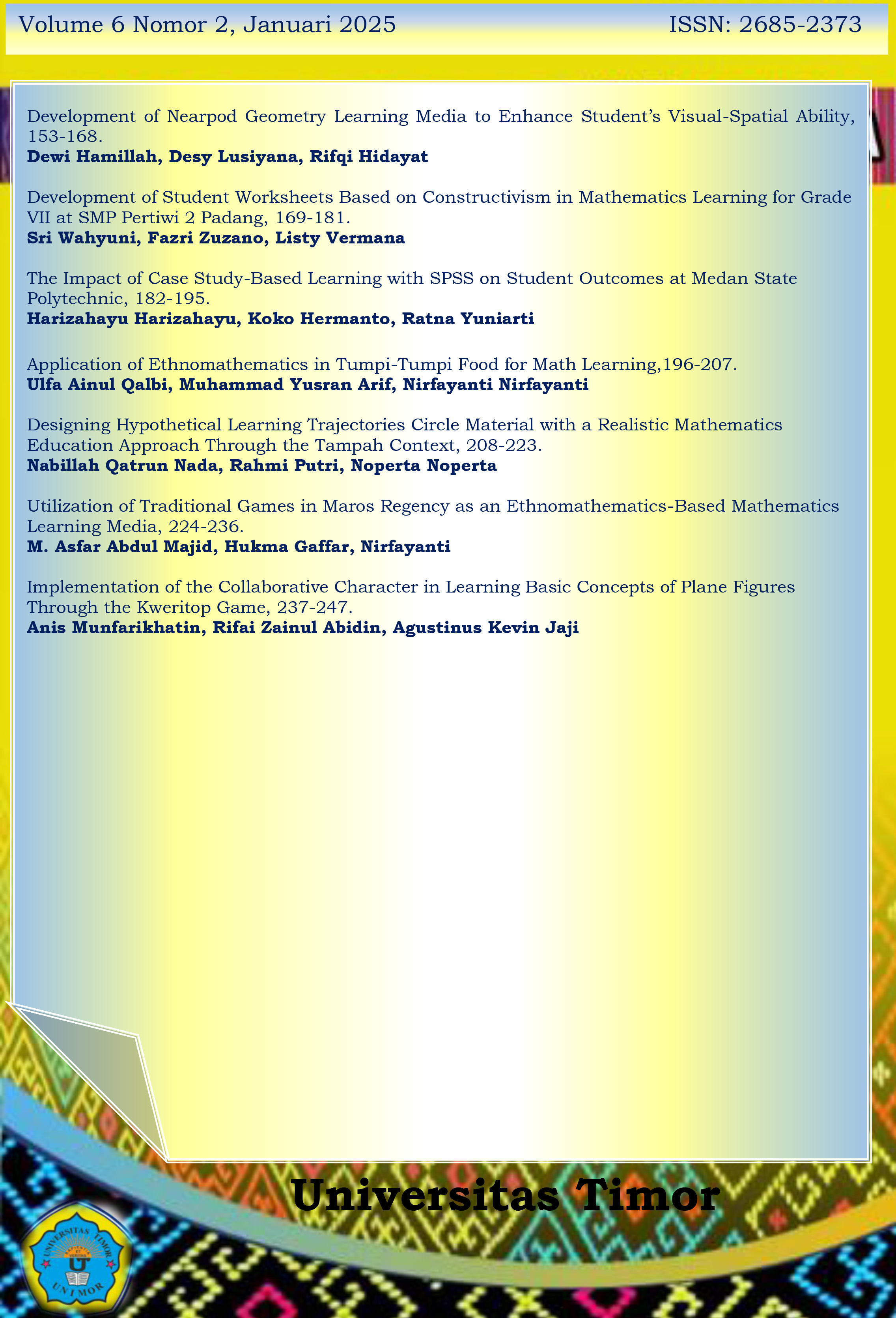
The Impact of Case Study-Based Learning with SPSS on Student Outcomes at Medan State Polytechnic
DOI:
https://doi.org/10.32938/jpm.v6i2.8759Keywords:
Statistical learning model, Integrating Theory, Teaching Materials, Case Studies, Learning ApproachesAbstract
This study intends to create a statistical learning model by integrating theory and practice, using the SPSS software application with case studies of problem solving in Computer Engineering and Informatics students at the Medan State Polytechnic. The design of this study began with a literature review before making lesson plans with the task of making teaching materials and providing content to students. Besides that, after the writer led the discussion, he was given the task of determining cases based on the subjects chosen by the students according to their interests. In this study there were 70 students who participated as the research sample. NONCase and STDCase both have standard deviation values of 1.62001 and 1.84694, respectively. Because the average learning outcomes of NONCase 74.2571 and STDCase 78.8857 show that descriptively there are differences between NONCase-based learning and case study/STDCase-based learning. The NONCase method and the STDCase learning method using the SPSS program have a significant linear relationship between the variables, according to case study-based research. Using the formula F count = 0.982 > F table = 1.507 It can be concluded that there is a significant linear relationship between the mastery of the STDCase learning approach and the SPSS program because F count is smaller than F table
References
Andita, C. D., & Taufina, T. (2020). Metode Problem Solving Untuk Meningkatkan Hasil Belajar Matematika di Sekolah Dasar. Jurnal Basicedu, 4(3), 541–550. https://doi.org/10.31004/basicedu.v4i3.397
Anisa, Y. (2022). Peran Channel Youtube Sebagai Media Alternatif untuk Membantu Proses Pembelajaran Matematika dan Media Informasi pada Tingkat Perguruan Tinggi. Jurnal Pendidikan Matematika Raflesia, 7(1), 13–21.
Artika, T. (2019). Meningkatkan Kemampuan Pemecahan Masalah Matematis Siswa dengan Menggunakan Metode Pembelajran Thinking Aloud Pair Problem Solving (TAPPS) (Vol. 8, Issue 2). https://doi.org/https://doi.org/10.35194/jp.v8i2.791
Fitriyanti, F., Laras, I. S., Khasanah, K., Anita, I. D., & Rahmawati, F. (2021). Implementasi Metode Collaborative Learning Dalam Pembelajaran Statistika Untuk Meningkatkan Keterampilan 4C (Critical And Problem Solving Skills, Collaboration Skills, Communication Skills, And Creativity And Innovation Skills) Pada Siswa Kelas XI. Edunesia : Jurnal Ilmiah Pendidikan, 2(1), 249–259. https://doi.org/10.51276/edu.v2i1.115
Hamdanah. (2020). Implementasi Pendekatan Remedial untuk Pengentasan Masalah Belajar. Indonesia Jurnal of Education, 3(1).
Harizahayu, Fathoni, M., & Hermanto, K. (2022). Analysis validity and reliability of monitoring and evaluation final examination: Mathematics i in Computer Engineering Study Program. AIP Conference Proceedings, 2577. https://doi.org/10.1063/5.0096078
Juna Irawana, T. (2020). Penggunaan Metode Problem Solving untuk Meningkatkan Motivasi dan Hasil Penilaian Pendidikan Kewarganegaraan Peserta Didik di Sekolah Dasar (Vol. 4, Issue 2). https://doi.org/https://doi.org/10.31004/basicedu.v4i2.367
Rahayu, E. L., Akbar, P., Afrilianto, M., Siliwangi, I., Terusan, J., Sudirman, J., Tengah, C., Cimahi, K., & Barat, J. (n.d.). Pengaruh Metode Mind Mapping Terhadap Strategi Thinking Aloud Pair Problem Solving Terhadap Kemampuan Berfikir Kreatif Matematis. https://doi.org/https://doi.org/10.31004/joe.v1i2.64
Riyanto, S., & Fatim Nugrahanti, dan. (2018). Pengembangan Pembelajaran Statistika Berbasis Praktikum Aplikasi Software SPSS dengan Bantuan Multimedia untuk Mempermudah Pemahaman Mahasiswa terhadap Ilmu Statistika. In Journal of Computer and Information Technology E-ISSN (Vol. 1, Issue 2). https://doi.org/http://doi.org/10.25273/doubleclick.v1i2.1590
S, H. H. (2020). Estimasi Maksimum Likelihood Melalui Algoritma Ekspektasi Maksimasi Untuk Model Regresi Linear dengan Data Hilang. Jurnal Matematika, 10(2), 105. https://doi.org/10.24843/jmat.2020.v10.i02.p127
Sari, W. M., & Susiloningsih, D. E. (2015). Penerapan Model Assure dengan Metode Problem Solving untuk Meningkatkan Keterampilan Berfikir Kritis. In Jurnal Inovasi Pendidikan Kimia (Vol. 9, Issue 1). https://doi.org/https://doi.org/10.15294/jipk.v9i1.4814
Setiawan, B., Rachmadtullah, R., & Iasha, V. (2020). Problem-Solving Method: The Effectiveness of The Pre-service Elementary Education Teacher Activeness in The Concept of Physics Content. Jurnal Basicedu, 4(4), 1074–1083. https://doi.org/10.31004/basicedu.v4i4.484
Downloads
Published
Versions
- 2025-02-03 (2)
- 2025-01-31 (1)
Issue
Section
License
Copyright (c) 2025 RANGE: Jurnal Pendidikan Matematika

This work is licensed under a Creative Commons Attribution-NonCommercial-ShareAlike 4.0 International License.
RANGE: Jurnal Pendidikan Matematika