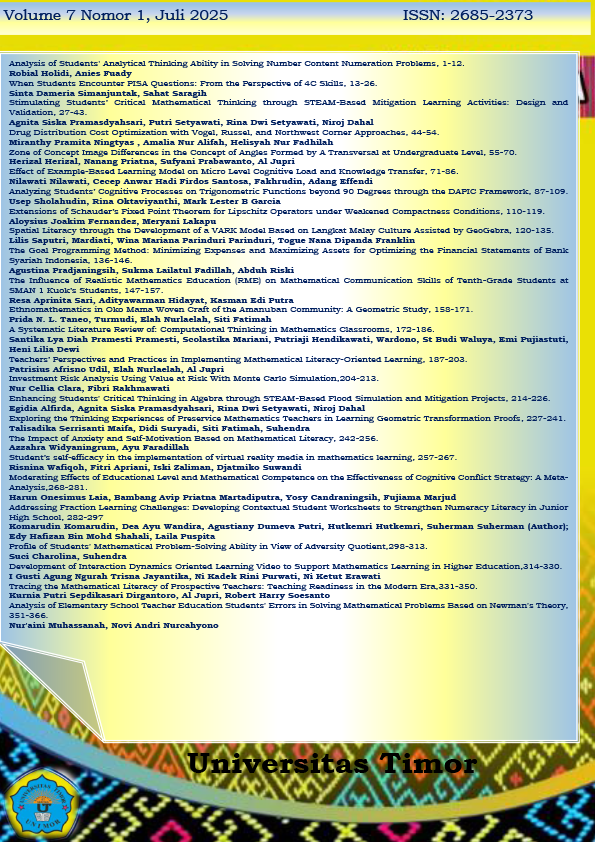
Effect of Example-Based Learning Model on Micro Level Cognitive Load and Knowledge Transfer
DOI:
https://doi.org/10.32938/jpm.v7i1.9517Keywords:
Example-based learning, cognitive load, knowledge transfer, retention, near-transfeAbstract
Students often face difficulties in solving math problems due to high cognitive load. This load can interfere with optimal information processing, particularly at the micro-level, such as in problem-solving steps. Although many studies have examined cognitive load, most focus on macro-level, with limited exploration of micro-level cognitive processing. To address this, an effective learning approach is needed to optimize students’ working memory capacity and promote knowledge transfer. This study aims to investigate the effect of an example-based learning model on cognitive load and knowledge transfer in mathematics learning. A quasi-experimental method was conducted involving 78 eighth-grade students from a school in Serang City, divided into two groups: an experimental group applying the example-based learning model and a control group using a problem-solving model. Data were collected using a mental effort rating scale and essay questions to measure cognitive load at each problem-solving step, along with retention and near-transfer tests. Analysis using Two-Way ANOVA showed that the example-based learning model significantly reduced cognitive load throughout the problem-solving stages. It also produced better outcomes in retention and near-transfer tests, indicating more effective knowledge transfer. These findings suggest that example-based learning can be a valuable instructional strategy to improve mathematical problem-solving, particularly for students with limited background knowledge. The novelty of this study rests on the simultaneous examination of retention and transfer, focusing on students' micro-level cognitive processing during example-based learning. Structured examples were shown to reduce cognitive burden while fostering transferable problem-solving strategies.
References
Agustin, A., Retnowati, E., & Ng, K. T. (2022). The Transferability Level of Junior High School Students in Solving Geometry Problems. Journal of Innovation in Educational and Cultural Research, 3(1), 59–69. https://doi.org/10.46843/jiecr.v3i1.57
Andini, P. A., Novaliyosi, & Santosa, C. A. H. F. (2024). Kemampuan Pemecahan Masalah Matematis dengan Pendekatan Worked Example: Systematic Literature Review. Jurnal Ilmiah Pendidikan Matematika, Matematika Dan Statistika, 5(2), 1154–1162. https://garuda.kemdikbud.go.id/documents/detail/4093723
Anggraini, V., Delyana, H., & Sari, I. K. (2022). Analisis Kemampuan Pemecahan Masalah Matematis ditinjau dari Minat Belajar Siswa. AKSIOMA: Jurnal Program Studi Pendidikan Matematika, 11(2), 1231–1240. https://doi.org/10.24127/ajpm.v11i2.5034
Ardiana, I., & Retnowati, E. (2022). Kemampuan Transfer Permasalahan Bangun Datar Tidak Beraturan dengan Goal-Free Problems. Jurnal Pedagogi Matematika, 8(3), 190–201. https://journal.student.uny.ac.id/index.php/jpm/article/view/18161
Atkinson, R. K., Derry, S. J., Renkl, A., & Wortham, D. (2000). Learning from Examples: Instructional Principles from the Worked Examples Research. Review of Educational Research, 70(2), 181–214. https://doi.org/10.3102/00346543070002181
Chen, O., Retnowati, E., Chan, B. K. Y., & Kalyuga, S. (2023). The Effect of Worked Examples on Learning Solution Steps and Knowledge Transfer. Educational Psychology, 43(8), 914–928. https://doi.org/10.1080/01443410.2023.2273762
Chen, O., Retnowati, E., & Kalyuga, S. (2019). Effects of Worked Examples on Step Performance in Solving Complex Problems. Educational Psychology, 39(2), 188–202. https://doi.org/10.1080/01443410.2018.1515891
Dixon, R. A., & Brown, R. A. (2012). Transfer of Learning: Connecting Concepts During Problem Solving. Journal of Technology Education, 24(1), 2–17. https://doi.org/10.21061/jte.v24i1.a.1
El-Shaer, A., & Gaber, H. (2014). Impact of Problem-Based Learning on Students ` Critical Thinking Dispositions , Knowledge Acquisition and Retention. Journal of Education and Practice, 5(14), 74–86. https://api.semanticscholar.org/CorpusID:27660719
Fischer, F., Hmelo-Silver, C. E., Goldman, S. R., & Reiman, P. (2018). International Handbook of the Learning Sciences. In International Handbook of the Learning Sciences. New York: Routledge, Taylor Francis Group. https://doi.org/10.4324/9781315617572
Gog, T. van, & Rummel, N. (2010). Example-Based Learning: Integrating Cognitive and Social-Cognitive Research Perspectives. Educational Psychology Review, 22(2), 155–174. https://doi.org/10.1007/s10648-010-9134-7
Hermawati, Jumroh, & Sari, E. F. P. (2021). Analisis Kemampuan Pemecahan Masalah Matematis pada Materi Kubus dan Balok di SMP. Mosharafa: Jurnal Pendidikan Matematika, 10(1), 141–152. https://doi.org/10.31980/mosharafa.v10i1.648
Hiller, S., Rumann, S., Berthold, K., & Roelle, J. (2020). Example-Based Learning: Should Learners Receive Closed-Book or Open-Book Self-Explanation Prompts? Instructional Science, 48(6), 623–649. https://doi.org/10.1007/s11251-020-09523-4
Jamaludin, D. N. (2022). Information Processing and Memory in Learning. Journal of Educational Integration and Development, 2(2), 88–102. https://doi.org/10.55868/jeid.v2i2.109
Lee, H. M., & Ayres, P. (2024). The Worked-Example Effect and a Mastery Approach Goal Orientation. Education Sciences, 14(6). https://doi.org/10.3390/educsci14060597
Lutz, S. T., & Huitt, W. G. (2018). Information Processing and Memory: Theory and Applications. Becoming a Brilliant Star: Twelve Core Ideas Supporting Holistic Education, 25–43. https://www.edpsycinteractive.org/papers/2018-02-lutz-huitt-brilliant-star-information-processing.pdf
Maydawati, L. (2024). Sistem Persamaan Linear Dua Variabel dengan Metode Subsitusi dan Eliminasi. Jurnal Pustaka Cendikia Pendidikan, 02(01), 46–50. https://pcpendidikan.org/index.php/jpcp/article/view/52
Mayer, R. E. (2002). Rote Versus Meaningful Learning. Theory Into Practice, 41(4), 226–232. https://doi.org/10.1207/s15430421tip4104_4
Munthe, R. T. I., & Hakim, D. L. (2022). Analisis Kemampuan Berpikir Aljabar Siswa SMP dalam Menyelesaikan Masalah Sistem Persamaan Linear Dua Variabel (SPLDV). Prisma, 11(2), 371–383. https://doi.org/10.35194/jp.v11i2.2388
Nari, N., Suhaili, N., & Sari, P. L. (2023). Analisis Beban Kognitif Intrinsik Siswa Pada Kemampuan Pemecahan Masalah Matematis. Lemma : Letters of Mathematics Education, 10(01), 14–27. https://doi.org/10.22202/jl.2023.v10i1.6869
NCTM. (2000). Principles And Standarts For School Mathematics. Reston. https://doi.org/10.5951/at.29.5.0059
Nokes, T. J. (2009). Mechanisms of Knowledge Transfer. Thinking and Reasoning, 15(1), 1–36. https://doi.org/10.1080/13546780802490186
Nurhayati, E., Nurfauziah, P., & Fitriani, N. (2021). Analisis Kesulitan Siswa Kelas VIII dalam Memahami Materi Sistem Persamaan Linear Dua Variabel (SPLDV) dalam Pembelajaran Daring. Jurnal Pembelajaran Matematika Inovatif, 4(6), 1609–1620. https://doi.org/10.22460/jpmi.v4i6.1609-1620
Orón, J. V., & Lizasoain, I. (2023). Achieving Transfer from Mathematics Learning. Education Sciences, 13(2), 1–13. https://doi.org/10.3390/educsci13020161
Paas, F. (1992). Training Strategies for Attaining Transfer of Problem-Solving Skill in Statistics: A Cognitive-Load Approach. Journal of Educational Psychology, 84(4), 429–434. https://doi.org/10.1037/0022-0663.84.4.429
Paas, F., & van Merriënboer, J. J. G. (2020). Cognitive-Load Theory: Methods to Manage Working Memory Load in the Learning of Complex Tasks. Current Directions in Psychological Science, 29(4), 394–398. https://doi.org/10.1177/0963721420922183
Pransisca, M. A., & Gazali, M. (2022). Analisis Kemampuan Pemecahan Masalah dan Self-Regulatif Siswa SD dalam Pembelajaran Matematika Parenting. Jurnal Ilmiah Global Education, 3(1), 10–16. https://doi.org/10.55681/jige.v3i1.166
Putra, F. K. A., & Budihardjo. (2018). Penerapan Model Pembelajaran Problem Solving untuk Meningkatkan Hasil Belajar Siswa Kelas XII TKR pada Mata Pelajaran Sistem Pengapian Konvensional di SMK Negeri Madiun. Jurnal Pendidikan Teknik Mesin, 02(03), 1–8. https://media.neliti.com/media/publications/247983-none-a6885e8d.pdf
Renkl, A. (2014). Toward an instructionally oriented theory of example-based learning. Cognitive Science, 38(1), 1–37. https://doi.org/10.1111/cogs.12086
Retnowati, E., & Fadlila, N. (2023). The Compound Area of Quadrilaterals and Triangles: A Worked Example Based Learning Design. JTAM (Jurnal Teori Dan Aplikasi Matematika), 7(1), 150. https://doi.org/10.31764/jtam.v7i1.11678
Ritter, F. E., Nerb, J., Lehtinen, E., & O’Shea, T. M. (2007). In Order To Learn. New York: Oxford University Press.
Sala, G., Deniz Aksayli, N., Semir Tatlidil, K., Tatsumi, T., Gondo, Y., & Gobet, F. (2019). Near and Far Transfer in Cognitive Training: A Second-Order Meta-Analysis. Collabra: Psychology, 5(1), 1–22. https://doi.org/10.1525/collabra.203
Santosa, C. A. H. F., & Filiz, M. (2025). Investigating the Limit of Peer Collaboration: Insight from Worked-Example in Multivariable Calculus. Infinity Journal, 14(2), 461–482. https://doi.org/10.22460/infinity.v14i2.p461-482
Santosa, C. A. H. F., Prabawanto, S., & Marethi, I. (2019). Fostering Germane Load Through Self-Explanation Prompting in Calculus Instruction. Indonesian Journal on Learning and Advanced Education, 1(1), 37–47. https://doi.org/10.23917/ijolae.v1i1.7421
Santosa, C. A. H. F., Rafianti, I., & Yulistiany, D. (2022). Worked-Example Method on Mathematical Problem-Solving Ability in term of Students’ Initial Ability. Kreano, Jurnal Matematika Kreatif-Inovatif, 13(2), 210–220. https://doi.org/10.15294/kreano.v13i2.33301
Santosa, C. A. H. F., Suryadi, D., Prabawanto, S., & Syamsuri, S. (2018). The Role of Worked-Example in Enhancing Students’ Self-Explanation and Cognitive Efficiency in Calculus Instruction. Jurnal Riset Pendidikan Matematika, 5(2), 168–180. https://doi.org/10.21831/jrpm.v0i0.19602
Septhiani, S. (2022). Analisis Hubungan Self-Efficacy terhadap Kemampuan Pemecahan Masalah Matematika. Jurnal Cendekia : Jurnal Pendidikan Matematika, 6(3), 3078–3086. https://doi.org/10.31004/cendekia.v6i3.1423
Sholikhah, S., & Fahmi, S. (2022). Desain Pembelajaran Worked Example Pada Materi Trigonometri. Seminar Nasional Pengenalan Lapangan Persekolahan UAD, 1471–1480.
Sweller, J. (2023). The Development of Cognitive Load Theory: Replication Crises and Incorporation of Other Theories Can Lead to Theory Expansion. Educational Psychology Review, 35(4), 1–20. https://doi.org/10.1007/s10648-023-09817-2
Sweller, J. (2024). Cognitive Load Theory and Individual Differences. Learning and Individual Differences, 110(1), 1–5. https://doi.org/10.1016/j.lindif.2024.102423
Sweller, J., Ayres, P., & Kalyuga, S. (2011). Cognitive Load Theroy. In Recenti Progressi in Medicina. New York: Springer.
Tias Anggraini, H. (2023). Peningkatan Kemampuan Berpikir Kritis dan Representasi Visual Thinking Matematis Siswa dengan Penerapan Metode Pembelajaran Kolawole’S Problem Solving. EDU-MAT: Jurnal Pendidikan Matematika, 11(2), 367–381. https://doi.org/10.20527/edumat.v11i2.17394
Uzun, C. S., & Arslan, S. (2023). Modelling of Student Teachers’ Mathematical Conceptions According to Ck¢ Theory: The “Knowledge Transfer” Conception. E-International Journal of Educational Research, 14(1), 71–95. https://doi.org/10.19160/e-ijer.1168980
Valderama, J., & Oligo, J. (2021). Learning Retention in Mathematics Over Consecutive Weeks: Impact of Motivated Forgetting. International Journal of Evaluation and Research in Education, 10(4), 1245–1254. https://doi.org/10.11591/IJERE.V10I4.21577
Widodo, S. A., Darhim, D., & Ikhwanudin, T. (2018). Improving Mathematical Problem Solving Skills Through Visual Media. Journal of Physics: Conference Series, 948(1). https://doi.org/10.1088/1742-6596/948/1/012004
Downloads
Published
Issue
Section
License
Copyright (c) 2025 RANGE: Jurnal Pendidikan Matematika

This work is licensed under a Creative Commons Attribution-NonCommercial-ShareAlike 4.0 International License.
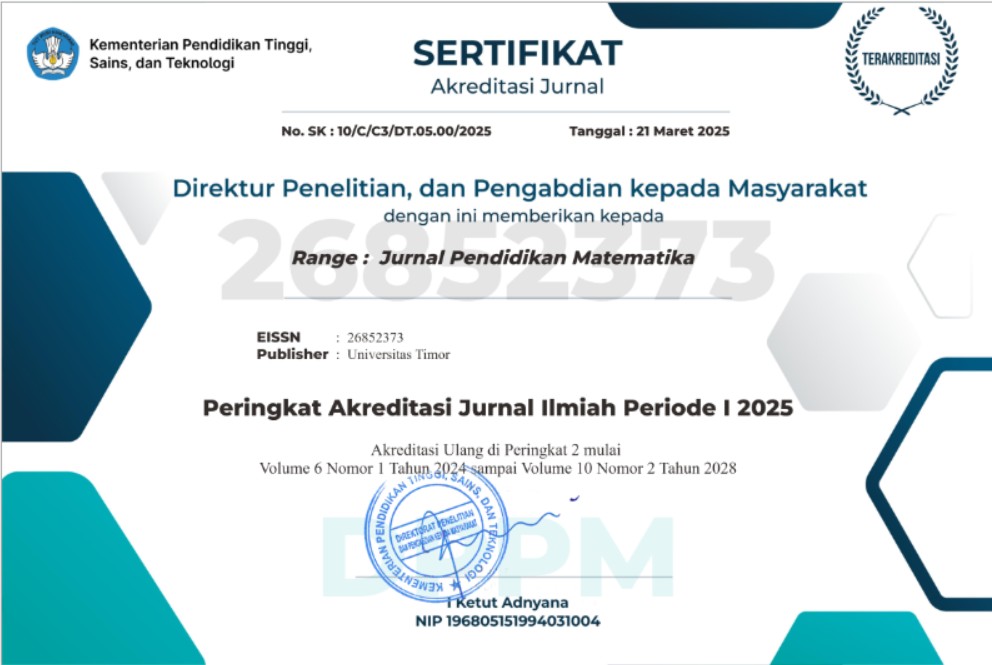
RANGE: Jurnal Pendidikan Matematika