
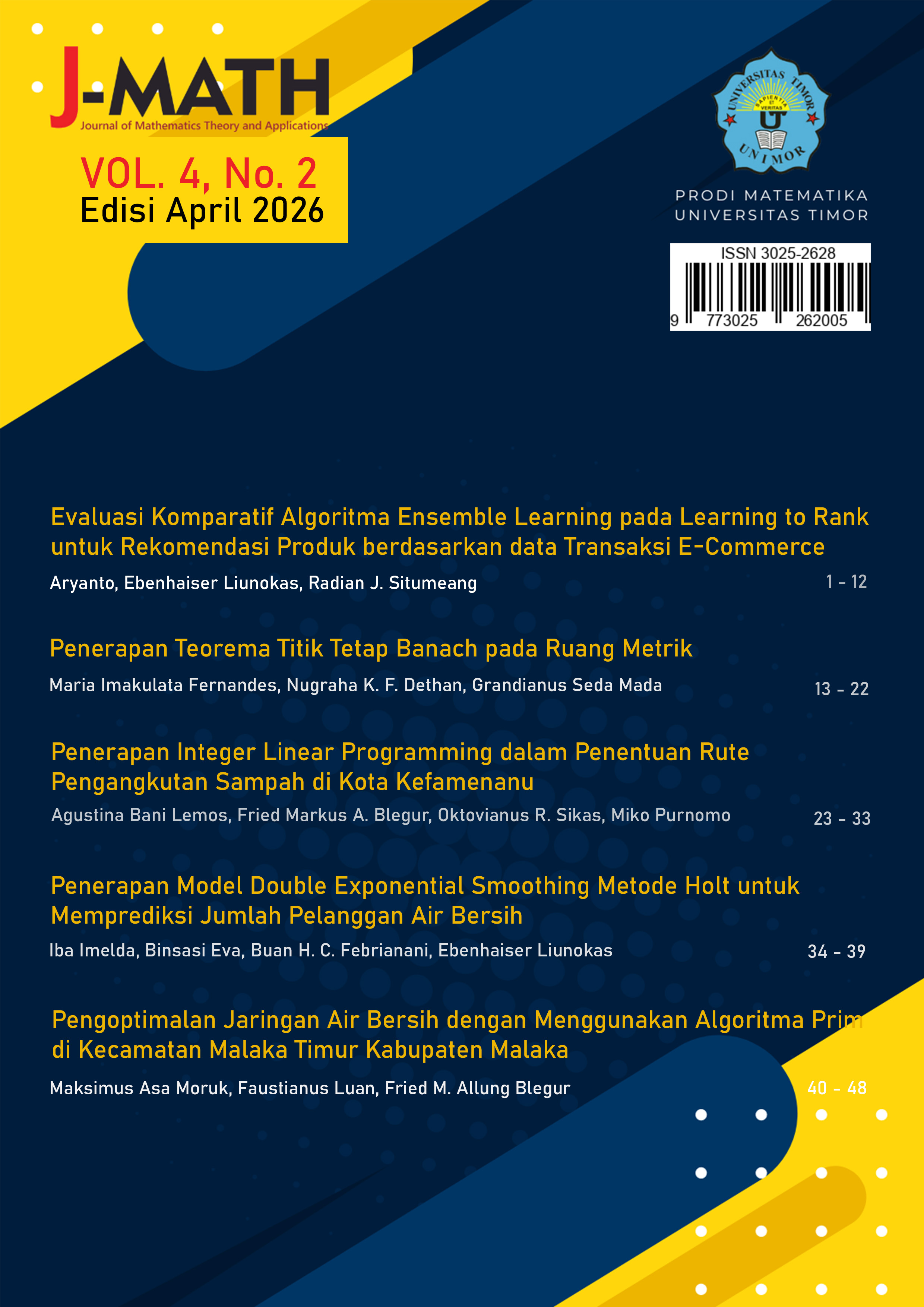
Evaluasi Komparatif Algoritma Ensemble Learning pada Learning to Rank untuk Rekomendasi Produk berdasarkan data Transaksi E-Commerce
Keywords:
Learning to Rank, XGBoost, LightGBM, CatBoost, Rekomendasi Produk, NDCG, E-CommerceAbstract
Learning to Rank (LTR) merupakan pendekatan machine learning yang telah menjadi inti dari sistem rekomendasi produk modern dalam industri e-commerce. Penelitian ini bertujuan membandingkan performa tiga algoritma gradient boosting, yaitu XGBoost, LightGBM, dan CatBoost, yang diterapkan pada tugas LTR menggunakan Instacart Online Grocery Shopping Dataset 2017. Dataset tersebut memuat lebih dari 3 juta pesanan dari lebih dari 200.000 pengguna anonim. Feature engineering dilakukan dengan menghitung statistik agregasi pada level pengguna dan level produk berdasarkan data transaksi historis. Pembagian data dilakukan berdasarkan pengguna untuk mencegah kebocoran informasi antara set pelatihan dan pengujian. Setiap algoritma dilatih menggunakan objektif ranking listwise atau pairwise bawaan masing-masing, dan dievaluasi menggunakan metrik NDCG@5, MAP@5, dan Mean Reciprocal Rank (MRR). Hasil eksperimen menunjukkan bahwa CatBoost mencapai NDCG@5 tertinggi (0,8036) dan MAP@5 tertinggi (0,8256), sementara XGBoost dan LightGBM menghasilkan performa yang kompetitif dan hampir identik. Ketiga model secara signifikan melampaui baseline Random Forest. Temuan ini menunjukkan bahwa algoritma gradient boosting sangat efektif untuk LTR dalam skenario rekomendasi ecommerce dan memberikan panduan praktis dalam pemilihan model ranking untuk sistem produksi.
References
Burges, C., Shaked, T., Renshaw, E., Lazier, A., Deeds, M., Hamilton, N., & Hullender, G. (2005). Learning
to rank using gradient descent. Proceedings of the 22nd International Conference on Machine
Learning (ICML), 89–96. https://doi.org/10.1145/1102351.1102363
Burges, C. J. C. (2010). From RankNet to LambdaRank to LambdaMART: An overview. Microsoft
Research Technical Report MSR-TR-2010-82, 1–23.
Cao, Z., Qin, T., Liu, T.-Y., Tsai, M.-F., & Li, H. (2007). Learning to rank: From pairwise approach to listwise
approach. Proceedings of the 24th International Conference on Machine Learning (ICML), 129–
136. https://doi.org/10.1145/1273496.1273513
Chapelle, O., & Chang, Y. (2011). Yahoo! Learning to rank challenge overview. Proceedings of the
Learning to Rank Challenge (JMLR W&CP), 14, 1–24.
Chen, T., & Guestrin, C. (2016). XGBoost: A scalable tree boosting system. Proceedings of the 22nd ACM
SIGKDD International Conference on Knowledge Discovery and Data Mining, 785–794.
https://doi.org/10.1145/2939672.2939785
Covington, P., Adams, J., & Sargin, E. (2016). Deep neural networks for YouTube recommendations.
Proceedings of the 10th ACM Conference on Recommender Systems (RecSys), 191–198.
https://doi.org/10.1145/2959100.2959190
Friedman, J. H. (2001). Greedy function approximation: A gradient boosting machine. Annals of
Statistics, 29(5), 1189–1232. https://doi.org/10.1214/aos/1013203451
Harper, F. M., & Konstan, J. A. (2015). The MovieLens datasets: History and context. ACM Transactions
on Interactive Intelligent Systems (TiiS), 5(4), 1–19. https://doi.org/10.1145/2827872
He, X., Liao, L., Zhang, H., Nie, L., Hu, X., & Chua, T.-S. (2017). Neural collaborative filtering. Proceedings
of the 26th International Conference on World Wide Web (WWW), 173–182.
https://doi.org/10.1145/3038912.3052569
Instacart. (2017). Instacart Online Grocery Shopping Dataset 2017 [Dataset].
https://www.instacart.com/datasets/grocery-shopping-2017
Joachims, T. (2002). Optimizing search engines using clickthrough data. Proceedings of the 8th ACM
SIGKDD International Conference on Knowledge Discovery and Data Mining, 133–142.
https://doi.org/10.1145/775047.775067
Joachims, T., Swaminathan, A., & Schnabel, T. (2017). Unbiased learning-to-rank with biased feedback.
Proceedings of the 10th ACM International Conference on Web Search and Data Mining (WSDM),
781–789. https://doi.org/10.1145/3018661.3018699
Ke, G., Meng, Q., Finley, T., Wang, T., Chen, W., Ma, W., Ye, Q., & Liu, T.-Y. (2017). LightGBM: A highly
efficient gradient boosting decision tree. Advances in Neural Information Processing Systems
(NeurIPS), 30, 3146–3154.
Koren, Y., Bell, R., & Volinsky, C. (2009). Matrix factorization techniques for recommender systems.
Computer, 42(8), 30–37. https://doi.org/10.1109/MC.2009.263
Li, H. (2014). Learning to rank for information retrieval and natural language processing (2nd ed.).
Synthesis Lectures on Human Language Technologies, 7(3), 1–121.
https://doi.org/10.2200/S00607ED2V01Y201410HLT026
Liu, T.-Y. (2009). Learning to rank for information retrieval. Foundations and Trends in Information
Retrieval, 3(3), 225–331. https://doi.org/10.1561/1500000016
Prokhorenkova, L., Gusev, G., Vorobev, A., Dorogush, A. V., & Gulin, A. (2018). CatBoost: Unbiased
boosting with categorical features. Advances in Neural Information Processing Systems
(NeurIPS), 31, 6638–6648.
Qin, T., & Liu, T.-Y. (2013). Introducing LETOR 4.0 datasets. arXiv preprint arXiv:1306.2597.
https://arxiv.org/abs/1306.2597
Rendle, S., Freudenthaler, C., Gantner, Z., & Schmidt-Thieme, L. (2012). BPR: Bayesian personalized
ranking from implicit feedback. arXiv preprint arXiv:1205.2618.
https://arxiv.org/abs/1205.2618
Sarwar, B., Karypis, G., Konstan, J., & Riedl, J. (2001). Item-based collaborative filtering recommendation
algorithms. Proceedings of the 10th International Conference on World Wide Web (WWW),
285–295. https://doi.org/10.1145/371920.372071
Tang, J., & Wang, K. (2018). Personalized top-N sequential recommendation via convolutional sequence
embedding. Proceedings of the 11th ACM International Conference on Web Search and Data
Mining (WSDM), 565–573. https://doi.org/10.1145/3159652.3159656
Vaswani, A., Shazeer, N., Parmar, N., Uszkoreit, J., Jones, L., Gomez, A. N., Kaiser, Ł., & Polosukhin, I.
(2017). Attention is all you need. Advances in Neural Information Processing Systems (NeurIPS),
30, 5998–6008.
Wang, X., He, X., Wang, M., Feng, F., & Chua, T.-S. (2019). Neural graph collaborative filtering. Proceedings
of the 42nd International ACM SIGIR Conference on Research and Development in Information
Retrieval, 165–174. https://doi.org/10.1145/3331184.3331267
Zhang, S., Yao, L., Sun, A., & Tay, Y. (2019). Deep learning based recommender system: A survey and new
perspectives. ACM Computing Surveys, 52(1), 1–38. https://doi.org/10.1145/3285029
Zhang, Y., Chen, X., Li, S., Wang, F., & Zheng, N. (2020). Comparative study of gradient boosting methods
for classification tasks: XGBoost vs LightGBM vs CatBoost. Journal of Machine Learning Research,
21(145), 1–32.
Downloads
Published
How to Cite
Issue
Section
License
Pemberitahuan Hak Cipta Penulis yang menerbitkan naskah pada jurnal ini, menyetujui persyaratan berikut:
- Penulis mempertahankan hak cipta dan memberikan jurnal hak publikasi pertama dengan karya yang secara bersamaan dilisensikan di bawah Creative Commons Attribution License yang memungkinkan orang lain untuk berbagi dengan pengakuan kepenulisan karya dan publikasi awal dalam jurnal ini.
- Aspek formal legal aksesibilitas publikasi jurnal mengacu pada Creative Commons Attribution 4.0 (CC-BY 4.0). Anda bebas untuk berbagi—menyalin dan mendistribusikan ulang materi dalam media atau format apa pun—meracik ulang, mengubah, dan membangun materi untuk tujuan apa pun, bahkan secara komersial.
- Setiap publikasi (cetak/elektronik) bersifat open access untuk kepentingan pendidikan, penelitian, dan perpustakaan. Selain tujuan yang disebutkan di atas, dewan redaksi tidak bertanggung jawab atas pelanggaran hak cipta. Karya ini dilisensikan di bawah Creative Commons Attribution 4.0 (CC-BY 4.0)