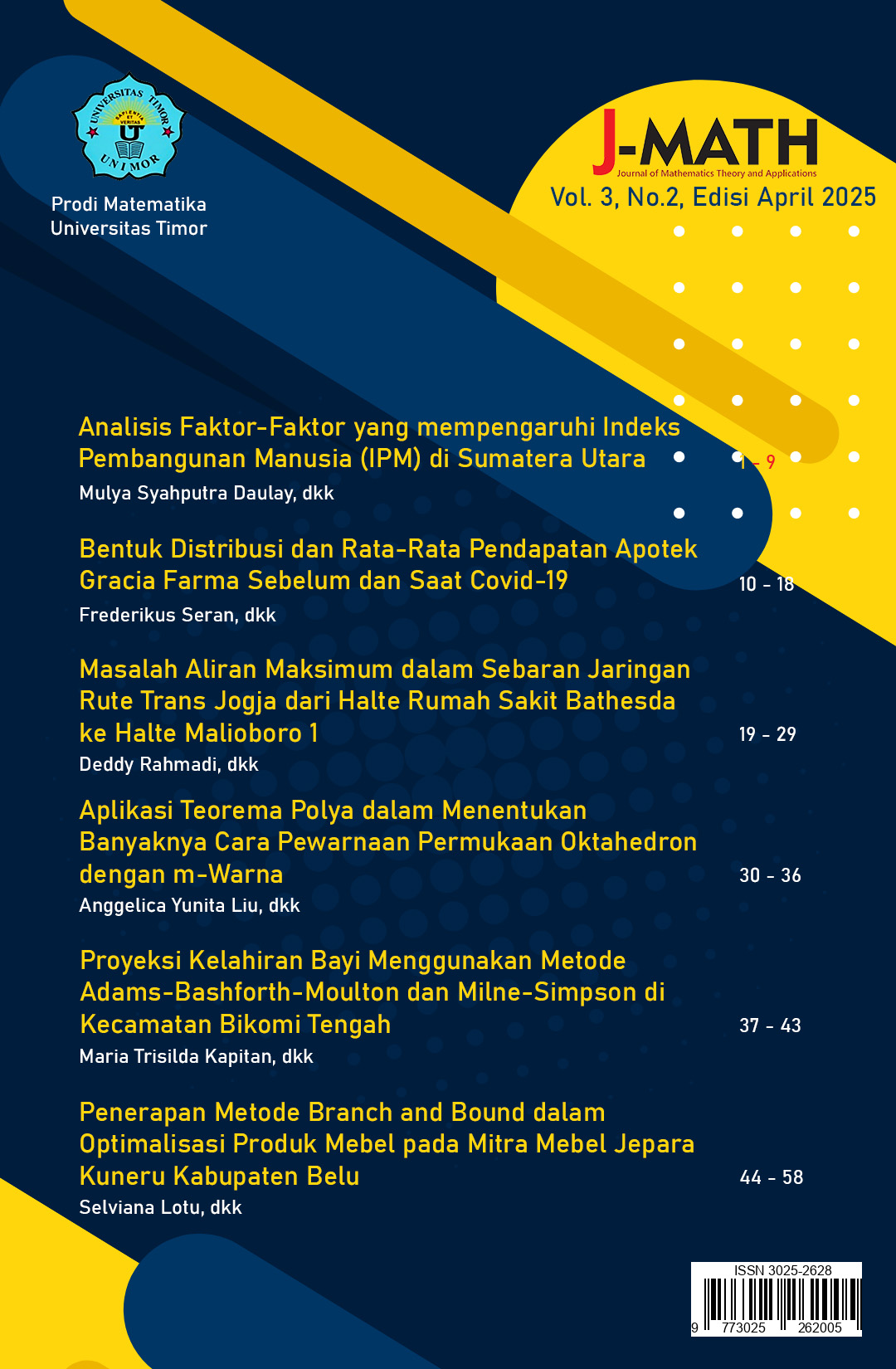
Analisis Faktor-Faktor yang mempengaruhi Indeks Pembangunan Manusia (IPM) di Sumatera Utara
DOI:
https://doi.org/10.32938/j-math.v3i2.7801Keywords:
Indeks Pembangunan Manusia, Harapan lama Sekolah, Pengeluaran Perkapita, Persentase Penduduk Miskin, Regresi Data PanelAbstract
The Human Development Index (HDI) measures human development achievements based on a number of basic components of quality of life. The research aims to see the influence of Expected Years of Schooling, Per Capita Expenditure and Percentage of Poor Population on the Human Development Index in North Sumatra Province. The method used in this research is a quantitative method, where the research results are then processed and analyzed to draw conclusions. From several tests, the Random Effect model (REM) was chosen as the best model. The results of the simultaneous test (F-test) of all X variables have an influence on Y variable because the F_count (714.6759) > F_table (3.30) and the test results are proven by a significant value of 0.0000 <0.05, it is concluded that H_1 is accepted and H_0 is rejected. The long-school expectation variable (HLS) (x_1) partially influences HDI in North Sumatra Province because it has a significant value of 0.0000 <0.05 and the value of T_count (15.47633) > T_table (2.039613). The variable per capita expenditure (PP) (x_2) partially influences HDI in North Sumatra Province because it has a significant value of 0.000 <0.05 and the value of T_count (23.32513) > T_table (2.039613). The variable percentage of poor people (PPM) (x_3) partially infuences HDI in North Sumatra Province because it has a significant value of 0.0000 <0.05 and the value of T_count (-4.117351) < T_table (-2.039613).
References
BPS. (2014). Indeks Pembangunan Manusia 2014 Metode Baru. https://doi.org/4102002
Ghozali. (2005). Aplikasi Analisis Multivariat dengan program SPSS. Badan Pernerbit Universitas Diponegoro.
Gujarati, D. N. (2006). Essentials of Econometrics ( dkk Mulyadi, J. A. (ed.); 3rd ed). Erlangga.
Iqbal, M. (2015). Regresi Data Panel ( 2 ) " Tahap Analisis ". Sarana Tukar Menukar Informasi Dan Pemikiran Dosen, 2, 1–7.
Jasasila, J. (2020). Pengaruh Tingkat Kemiskinan dan Jumlah Penduduk Terhadap Indeks Pembangunan Manusia (IPM) Kabupaten Batang Hari 2011 -2019.
Eksis: Jurnal Ilmiah Ekonomi Dan Bisnis, 11(1), 40. https://doi.org/10.33087/eksis.v11i1.192
Jaya, I. G. N. M., & N. S. (2009). Kajian Analisis Regresi dengan Data Panel.
Manurung, E. N., & Hutabarat, F. (2021). Pengaruh Angka Harapan Lama Sekolah, Rata-Rata Lama Sekolah, Pengeluaran per Kapita Terhadap Indeks Pembangunan Manusia. Jurnal Ilmiah Akuntansi Manajemen, 4(2), 121–129. https://doi.org/10.35326/jiam.v4i2.1718
Nandita, D. A., Alamsyah, L. B., Jati, E. P., & Widodo, E. (2019). Regresi Data Panel untuk Mengetahui Faktor-Faktor yang Mempengaruhi PDRB di Provinsi DIY Tahun 2011-2015. Indonesian Journal of Applied Statistics, 2(1), 42. https://doi.org/10.13057/ijas.v2i1.28950
Pangestika, M. (2017). Analisis Regresi Data Panel Terhadap Faktor-Faktor yang Mempengaruhi Indeks Pembangunan Manusia di D.I. Yogyakarta. Jurusan Statistika Fakultas Matematika dan Ilmu Pengetahuan Alam Universitas Islam Indonesia.
Pangestika, S. (2015). Analisis Estimasi Model Regresi Data Panel Dengan Pendekatan Common Effect Model (CEM), Fixed Effect Model (FEM), Dan Random Effect Model (REM). Unnes Journal, 2(1), 106.
Puspita, F. I., Ratnasari, V., & Purhadi, P. (2013). Model Probit Spasial pada Faktor-Faktor yang Mempengaruhi Klasifikasi IPM di Pulau Jawa.
CAUCHY: Jurnal Matematika Murni Dan Aplikasi, 2(4), 198–210. https://doi.org/10.18860/ca.v2i4.3116
Sriyana, J. (2014). Metode Regresi Data Panel. Ekonisia.
Yudiaatmaja. (2013). Analisis Regresi dengan Menggunakan Aplikasi Komputer Statistik SPSS. PT Gramedia Pusaka Utama.
Downloads
Published
How to Cite
Issue
Section
License
Pemberitahuan Hak Cipta Penulis yang menerbitkan naskah pada jurnal ini, menyetujui persyaratan berikut:
- Penulis mempertahankan hak cipta dan memberikan jurnal hak publikasi pertama dengan karya yang secara bersamaan dilisensikan di bawah Creative Commons Attribution License yang memungkinkan orang lain untuk berbagi dengan pengakuan kepenulisan karya dan publikasi awal dalam jurnal ini.
- Aspek formal legal aksesibilitas publikasi jurnal mengacu pada Creative Commons Attribution 4.0 (CC-BY 4.0). Anda bebas untuk berbagi—menyalin dan mendistribusikan ulang materi dalam media atau format apa pun—meracik ulang, mengubah, dan membangun materi untuk tujuan apa pun, bahkan secara komersial.
- Setiap publikasi (cetak/elektronik) bersifat open access untuk kepentingan pendidikan, penelitian, dan perpustakaan. Selain tujuan yang disebutkan di atas, dewan redaksi tidak bertanggung jawab atas pelanggaran hak cipta. Karya ini dilisensikan di bawah Creative Commons Attribution 4.0 (CC-BY 4.0)