Short Note: The distribution of Trichaleurina javanica in Central Kalimantan (Indonesia) and its Ethnomycology
Catatan Singkat: Distribusi Trichaleurina javanica di Kalimantan Tengah (Indonesia) dan Etnomikologinya
DOI:
https://doi.org/10.32938/jbe.v10i1.8234Keywords:
Borneo, Inventory, Macrofungi, Macroscopic, IndonesiaAbstract
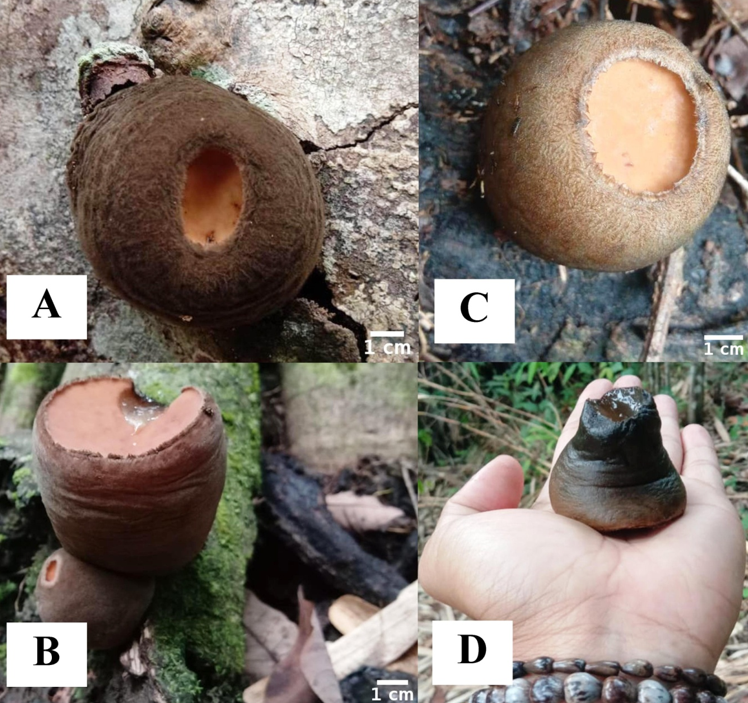
The genus Trichaleurina is a member of Pezizales, which was previously rarely reported from Indonesia. Trichaleurina was first reported by Boedjin in 1932 and 1959 but still used the name Galiella javanica and Galiella celebica. Trichaleurina is closely related to Galiella, Sarcosoma, and Bulgaria. In Indonesia, the first report on T. javanica from West Java in 2020. In the following year, information about the distribution of Trichaleurina was reported from Central Kalimantan (Indonesia). The current study aimed to describe the specimens from Central Kalimantan based on morphological data and record the ethnomycological use by the local people. Fresh materials were used to describe the morphological features. The macrofungi lived on dead wood in solitarily manner, fruiting body round to oval, conical at the bottom, dark brown that gets darker at the base, ascus 8-spored, cylindrical in shape, spores 25-26 × 9-10μm, thick walled. Our specimen was identical to those reported from Bogor (West Java). Trichaleurina javanica is used as food in the daily life of the Dayak Maanyan Tribe in Tamiang Terbang, Central Kalimantan, Indonesia. They usually consumed this macrofungi as local soup. This information adds to the record of the diversity and potency of macrofungi in Indonesia.
References
Arora, D. (1986). Mushrooms Demystified. USA, Teen Speed Press.
Boa, E. (2004). Wild Edible Fungi: A Global Overview of Their Use and Importance to People. Rome : FAO.
Boedijn, K.B. (1932). The genus Sarcosoma in Netherlands India. Bulletin du JardinBotanique de Buitenzorg, 3série, 12 (2): 273-279.
Boedijn, K.B. (1959). Notes on the genus Sarcosoma. Persoonia, 1 (1):7-9.
Carbone, M., Yei-Zeng, W., & Chun-Lin, H. (2013). Studies in Trichaleurina (Pezizales). Type studies of Trichaleurina polytricha and Urnula philippinarum. The status of Sarcosoma javanicum, Bulgaria celebica, and Trichaleurina tenuispora sp. nov., with notes on the anamorphic genus Kumanasamuha. Ascomycete.org., 5, 137-153. doi: 10.25664/art-0088.
Hermawan, R., Amelya, M.P., & Julia, Z.R. (2020). Trichaleurina javanica from West Java. Jurnal Mikologi Indonesia, 4(2): 175-181. http://dx.doi.org/10.46638/jmi.v4i2.85.
Kirk, P., Cannon, P., Minter, D., Stalpers, J. (Eds.). (2008). Ainsworth and Bisby’s Dictionary of the Fungi. http://dx.doi.org/10.1079/9780851998268.0000.
Largent ,D.L. (1977). How to Identify Mushrooms to Genus I: Macroscopic Features. Eureka (CA), Mad River Press Inc.
Noverita, N., Nabilah, N., Siti, F. Y., & Yudistari, Y. (2018). Jamur Makro Di Pulau Saktu Kepulauan Seribu Jakarta Utara dan Potensinya. Jurnal Mikologi Indonesia, 2(1): 16-29. http://dx.doi.org/10.46638/jmi.v2i1.38.
O'Dell, T., Lodge, D.J., & Mueller, G.M. (2004). Approaches to sampling macrofungi. (In): G. M. Mueller, G. Bills, M. S. Foster (eds) Biodiversity of Fungi: Inventory and Monitoring Methods. San Diego: Elsevier Academic Press. 163-168.
Patel, R.S., Vasava, A.M., & Rajput, K.S. (2018). Distribution of Trichaleurina javanica (Rehm) M. Carbone, Agnello & P. Alvarado (Chorioactidaceae) in India. Plant Biosystems - An International Journal Dealing with all Aspects of Plant Biology, 153(2): 231–234. http://dx.doi.org/10.1080/11263504.2018.1461704.
Putra, I.P., Hafazallah, K. (2020). Catatan Komunitas Pemburu Jamur Indonesia : Kolaborasi Lintas Profesi dan Generasi Mengenai Etnomikologi Jamur-Jamur Indonesia. Sukabumi : Haura Publishing.
Putra, I.P. (2020). The Potency of Some Wild Edible Mushrooms with Economic Value in Belitong Island, The Province of Bangka Belitung. Jurnal Wasian, 7(2): 121–135. http://dx.doi.org/10.20886/jwas.v7i2.6109.
Putra, I. P. (2021). Panduan karakterisasi jamur makroskopik di Indonesia: Bagian 1 – Deskripsi ciri makroskopis. Jurnal Penelitian Kehutanan Wallacea, 10(1), 25. https://doi.org/10.18330/jwallacea.2021.vol10iss1pp25-37
Rokuya, I., Yoshio, O., & Tsugia, H. (2011). Fungi of Japan. Japan, Yama-Kei Publishers.
Downloads
Published
Issue
Section
License
Copyright (c) 2025 BIO-EDU: Jurnal Pendidikan Biologi

This work is licensed under a Creative Commons Attribution-ShareAlike 4.0 International License.
The Authors submitting a manuscript do so on the understanding that if accepted for publication, the copyright of the article shall be assigned to BIO-EDU: Jurnal Pendidikan Biologi and Departement of Biology Education, Universitas Timor as the publisher of the journal. Copyright encompasses rights to reproduce and deliver the article in all form and media, including reprints, photographs, microfilms, and any other similar reproductions, as well as translations.
BIO-EDU journal and Departement Biology Education, Universitas Timor, and the Editors make every effort to ensure that no wrong or misleading data, opinions, or statements be published in the journal. In any way, the contents of the articles and advertisements published in BIO-EDU are the sole and responsibility of their respective authors and advertisers.
Users of this website will be licensed to use materials from this website following the Creative Commons Attribution-ShareAlike 4.0 International License.