Correlation Between Learning Activities and Student Learning Outcomes Using Problem-Based Learning at SMAN Mojoagung Jombang
Korelasi Antara Aktivitas Belajar Terhadap Hasil Belajar Siswa Menggunakan Problem Based Learning di SMAN Mojoagung Jombang
DOI:
https://doi.org/10.32938/jbe.v10i3.9272Keywords:
Student Activities, Cognitive Learning Outcomes, Problem Based LearningAbstract
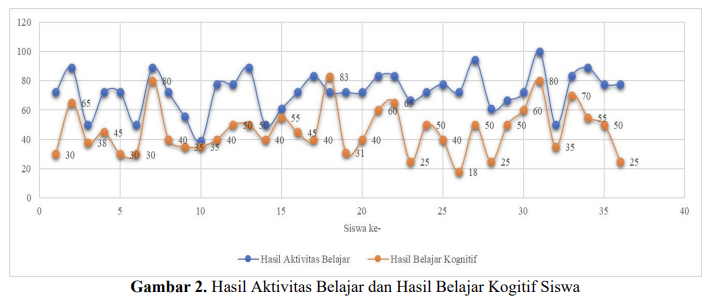
This study aims to analyze the relationship between student activities in learning and cognitive learning outcomes. The method used in this research is a quantitative method with a correlational design. The population in this study were junior high school students, with a sample of class X-5 SMA Negeri Mojoagung Jombang using purposive sampling technique. Data was collected through observation of student activities and cognitive learning outcome tests. The results of the analysis show that there is a positive correlation between student activity and learning outcomes. This is indicated by a Pearson Correlation of 0.536 (moderate relationship) with a p-value of 0.001 which is smaller than 0.05, indicating a significant relationship. The Spearman Correlation is 0.578, which also shows a moderate but slightly stronger relationship. Since the correlation value between student activity and learning outcomes is within the range of 0.40 - 0.599, the relationship that occurs is in the moderate category. This means there is a relationship between student activity and learning outcomes. The implication of this research shows that increasing student involvement in the learning process can contribute to improving student learning outcomes
References
Dewi, D. A., Hamid, S. I., Annisa, F., Oktafianti, M., & Genika, P. R. (2021). Menumbuhkan karakter siswa melalui pemanfaatan literasi digital. Jurnal Basicedu. https://www.jbasic.org/index.php/basicedu/article/view/1609
Khair, A. N. (2024). Efektivitas Problem-Based Learning ( PBL ) dalam Mengasah Keterampilan Kolaborasi dan Berpikir Kritis Siswa pada Proses Pembelajaran Terhadap Siswa Kelas X . 4 di SMA Negeri 9 Gowa. 6(3), 503–508.
Khotimah, K., Ami, M. S., & Sholihah, F. N. (2023). APPLICATION : Applied science in Learning Research Botanical Concepts Understanding of Biology Education Students. 2(3), 1–4.
Novitasari, F., & Puspitawati, R. P. (2022). Pengembangan E-Lkpd Berbasis Problem Solving Pada Materi Pertumbuhan Dan Perkembangan Untuk Melatih Keterampilan Berpikir Kritis Siswa Kelas Xii Sma. Jurnal Inovasi Pembelajaran Biologi, 3(1), 31–42. https://doi.org/10.26740/jipb.v3n1.p31-42
Rosyidah, L. A., & Sholihah, F. N. (2021). Pengembangan Perangkat Pembelajaran Berbasis Discovery Learning Melalui E-Learning pada Materi Ekosistem. Eduscope, 07(01), 2502–3985. https://ejournal.unwaha.ac.id/index.php/eduscope/article/view/1879%0Ahttp://ejournal.unwaha.ac.id/index.php/eduscope/article/download/1879/730
Rozak Hidayat, M., Nikmatus Sholihah, F., & Wahab Hasbullah, K. A. (2021). The Correlation Between Processing Skills and Learning Outcomes Based on Implementation Discovery Learning. Multidiscipline International Conference, 1(1), 11–16. https://ejournal.unwaha.ac.id/index.php/ICMT/article/view/2188
Sholihah, F. N., & Sari, E. N. (2022). Using Youtube in Training Process Skills Through Student Self-Practice. APPLICATION: Applied Science in Learning Research, 2(2), 87–92. https://doi.org/10.32764/application.v2i2.3047
Widodo, S. A. (2016). Kesalahan Dalam Pemecahan Masalah Divergensi Pada Mahasiswa Matematika. AdMathEdu : Jurnal Ilmiah Pendidikan Matematika, Ilmu Matematika Dan Matematika Terapan, 4(1). https://doi.org/10.12928/admathedu.v4i1.4810
Yusuf, R. R., Fachruddin S., M., & Yensy, N. A. (2017). Upaya Meningkatkan Aktivitas Dan Hasil Belajar Siswa Dengan Menerapkan Pendekatan Resource Based Learning Pada Materi Bangun Ruang Sisi Datar. Jurnal Penelitian Pembelajaran Matematika Sekolah (JP2MS), 1(1), 73–80. https://doi.org/10.33369/jp2ms.1.1.73-80
Downloads
Published
How to Cite
Issue
Section
License
Copyright (c) 2026 BIO-EDU: Jurnal Pendidikan Biologi

This work is licensed under a Creative Commons Attribution-ShareAlike 4.0 International License.
The Authors submitting a manuscript do so on the understanding that if accepted for publication, the copyright of the article shall be assigned to BIO-EDU: Jurnal Pendidikan Biologi and Departement of Biology Education, Universitas Timor as the publisher of the journal. Copyright encompasses rights to reproduce and deliver the article in all form and media, including reprints, photographs, microfilms, and any other similar reproductions, as well as translations.
BIO-EDU journal and Departement Biology Education, Universitas Timor, and the Editors make every effort to ensure that no wrong or misleading data, opinions, or statements be published in the journal. In any way, the contents of the articles and advertisements published in BIO-EDU are the sole and responsibility of their respective authors and advertisers.
Users of this website will be licensed to use materials from this website following the Creative Commons Attribution-ShareAlike 4.0 International License.