Development of E-module on Classification Game (SIGAME) as Student Learning Resource
DOI:
https://doi.org/10.32938/jbe.v11i1.10428Keywords:
E-Module, Education Game, Learning Resource, Junior High School StudentsAbstract
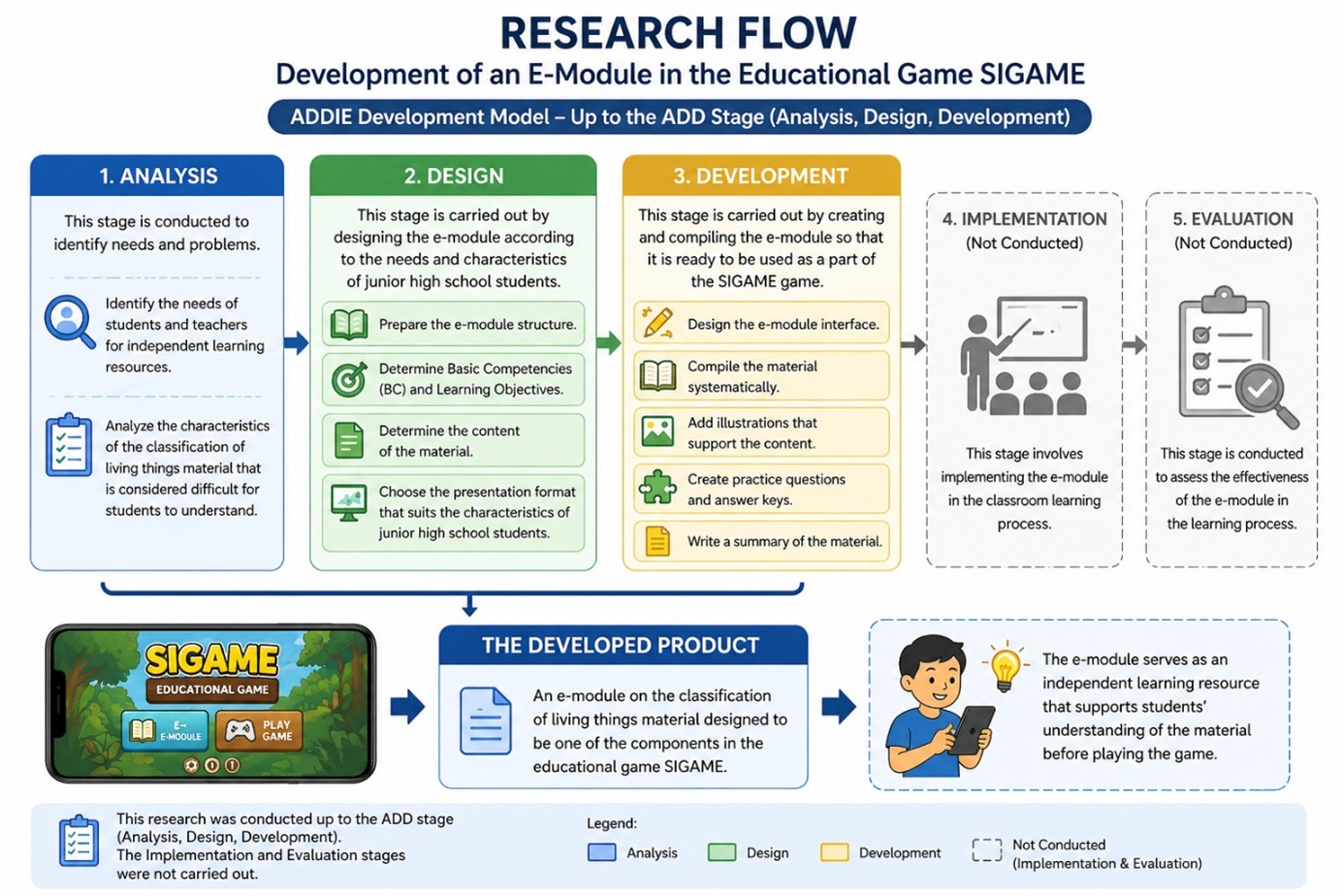
This study aims to develop an e-module integrated into the educational game named Classification Game (SIGAME) and to analyze validation results from experts and practitioners. The research employed a Research and Development (R&D) method using the ADDIE model, limited to the stages of Analysis, Design, and Development. The final product was an e-module on living things classification for seventh-grade students, designed as a component of the educational game. Research instruments included needs analysis questionnaires, validation guidelines, and product assessment sheets. The data were analyzed descriptively through both qualitative feedback and quantitative scoring from validators. Findings revealed that the e-module contained complete components such as interactive materials, exercises, answer keys, and summaries. Subject matter experts rated the module as excellent in terms of language, presentation, and content accuracy, although the scope of material remained limited. Media experts evaluated graphical design, interactivity, and layout as highly suitable for junior high school students. Practitioners rated the e-module as highly effective and contextually relevant for classroom use. The e-module serves as a self-learning resource that strengthens students' understanding before playing the game. Interactive components and evaluation exercises allow students to independently measure their achievements while increasing their motivation to learn through integration with technology-based applications. It can be concluded that the SIGAME e-module is “Very Adequate” for use in the next development stage, namely testing its practicality and implementing learning in schools, as an independent learning resource that supports mastery of the concept of classifying living things.
References
Adawiyah, R., & Kartika, I. (2021). Pengembangan Ensiklopedia IPA Berbasis Integrasi-Interkoneksi Islam-Sains sebagai Sumber Belajar Mandiri Peserta Didik Madrasah Tsanawiyah. Edusains, 13(1), 34–44. https://doi.org/10.15408/es.v13i1.12970
Agustian, D., Wardoyo, S., Amartha, A., Anjani, T. A., Wulansari, T., & Marsanda, E. (2024). The Role of E-Module in the Teaching and Learning Process in Vocational Secondary Schools (SMK): a Literature Review. Al Hikmah: Journal of Education, 5(2), 211. https://doi.org/10.54168/ahje.v5i2.345
Aldoobie, N. (2015). ADDIE Model. American International Journal of Contemporary Research, 5(6), 68–72.
Arifin, N., Effendi, M. H., & Purwati, N. (2024). The Effect of Using E-modules in Biology Learning on Learning Outcomes of High School and University Students: Meta-Analysis. Biota, 17(1), 35–46. https://doi.org/10.20414/jb.v17i1.498
Aroyandini, E. N., & Aloysius, S. (2021). Increasing students’ learning motivation through android-base biology educational game with e-module during COVID-19 pandemic. Proceedings of the 6th International Seminar on Science Education (ISSE 2020), 541, 162–168.
Aroyandini, E. N., Anfa, Q., & Firanti, A. (2021). Penggunaan Media Pembelajaran Berbasis E-Learning Terhadap Motivasi Belajar Biologi Siswa. BIO-EDU: Jurnal Pendidikan Biologi, 6(3), 198–208. https://doi.org/10.32938/jbe.v6i3.1352
Dwiyono. (2017). Pengembangan Game Edukasi sebagai Media Pembelajaran Interaktif pada Kompetensi Dasar Mendeskripsikan Penggunaan Peralatan Tangan (Hand Tools) dan Peralatan Bertenaga (Power Tools). Jurnal Pendidikan Teknik Mekatronika, 7(4), 343–351. http://journal.student.uny.ac.id/ojs
Hagma, M. A. F., Ruswan, R., & Wijayanti, E. (2024). Development of an Islamic Integrated Biology E-Module on Class XI High School Excretory System Material to Empower Students ’ Critical Thinking Skills. Bio-Edu: Jurnal Pendidikan Biologi, 09(02), 122–131. https://doi.org/10.32938/jbe.v9i2.6575
Herlina, E., & Abidin, Z. (2024). Development of interactive e-modules to improve students’ scientific literacy abilities: A literature review. Jurnal Mangifera Edu, 8(2), 74–87. https://doi.org/10.31943/mangiferaedu.v8i2.181
Hirumi, A. (2014). Bermain Game di Sekolah : Video Game dan Permainan Komputer Simulasi untuk Anak SD dan SMP. Indeks.
Insani, M. D. (2016). Studi Pendahuluan Identifikasi Kesulitan dalam Pembelajaran pada Guru IPA SMP Se-Kota Malang. Jurnal Pendidikan Biologi, 7(2), 81–93.
Kale, F., Situmorang, R. P., & Hastuti, S. P. (2021). Development of Mobile Learning-based Edugame on Respiratory System Material to Improve Students’ Digital Literacy. Formatif: Jurnal Ilmiah Pendidikan MIPA, 11(2), 151–160. https://doi.org/10.30998/formatif.v11i2.6237
Kurniawan, M. R., & Risnani, L. Y. (2021). Pengembangan Game Edukasi Digital dan Implementasi Pada Pembelajaran Biologi Materi Plantae Siswa SMA Kelas X. BIOEDUKASI (Jurnal Pendidikan Biologi), 12(1), 1. https://doi.org/10.24127/bioedukasi.v12i1.3759
Lantzouni, M., Poulopoulos, V., & Wallace, M. (2024). Gaming for the Education of Biology in High Schools. Encyclopedia, 4(2), 672–681. https://doi.org/10.3390/encyclopedia4020041
Mardianti, I., Kasmantoni, K., & Walid, A. (2020). Pengembangan Modul Pembelajaran IPA Berbasis Etnosains Materi Pencemaran Lingkungan Untuk Melatih Literasi Sains Siswa Kelas VII di SMP. Bio-Edu: Jurnal Pendidikan Biologi, 5(2), 97–106. https://doi.org/10.32938/jbe.v5i2.545
Masykhur, M. A., & Risnani, L. Y. (2020). Pengembangan dan Uji Kelayakan Game Edukasi Digitalsebagai Media Pembelajaran Biologi Siswa Sma Kelas X pada Materi Animalia. Bioedukasi: Jurnal Pendidikan Biologi, 11(2), 90. https://doi.org/10.24127/bioedukasi.v11i2.3276
Prastowo, A. (2013). Panduan Kreatif Membuat Bahan Ajar Inovatif. DIVA Press.
Prayitno, Y. S., Arif, M., Dellia, P., Wijaya, E. Y., & Sari, A. K. (2022). Pengembangan Game Edukasi Berbasis Android Pada Mata Pelajaran Biologi Materi Sistem Peredaran Darah Untuk Siswa Kelas XI IPA Tingkat SMA. Journal of Education and Informatics Research, 1(1), 10–17.
Putra, Y. I., Fadli, R., & Dahry, S. (2023). Meta analyzing the ease of use of e-modules in learning. Jurnal Inovasi Teknologi Pendidikan, 10(4), 338–343. https://doi.org/10.21831/jitp.v10i4.62229
Rusdi, H., Ervianti, R., Adrias, A., & Zulkarnaini, A. P. (2025). Pengaruh Media Pembelajaran Digital terhadap Motivasi Belajar Siswa Sekolah Dasar. Pendas: Jurnal Ilmiah Pendidikan Dasar, 10(2), 347–360.
Sari, A., Muhartati, E., Oprasmani, E., & Putri, A. N. (2023). Development of Science Learning E-Module Equipped with Game on Material Classification of Living Things for Grade VII Students. Bioeduca : Journal of Biology Education, 5(1), 34–51. https://doi.org/10.21580/bioeduca.v5i1.14751
Sari, K., & Azizah, N. (2023). Literature Study: E-Module Development in Physics Learning. 2nd Annual International Conference on Islamic Education for Students (AICOIES 2023), Aicoies, 337–350.
Sari, N. P., Suhirman, S., & Walid, A. (2020). Pengembangan Modul Pembelajaran IPA Berbasis Etnosains Materi Interaksi Makhluk Hidup dengan Lingkungannya Untuk Menanamkan Jiwa Konservasi Siswa Kelas VII SMP. Bio-Edu: Jurnal Pendidikan Biologi, 5(2), 62–73. https://doi.org/10.32938/jbe.v5i2.554
Sholeh, B., Hufad, A., & Fathurrohman, M. (2023). Pemanfaatan E-Modul Interaktif dalam Pembelajaran Mandiri Sesuai Kapasitas Siswa. Risalah: Jurnal Pendidikan Dan Studi Islam, 9(2), 2614–3275. https://doi.org/10.31943/jurnal_risalah.v9i2.458.
Smaldino, S. E. (2017). Instructional Technology & Media for Learning (Teknologi Pembelajaran dan Media untuk Belajar). Prenada Media.
Suparno, J., Sunarno, W., & Ashadi, A. (2019). Pengembangan Modul IPA Terpadu Untuk SMP/MTs Berbasis Problem Based Learning (PBL) dengan Tema Fotosintesis untuk Meningkatkan Kemampuan Berpikir Kritis. Inkuiri: Jurnal Pendidikan IPA, 8(2), 119–129. https://doi.org/10.20961/inkuiri.v8i2.31828
Syafruddin, S., Lestari, I. D., Noviati, W., & Ramdhayani, E. (2021). Development of Learning Media for Educational Games Based on Adobe Flash in Biology. Proceedings of the 2nd Annual Conference on Education and Social Science (ACCESS 2020), 556(Access 2020), 107–111. https://doi.org/10.2991/assehr.k.210525.056
Wahyuningtyas, N., Ruja, I. N., & Yahya, M. H. (2021). Developing of a Learning Media for Smartphones for Disaster Mitigation Education. International Journal of Emerging Technologies in Learning (IJET), 16(7), 160–174.
Zaharah, Z., & Susilowati, A. (2020). Meningkatkan Motivasi Belajar Peserta Didik Dengan Menggunakan Media Modul Elektronik Di Era Revolusi Industri 4.0. Biodik, 6(2), 39–52. https://doi.org/10.22437/bio.v6i2.8950
Downloads
Published
How to Cite
Issue
Section
License
Copyright (c) 2026 BIO-EDU: Jurnal Pendidikan Biologi

This work is licensed under a Creative Commons Attribution-ShareAlike 4.0 International License.
The Authors submitting a manuscript do so on the understanding that if accepted for publication, the copyright of the article shall be assigned to BIO-EDU: Jurnal Pendidikan Biologi and Departement of Biology Education, Universitas Timor as the publisher of the journal. Copyright encompasses rights to reproduce and deliver the article in all form and media, including reprints, photographs, microfilms, and any other similar reproductions, as well as translations.
BIO-EDU journal and Departement Biology Education, Universitas Timor, and the Editors make every effort to ensure that no wrong or misleading data, opinions, or statements be published in the journal. In any way, the contents of the articles and advertisements published in BIO-EDU are the sole and responsibility of their respective authors and advertisers.
Users of this website will be licensed to use materials from this website following the Creative Commons Attribution-ShareAlike 4.0 International License.