
Analysis of Mangrove Vegetation Abundance and Species Richness in the Mangrove Forest Area of Mojo Village, Ulujami District, Pemalang Regency, Central Java
DOI:
https://doi.org/10.32938/jbe.v11i2.10696Keywords:
Mangrove vegetation analysis, Ulujami mangrove forests, Mangrove forest water qualityAbstract
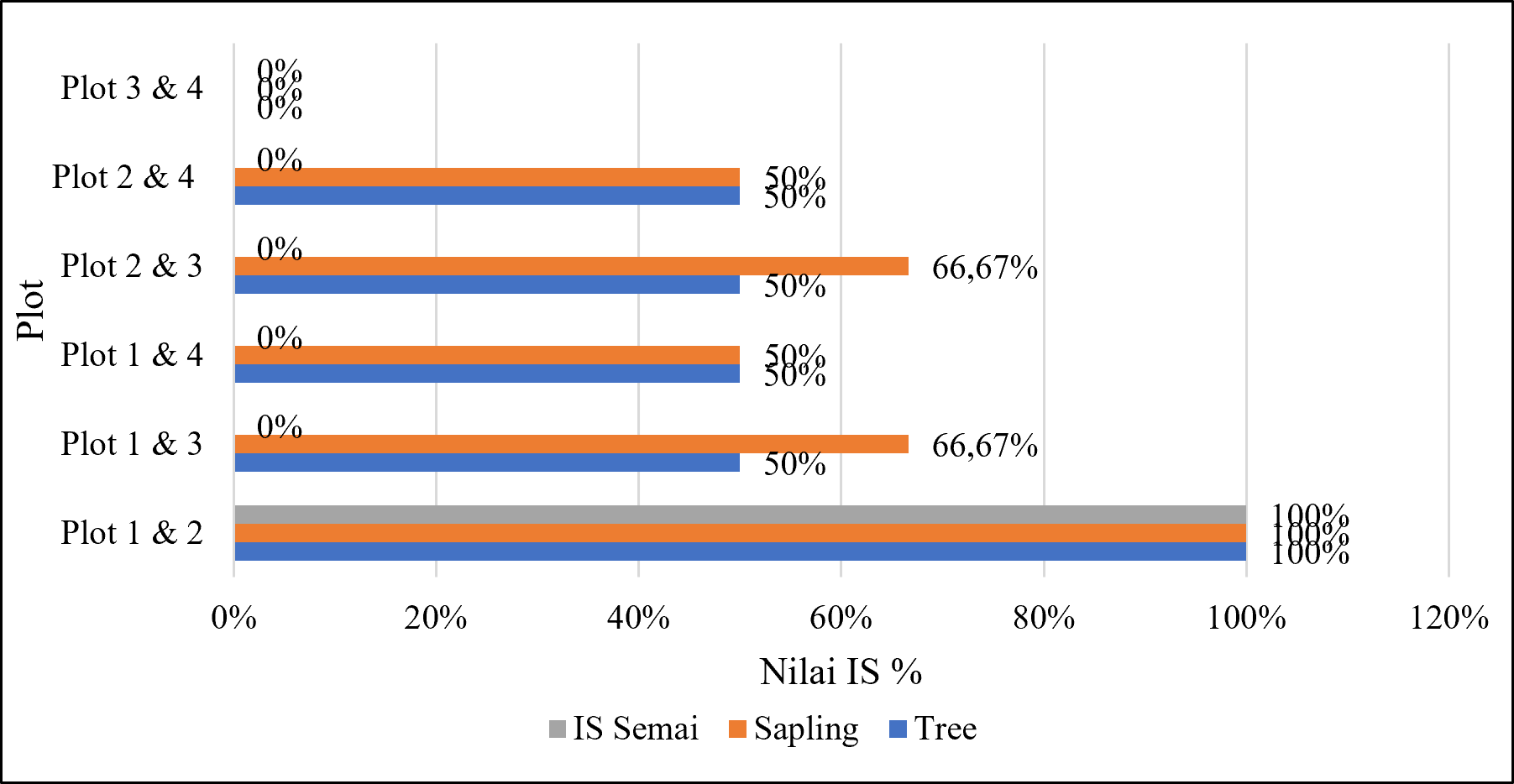
Ulujami district is one of the districts in Pemalang district and has a mangrove forest area of 445 Ha but continues to suffer abrasion. The purpose of this practice is to know the common and richness of mangrove vegetation in the mangrove forest area of Mojo Village, Ulujami district, Pemalang district. The research was conducted in August 2023 – September 2023. The method used is purposive sampling by dividing 4 stations and each station has 3 plots with different sizes namely 10 x 10 m, 5 x 5 m and 2 x 2 m. Based on the research that has been done on the mangrove species found as many as 4 (four) species of mangrove namely Avicennia alba Blume, Avicenna marina (Forssk.) Vierh., Rhizopora mucronata Poir., and Sonneratia caseolaris (L.) Engl. The sørensen Safety Index has the highest 0-100% range of values in the tree, shrub, and straw categories obtained by plot 1 and 2 with 100% values belonging to very similar categories. The results of water quality measurements at each station in the mangrove forest area of Mojo Village include temperature 28.8-30°C, salinity 25-29 ppt, water pH 5.9 6.21, and DO 5.5-14.9 mg/l.
References
Anhar, A., Erida, G., Siregar, A.W., Rahmah, H., Muslih, A.M., Hanafi, I., & Hayati, D. (2025). Vegetation Diversity in the Geumpang Protected Forest Area, Pidie District, Aceh, Indonesia. Biodiversitas. 26(9), 4490-4499. https://doi.org/10.13057/biodiv/d260921
Gaol, M. L., Boro, T. L., Danong, M. T., & Ruma, M. T. L. (2023). Komposisi, Keragaman, dan Distribusi Spesies Mangrove di Wilayah Nusa Tenggara Timur. Biotropikal Sains, 20(2), 32–46. https://ejurnal.undana.ac.id/index.php/biotropikal/issue/view/591/5-KOMPOSISI%2C%20KERAGAMAN
Gilman, E., Ellinson, J., Duke, N.C & Field, C. (2008). Threats to Mangroves from Climate Change and adaption options: a review. Aquatic Botany. 89(2): 237-250. https://doi.org/10.1016/j.aquabot.2007.12.009
Hadi, E.E.W., Widyastuti, S. M., & Wahyuono, S. (2016). Keanekaragaman dan Pemanfaatan Tumbuhan Bawah Pada Sistem Agroforestri di Perbukitan Menoreh, Kabupaten Kulon Progo (Diversity and Untilization of Understorey in Agroforestry System of Menoreh Hill, Kulon Progo Regency). J. Manusia dan Lingkungan, Vol. 23, No.2, Juli 2016: 206-215. https://doi.org/10.22146/jml.18792
Irwanto. 2006. Keanekaragaman Fauna Pada Habitat Mangrove. Yogyakarta.
Küchler, A. W. (1976). [Review of Aims and Methods of Vegetation Ecology, by D. Mueller-Dombois & H. Ellenberg]. Geographical Review, 66(1), 114–116. https://doi.org/10.2307/213332
Kusmana, C. (1995). Manajemen hutan mangrove Indonesia. Lab Ekologi Hutan. Jurusan Manajemen Hutan, Fakultas Kehutanan, IPB. Bogor. https://repository.ipb.ac.id/handle/123456789/26315
Kusmana, C., S. Wilarso, I. Hilwan, P. Pamoengkas, C. Wibowo, T. Tiryana, A. Triswanto, Yunasfi, Hamzah. (2003). Teknik Rehabilitasi Mangrove. Fakultas Kehutanan. Institut Pertanian Bogor. Bogor. https://cir.nii.ac.jp/crid/1971149384802877363
Margalef, R., 1958. Temporal succession and spatial heterogeneity in phytoplankton. In: Perspectives in Marine biology, Buzzati-Traverso (ed.), Univ. Calif. Press, Berkeley, pp. 323-347. https://digital.csic.es/bitstream/10261/165671/3/Margelef_1958_preprint.pdf
Muali. 2020. Strategi Pengelolaan Hutan Mangrove di Desa Mojo Kecamtan Ulujami Kabupaten Pemalang Jawa Tengah. Dinas Perikanan Kabupaten Pemalang, Propinsi Jawa Tengah. https://doi.org/10.33830/jmst.v21i1.778.2020
Ndede, I. G., Dr. Ir. Johny S., Tasirin, MScF,. Ir. Maria Y. M. A. Sumakud, MSc. (2017). Komposisi dan Struktur Vegetasi Hutan Mangrove di Desa Sapa Kabupaten Minahasa Selatan. Cocos. 8(6), 1-10. https://ejournal.unsrat.ac.id/v3/index.php/cocos/article/view/16614
Pelupessy, I. A., Kesaulya, I., & Malik, dan S. (2017). Produktivitas Primer dan Faktor Fisika-Kimia di Perairan di Teluk Ambon Dalam, Prosiding Seminar Nasional Kemaritiman dan Sumber Daya Pulau-pulau Kecil, 2(1), 89-104. https://ejournal.unkhair.ac.id/index.php/ksppk/article/view/639
Pemerintah Kabupaten Pemalang. 2006. Profil Desa Mojo 2006. Kantor Desa Mojo Kec. Ulujami Kab. Pemalang. https://peraturan.bpk.go.id/Download/354465/Perda%20Kab.%20Pemalang%20Tahun%202006%20No%202_ocr.pdf
Purnamawati, A. D., Saputra, S. W., & Wijayanto, D. (2015). Nilai Ekonomi Hutan Mangrove Di Desa Mojo Kecamatan Ulujami Kabupaten Pemalang. Management of Aquatic Resources Journal (MAQUARES), 4(3), 204-213. https://ejournal3.undip.ac.id/index.php/maquares/article/download/9447/9173
Renta, P. P., Pribadi, R., Zainuri, M., & Fajar Utami, M. A. (2016). Struktur Komunitas Mangrove Di Desa Mojo Kabupaten Pemalang Jawa Tengah. Jurnal Enggano, 1(2), 1–10. https://doi.org/10.31186/jenggano.1.2.1-10
Sanadi, S., Tampubolon, N., Widiastuti, N., Simatauw, F. F. C., Bato, M., & Duwit, B. (2023). Analysis of Mangrove Vegetation in Bonkawir Village Waisai City Raja Ampat Regency. Jurnal Sumberdaya Akuatik Indopasifik, 7(2), 201–214. https://doi.org/10.46252/jsai-fpik-unipa.2023.Vol.7.No.2.256
Schaduw, J. N. W. (2018). Distribusi Dan Karakteristik Kualitas Perairan Ekosistem Mangrove Pulau Kecil Taman Nasional Bunaken. Majalah Geografi Indonesia, 32 (1), 40-49. http://doi.org/10.22146/mgi.32204
Setyawan, A. D., Indrowuryanto, I., Wiryanto, W., Winarno., K, & Susilowati., A. (2008). Mangrove plants in coastal area of Central Java: 3. Horizontal and vertical diagram of vegetation profile. Biodiversitas, 9(4): 315-321. https://doi.org/10.13057/biodiv/d090416
Wahyuningsih, E., Sulastri, C.W., Aji, I.M.L., & Lestari, A.T. (2024). Kualitas Lingkungan pada Tegakan Mangrove di Blok Hutan Mondulambi, Taman Nasional Manupeu Tanah Daru. PERENNIAL, 20(2), 73-83. https://doi.org/10.24259/perennial.v20i2.35755
Downloads
Published
How to Cite
Issue
Section
License
Copyright (c) 2026 BIO-EDU: Jurnal Pendidikan Biologi

This work is licensed under a Creative Commons Attribution-ShareAlike 4.0 International License.
The Authors submitting a manuscript do so on the understanding that if accepted for publication, the copyright of the article shall be assigned to BIO-EDU: Jurnal Pendidikan Biologi and Departement of Biology Education, Universitas Timor as the publisher of the journal. Copyright encompasses rights to reproduce and deliver the article in all form and media, including reprints, photographs, microfilms, and any other similar reproductions, as well as translations.
BIO-EDU journal and Departement Biology Education, Universitas Timor, and the Editors make every effort to ensure that no wrong or misleading data, opinions, or statements be published in the journal. In any way, the contents of the articles and advertisements published in BIO-EDU are the sole and responsibility of their respective authors and advertisers.
Users of this website will be licensed to use materials from this website following the Creative Commons Attribution-ShareAlike 4.0 International License.