Profile of Epistemic Assessment Experiences in Science: Scientific Models in Biology Learning
DOI:
https://doi.org/10.32938/jbe.v11i2.11050Keywords:
Epistemic assessment, Scientific models, Biology learning, Epistemic science knowledge, Assessment experience profileAbstract
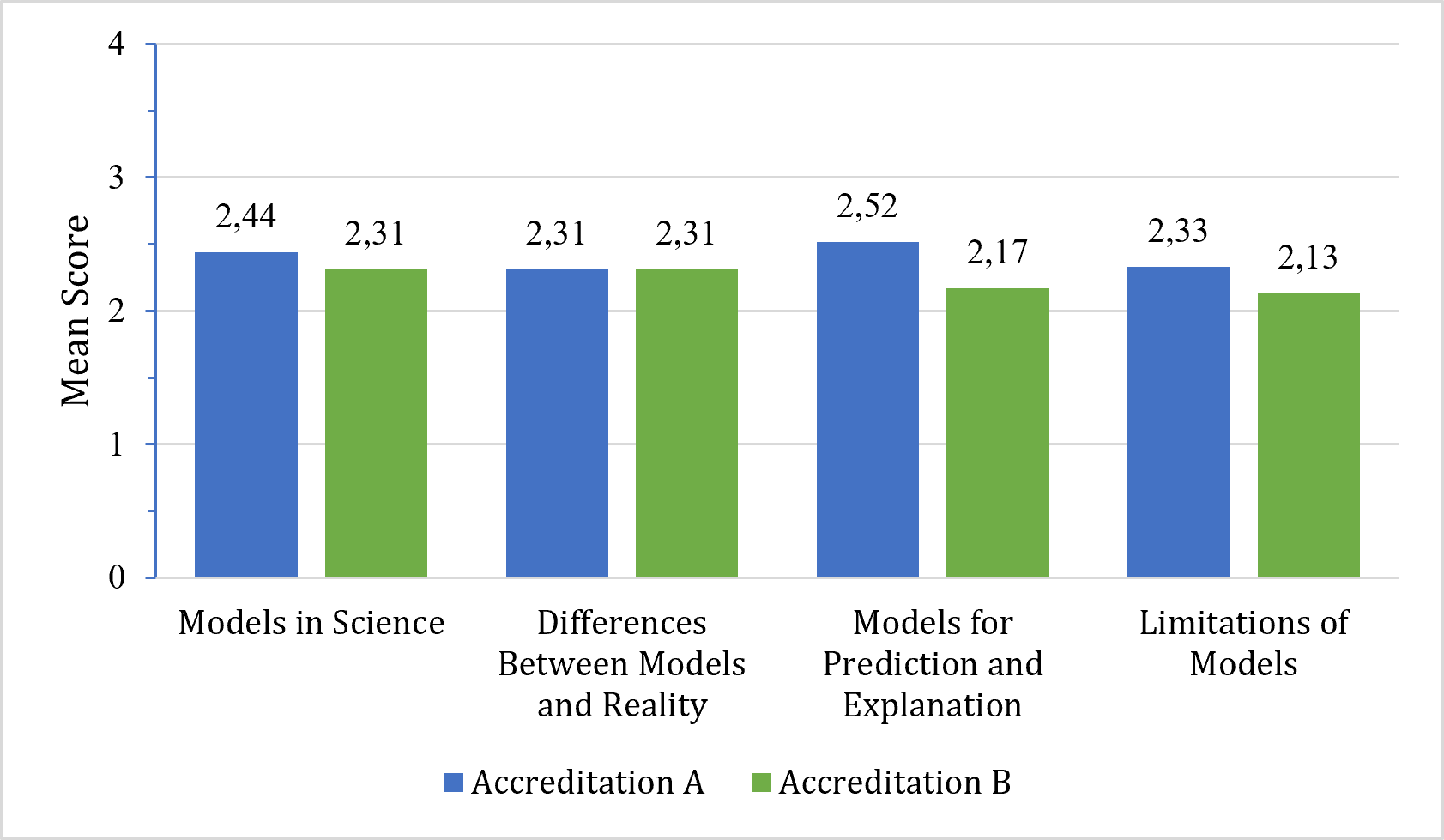
This study aims to profile high school students’ epistemic assessment experiences of the scientific model in biology learning. A descriptive method was used, involving 225 eleventh-grade students from ten high schools with A and B accreditation in the cities of Bandung and Cimahi. Data were collected via a four-point Likert-scale questionnaire with multiple-response options and semi-structured interviews, then analyzed based on the mean scores for each sub-element. The results indicate that students’ experiences with the epistemic assessment of the scientific model are still not widely present in biology assessments in the classroom, as evidenced by all sub-elements scoring only in the “sometimes” category. The sub-elements of the model for prediction and explanation obtained the highest average (2.50), while the limitations of the model and the differences between the model and reality were the aspects students experienced least frequently (2.31). These findings indicate that biology assessment is still dominated by the use of models to explain and predict phenomena, while evaluative aspects such as comparing and evaluating models have not been widely accommodated. Differences in school accreditation also did not indicate significant differences in the epistemic orientation of assessment. Therefore, biology assessment needs to be more directed toward developing students’ ability to critically evaluate, compare, and revise scientific models.
References
An Nisaa, R., & Maesaroh. (2022). Analisis Buku Ajar Biologi SMA Kelas XI Materi Sistem Peredaran Darah dan Sistem Endokrin. BIO-EDU: Jurnal Pendidikan Biologi, 7(1), 61–67. https://doi.org/10.32938/jbe.v7i1.1949
Astriningrum, D., & Widodo, A. (2025). Preservice biology t eachers ’ readiness to teach inquiry lessons : A reflective analysis from microteaching class. Assimilation Indonesian Journal of Biology Educational, 8(2), 137–146. https://doi.org/10.17509/aijbe.v8i2.85723
Chan, K. K. H., Lau, D. S. P., & van Driel, J. (2025). Different Designs, Different Outcomes? A Critical Systematic Review of Interventions for Preparing Preservice Science Teachers to Teach Scientific Models and Modeling. Science Education, 109(2), 386–428. https://doi.org/10.1002/sce.21911
Chang, H. Y. (2022). Science teachers’ and students’ metavisualization in scientific modeling. Science Education, 106(2), 448–475. https://doi.org/10.1002/sce.21693
Chiu, M. H., & Lin, J. W. (2019). Modeling competence in science education. Disciplinary and Interdisciplinary Science Education Research, 1(1), 1–11. https://doi.org/10.1186/s43031-019-0012-y
Cohen, L., Manion, L., & Morrison, K. (2007). Research Methods in Education (6th ed.). Routledge. DOI: https://doi.org/10.4324/9780203029053.
Erduran, S., Ioannidou, O., & Baird, J. A. (2021). The impact of epistemic framing of teaching videos and summative assessments on students’ learning of scientific methods. International Journal of Science Education, 43(18), 2885–2910. https://doi.org/10.1080/09500693.2021.1998717
Fairuz, T., & Putri, M. D. (2025). Epistemic Knowledge Assessment Instrument on Energy Crisis Material for Junior High School Students. INKUIRI: Jurnal Pendidikan IPA, 14(2), 109. https://doi.org/10.20961/inkuiri.v14i2.101249
Habsari, K. Y., Sumarno, & Rahayu, P. (2025). Identifikasi Faktor Penyebab Miskonsepsi Siswa dengan Menggunakan Five-Tier pada Materi Menjelajah Sel Kelas XI. BIO-EDU: Jurnal Pendidikan Biologi, 10(2), 121–128. https://doi.org/10.32938/jbe.v10i2.7787
Inkinen, J., Klager, C., Juuti, K., Schneider, B., Salmela-Aro, K., Krajcik, J., & Lavonen, J. (2020). High school students’ situational engagement associated with scientific practices in designed science learning situations. Science Education, 104(4), 667–692. https://doi.org/10.1002/sce.21570
Jansen, S., Knippels, M. C. P. J., & van Joolingen, W. R. (2019). Assessing students ’ understanding of models of biological processes : a revised framework processes : a revised framework. International Journal of Science Education ISSN:, 41(8), 981–994. https://doi.org/10.1080/09500693.2019.1582821
Lee, D., Wright, M., Faber, C., Kennedy, C., & Dittrich-Reed, D. (2021). Participation in biology education research influences students’ epistemic development. CBE Life Sciences Education, 20(4). https://doi.org/10.1187/CBE.20-11-0255
Lieberei, T., Großmann, L., Welter, V. D. E., Krüger, D., & Krell, M. (2024). Considering Multiple Sources of Validity Evidence Can Help to Address Challenges in the Development of Pedagogical Content Knowledge (PCK) Multiple-Choice Items. Research in Science Education, 1349–1369. https://doi.org/10.1007/s11165-024-10227-9
Louca, L. T., & Zacharia, Z. C. (2012). Modeling-based learning in science education: Cognitive, metacognitive, social, material and epistemological contributions. Educational Review, 64(4), 471–492. https://doi.org/10.1080/00131911.2011.628748
Manee, K., & Nuangchalerm, P. (2023). Development of grade 10 students’ modelling skills on circulatory system through model-based learning. Journal of Advanced Sciences and Mathematics Education, 3(2), 113–120. https://doi.org/10.58524/jasme.v3i2.321
Minshew, L. M., Anderson, J. L., & Bartlett, K. A. (2022). Outside the standard test: The development of a model-based assessment and corresponding rubric. Instructional Science, 50(4), 599–624. https://doi.org/10.1007/s11251-022-09582-9
Nurdini, Y., Wulan, A. R., & Diana, S. (2020). Assessment for learning through written feedback to develop 21st-century critical thinking skills on plantae learning. Journal of Physics: Conference Series, 1521(4). https://doi.org/10.1088/1742-6596/1521/4/042019
Nurfitriani, Wulan, A. R., & Anggraeni, S. (2018). Pengembangan Asesmen Kinerja untuk Menilai Keterampilan Proses Sains Terintegrasi Siswa pada Konsep Ekosistem. Assimilation: Indonesian Journal of Biology Education, 1(1), 33–38. https://doi.org/10.17509/aijbe.v1i1.11454
Nurgiyantoro, B., Gunawan, & Marzuki. (2012). Statistik Terapan untuk Penelitian Ilmu-Ilmu Sosial. Gadjah Mada University Press.
Nurhijah, S. S., Wulan, A. R., & Diana, S. (2020). Implementation of formative assessment through oral feedback to develop 21st century critical thinking skills of student on plantae learning. Journal of Physics: Conference Series, 1521(4). https://doi.org/10.1088/1742-6596/1521/4/042021
OECD. (2023). Pisa 2025 Science Framework (Draft). 1–93. https://pisa-framework.oecd.org/science-2025/assets/docs/PISA_2025_Science_Framework.pdf
Rahmi, S. N., Megawati, Alberida, H., & Fadilah, M. (2025). Assessment of biology learning outcomes in education: A systematic literature review. Biosfer: Jurnal Pendidikan Biologi, 18(1), 10–25. https://doi.org/10.21009/biosferjpb.47179
Rifan, N. M., & Latif, A. A. (2025). Constructive Alignment as a Framework for Enhancing Motivation and Higher - Order Thinking in Science Classrooms : A Systematic Synthesis. International Journal of Research and Innovation in Social Science, 9(26), 8078–8086. https://doi.org/10.47772/IJRISS
Schwarz, C. E., DeGlopper, K. S., Greco, N. C., Russ, R. S., & Stowe, R. L. (2025). Modeling Student Negotiation of Assessment-Related Epistemological Messages in a College Science Course. Science Education, 109(2), 429–447. https://doi.org/10.1002/sce.21914
Sidik, R. M., Wulan, A. R., & Kusnadi, K. (2025). Development and validation an instrument for evaluating epistemic knowledge: Educational biology context. JPBI (Jurnal Pendidikan Biologi Indonesia), 11(3), 848–858. https://doi.org/10.22219/jpbi.v11i3.41420
Sugiyono. (2020). Metode Penelitian Kuantitatif, Kualitatif, dan Kombinasi R&D. Bandung: PT Alfabeta
Tillah, N. F., & Subekti, H. (2025). Analisis Kemampuan Literasi Sains Siswa SMP Berdasarkan Indikator dan Level Literasi Sains. Edusaintek: Jurnal Pendidikan, Sains Dan Teknologi, 12(1), 137–154. https://doi.org/10.47668/edusaintek.v12i1.1271
Wilson, K. J., Long, T. M., Momsen, J. L., & Speth, E. B. (2020). Modeling in the classroom: Making relationships and systems visible. CBE Life Sciences Education, 19(1), 1–5. https://doi.org/10.1187/cbe.19-11-0255
Zetterqvist, A., & Bach, F. (2023). Epistemic knowledge–a vital part of scientific literacy? International Journal of Science Education, 45(6), 484–501. https://doi.org/10.1080/09500693.2023.2166372
Downloads
Published
How to Cite
Issue
Section
License
Copyright (c) 2026 BIO-EDU: Jurnal Pendidikan Biologi

This work is licensed under a Creative Commons Attribution-ShareAlike 4.0 International License.
The Authors submitting a manuscript do so on the understanding that if accepted for publication, the copyright of the article shall be assigned to BIO-EDU: Jurnal Pendidikan Biologi and Departement of Biology Education, Universitas Timor as the publisher of the journal. Copyright encompasses rights to reproduce and deliver the article in all form and media, including reprints, photographs, microfilms, and any other similar reproductions, as well as translations.
BIO-EDU journal and Departement Biology Education, Universitas Timor, and the Editors make every effort to ensure that no wrong or misleading data, opinions, or statements be published in the journal. In any way, the contents of the articles and advertisements published in BIO-EDU are the sole and responsibility of their respective authors and advertisers.
Users of this website will be licensed to use materials from this website following the Creative Commons Attribution-ShareAlike 4.0 International License.