Evaluating Education and Conservation Functions in Digital Communication of Conservation Institutions: A Content Analysis of Surabaya Zoo's Instagram Account
DOI:
https://doi.org/10.32938/jbe.v11i2.11104Keywords:
Digital communication, Zoo, Education, Ex citu conservationAbstract
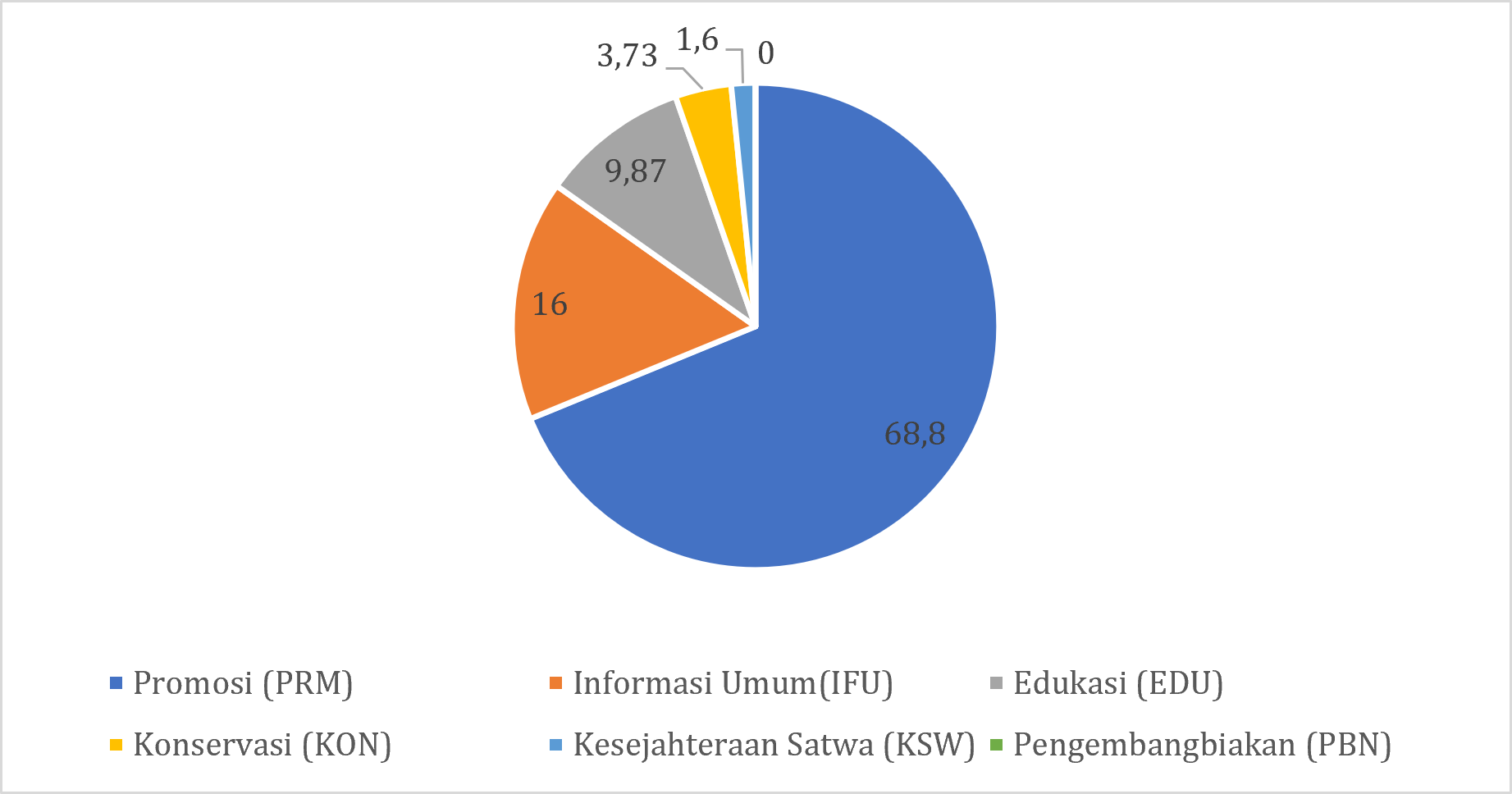
Conservation Institutions (LK) hold a constitutional mandate to perform education and wildlife preservation functions. In the digital era, social media becomes a crucial tool for disseminating ex-situ conservation values to the public. This study aims to evaluate the extent to which the official Instagram account of Surabaya Zoo (@surabayazoo) represents these functions. Utilizing a quantitative content analysis method, this research examined 375 posts over a one-year period, categorized into six message functions: Education (EDU), Conservation (KON), Animal Welfare (KSW), Breeding (PBN), Promotion (PRM), and General Information (IFU). The inter-coder reliability test using the Holsti formula showed an agreement level of 0.918, indicating high data validity. The results reveal a significant imbalance, with promotion content (PRM) dominating at 68.80%, followed by general information (16.00%), and education (9.87%). Meanwhile, crucial aspects such as conservation (3.73%), animal welfare (1.60%), and breeding (0%) received very marginal portions. These findings indicate the commodification of wildlife in digital spaces and the identity disparity of conservation institutions as scientific institutions versus tourist destinations. The study concludes that Surabaya Zoo's digital communication strategy is more oriented towards commercial interests and business marketing rather than strengthening conservation literacy. A reorientation of content policy is required to align with the ethical identity of conservation institutions as biodiversity preservation and educational entities.
References
Beer, H.N., Shrader, T.C., Schmidt, T.B., & Yates, D.T. (2023). The Evolution of Zoos as Conservation Institutions: A Summary of the Transition from Menageries to Zoological Gardens and Parallel Improvement of Mammalian Welfare Management. Journal of Zoological and Botanical Gardens, 4, 648–664. https://doi.org/10.3390/jzbg4040046
Bergman, J.N., Buxton, R.T., Lin, H-Y., Lenda, M., Attinello, K., Hajdasz, A.C., Rivest, S.A., Tran Nguyen, T., Cooke, S.J., & Bennett, J.R. (2022). Evaluating the benefits and risks of social media for wildlife conservation. FACETS, 7, 360–397. https://doi.org/10.1139/facets-2021-0112
British Ecological Society. (2025). Messaging with appeal to intrinsic or relational values shows potential to shift demand for wildlife as pets. Applied Ecology Resources. https://www.britishecologicalsociety.org/applied-ecology-resources/document/20250040716/
Daryl D. Green, Richard Martinez, et al. (2018). In a World of Social Media: A Case Study Analysis of Instagram. American Research Journal of Business and Management, 4(1), 1-8.
Elena, D. (2025). The Role of Zoos: Conservation or Captivity? Journal of Animal Health and Behaviour Sciences, 9, 295. https://doi.org/10.4172/jahbs.1000295
Fatima, N. (2024). The Role of Zoos in Biodiversity Conservation. MARKHOR (The Journal of Zoology), 5(04), 1. https://doi.org/10.54393/mjz.v5i04.140
Galiano-Coronil, A., Ravina-Ripoll, R., Cano-Tenorio, R., & Tobar-Pesantez, L.B. (2024). Exploring X as a social marketing and happiness management instrument for biodiversity. International Journal of Management and Decision Making, 23(4), 505–528. https://doi.org/10.1504/IJMDM.2024.139417
Hooper, J. (2023). Thinking with Civets: The Role of Zoos in the Decolonisation of Animal Tourism. Animals, 13, 1739. https://doi.org/10.3390/ani13111739
Kementerian Kehutanan Republik Indonesia. (2012). Peraturan Menteri Kehutanan No. P.31/Menhut-II/2012 tentang Lembaga Konservasi. Jakarta: Kementerian Kehutanan.
Krippendorff, K. (2018). Content Analysis: An Introduction to Its Methodology (4th ed.). Thousand Oaks, CA: Sage Publications. https://doi.org/10.4135/9781071878781
Massingham, E.J., Wilson, K.A., Meijaard, E., Ancrenaz, M., Santika, T., Friedman, R., Possingham, H.P., & Dean, A.J. (2023). Public opinion on protecting iconic species depends on individual wellbeing: Perceptions about orangutan conservation in Indonesia and Malaysia. Environmental Science and Policy, 150, 103588. https://doi.org/10.1016/j.envsci.2023.103588
McDougall, P.T., Réale, D., Sol, D., & Reader, S.M. (2006). Wildlife conservation and animal temperament: causes and consequences of evolutionary change for captive, reintroduced, and wild populations. Animal Conservation, 9(1), 39-48. https://doi.org/10.1111/j.1469-1795.2005.00004.x
Moss, A., Vukelic, M., Walker, S.L., Smith, C., & Spooner, S.L. (2023). The Role of Zoos and Aquariums in Contributing to the Kunming–Montreal Global Biodiversity Framework. Journal of Zoological and Botanical Gardens, 4, 445–461. https://doi.org/10.3390/jzbg4020033
Nevyra, V.I., Indar, et al. (2022). Penggunaan Instagram sebagai Media Komunikasi. Communication and Social Media, 1(2), 49-56. DOI:https://doi.org/10.57251/csm.v1i2.321
Ojalammi, S., & Nygren, N.V. (2018). Visitor Perceptions of Nature Conservation at Helsinki Zoo. Anthrozoös, 31(2), 233–246. https://doi.org/10.1080/08927936.2018.1434063
Phillips, N., Maréchal, L., Ventura, B., & Cooper, J. (2024). How does perception of zoo animal welfare influence public attitudes, experiences, and behavioural intentions? A mixed methods systematic review. bioRxiv, 2024.03.20.585889. https://doi.org/10.1101/2024.03.20.585889
Pratiwinindya, R.A., et al. (2021). The use of interactive multimedia to build awareness against animal exploitation in environmental conservation education for children. IOP Conference Series: Materials Science and Engineering, 1098, 032019. https://doi.org/10.1088/1757-899X/1098/3/032019
Rioldi, E.D. (2013). The influence of conservation breeding programs on animal communication and behaviour – a literary review. Proceedings Paper. https://api.semanticscholar.org/CorpusID:82143833
Rose, P.E., & Riley, L.M. (2022). Expanding the role of the future zoo: Wellbeing should become the fifth aim for modern zoos. Frontiers in Psychology, 13:1018722. https://doi.org/10.3389/fpsyg.2022.1018722
Shaw, M.N., Borrie, W.T., McLeod, E.M., & Miller, K.K. (2022). Wildlife Photos on Social Media: A Quantitative Content Analysis of Conservation Organisations' Instagram Images. Animals, 12, 1787. https://doi.org/10.3390/ani12141787
Wulandari, T.D. (2020). Strategi Public Relations Kebun Binatang Gembira Loka Menghadapi Pandemi COVID-19. Jurnal Gama Societa, 3(2), 101-112. https://doi.org/10.22146/jgs.66015
Zuhdi, I.N. (2025). Analisis Pola Komunikasi pada Program Breeding Loan (Studi Kasus Ragunan dan Batu Secret Zoo). Tesis, Universitas Pembangunan Nasional Veteran Jakarta. http://repository.upnvj.ac.id/39682/
Downloads
Published
How to Cite
Issue
Section
License
Copyright (c) 2026 BIO-EDU: Jurnal Pendidikan Biologi

This work is licensed under a Creative Commons Attribution-ShareAlike 4.0 International License.
The Authors submitting a manuscript do so on the understanding that if accepted for publication, the copyright of the article shall be assigned to BIO-EDU: Jurnal Pendidikan Biologi and Departement of Biology Education, Universitas Timor as the publisher of the journal. Copyright encompasses rights to reproduce and deliver the article in all form and media, including reprints, photographs, microfilms, and any other similar reproductions, as well as translations.
BIO-EDU journal and Departement Biology Education, Universitas Timor, and the Editors make every effort to ensure that no wrong or misleading data, opinions, or statements be published in the journal. In any way, the contents of the articles and advertisements published in BIO-EDU are the sole and responsibility of their respective authors and advertisers.
Users of this website will be licensed to use materials from this website following the Creative Commons Attribution-ShareAlike 4.0 International License.