
Analysis of Students' Reflective Thinking Skills Through Problem Based Learning on Introduction to Cell Material for Grade VIII SMP Sriwedari Malang
DOI:
https://doi.org/10.32938/jbe.v11i2.11121Keywords:
Reflective thinking skills, Problem-based learning, Cell introduction, ScienceAbstract
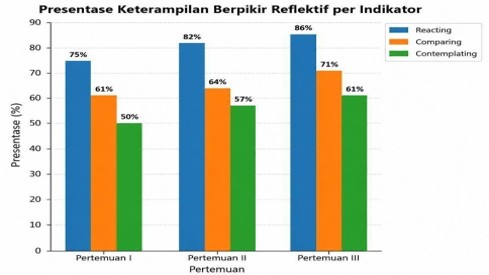
This study was motivated by the still-low level of students' reflective thinking skills in science learning, particularly in understanding their learning experiences, connecting prior knowledge with new information, and reflecting on the learning process. Problem-based learning (PBL) was chosen because it provides students with opportunities to actively engage in problem-solving, discussion, and reflection on their learning. This study aims to analyze the reflective thinking skills of eighth-grade students at Sriwedari Junior High School in Malang through the application of the problem-based learning model to the topic of cell introduction. The study employed a qualitative approach using the case study method. The research subjects consisted of seven eighth-grade students at Sriwedari Junior High School in Malang. Data were collected through observation, student reflection sheets, and documentation. Data analysis was conducted using the miles and huberman model, which includes data reduction, data presentation, and drawing conclusions. The results of the study indicate that students' reflective thinking skills developed gradually during the implementation of PBL. The “reacting” indicator emerged most prominently because students were able to respond to learning experiences and connect them to their prior knowledge. The “comparing” indicator was developed through discussion and inquiry activities that allowed students to compare new information with their previous learning experiences. Meanwhile, the “contemplating” indicator began to emerge through presentation and reflection activities, although it still showed lower achievement compared to the other indicators. The implementation of PBL provided students with opportunities to develop reflective thinking skills through problem-solving activities, group discussions, presentations, and learning reflections.
References
Anggraini, D. P., & Trimulyono, G. (2025). (PBL) ForTraining Students' Critical Thinking Skills On Virus MaterialClass X High School. BIO-EDU, 14(2), 316–325. https://ejournal.unesa.ac.id/index.php/bioedu/article/view/65711
Anwar, I., Rohmani, L. A., & Putra, A. A. I. A. (2023). Improving Junior High School Students' Critical Thinking in Science Learning Through the Problem Based Learning Model. 3(01), 145–151. https://doi.org/10.57008/jjp.v3i01.430
Dolmans, D.H.J.M., Loyens, S.M.M., Marcq, H. et al. Deep and surface learning in problem-based learning: a review of the literature. Adv in Health Sci Educ 21, 1087–1112 (2016). https://doi.org/10.1007/s10459-015-9645-6
Endaryati, S.A., Slamet, S.T. & Suryandari, K.C. (2023). Problem-Based Learning Flipbook E-Module in Improving Students’ Critical Thinking Skills in "Always Save Energy" Thematic Learning. International Journal of Elementary Education, 7(1), 115–123. https://doi.org/10.23887/ijee.v7i1.58306
Flowers, S., Holder, K. H., Rump, G. K., & Gardner, S. M. (2023). Missed connections: Exploring features of undergraduate biology students' knowledge networks relating gene regulation, cell-cell communication, and phenotypic expression. CBE life sciences education, 22(4), ar44. https://doi.org/10.1187/cbe.22-03-0041
Fuady, A. (2017). Reflective Thinking in Mathematics Learning.JIPMat, 1(2). https://doi.org/10.26877/jipmat.v1i2.1236
Hanria, R., & Fauzan, A. (2023). Development of Problem-Based Learning E-modules to Improve Reflective Thinking Skills of Grade VII Students. Basicedu Journal, 7(1), 863–871. https://doi.org/10.31004/basicedu.v7i1.4764
Hayati, R., Alberida, H., Arsih, F., & Fajrina, S. (2023). Analysis of Students' Reflective Thinking Skills in Biology Learning Through the Application of a Problem-Solving Model Based on Socioscientific Issues. Scientific Journal of Educational Profession, 8(3), 1357–1364. https://doi.org/10.29303/jipp.v8i3.1479
Indriyana, E., Uchtiawati, S., & Fauziyah, N. (2025). Students' Mathematical Reflective Thinking Ability Reviewed from Learning Style in Problem Based Learning (PBL) Model.Journal of Mathematics Education Innovation, 6, 198–209. https://doi.org/10.30587/postulat.v6i2.11123
Mirzaei, F., Phang, F.A., & Kashefi, H. (2014). Assessing and Improving Reflective Thinking of Experienced and Inexperienced Teachers. Procedia: Sosial and Behavioral Sciences. 141, 633-639. https://doi.org/10.1016/j.sbspro.2014.05.111
Munawaroh, N. A., & Budijastuti, W. (2024). Training Critical Thinking Skills of Grade XI Students of SMA Development of Problem Based Learning LKPD Respiratory System Material to Practice Critical Thinking Skills of Grade in Senior High School. BioEdu: Berkala Ilmiah Pendidikan Biologi, 13(3), 594–605. https://www.google.com/goto?url=CAESggEB6zswFZ9pe3Rw2b7_2jO9o5JJlm6bbCP-BNBIBT1t1nn6c7A1wc-_0wZo0wStnbSMGDCMbmF_5L_GHVQ58ZjtQT0dj4qvnAi015yj-6qJbkOHyOA4Y65zUAlnY59z_9NXwwPXdkqWorWoO1zCseNwVcni0sg_KfSoNKjm8_G3AncF
Nindiasari, H., & Syamsuri, S. (2023). Peningkatan Pengetahuan Penyusunan Modul Ajar Kurikulum Merdeka untuk Kemampuan Berfikir Kritis dan Reflektif Matematis Guru Matematika. Jurnal Pengabdian Pada Masyarakat, 9(1), 182-197. Retrieved from https://jurnal.unmabanten.ac.id/index.php/jppm/article/view/711
Ningrum, A. K. P., Novaliyosi, & Nindisari, H. (2024). Systematic Literature Review: Problem-Based Learning Model on Students' Mathematical Reflective Thinking Ability. Jurnal Educatio FKIP UNMA, 10(3), 873–880. https://doi.org/10.31949/educatio.v10i3.9325
Oktafiani, A., & Nindiasari, H. (2023). E-LKPD Based on Problem Based Learning for Reflective Thinking Abilities. Journal of Research in Mathematics and Mathematics Education, 6, 82–92. https://doi.org/10.30605/proximal.v6i2.2679
Sahadah, S. Z., & Yuliani. (2024). Development Of Interactive E-Lkpd on Environmental Change Based on Problem Based Learning to Train Students’ Critical Thinking Skills the Development Problem-Based Learning Based Environmental Change Interactive e-LKPD to Train Students’ Critical. BIO-EDU, 13(3), 582–593. https://doi.org/10.26740/bioedu.v13n3.p582-593
Sani, R. N., & Ambarwati, R. (2024). Development Of E-Lkpd Based on Problem Based Learning (Pbl) on the Sub-Topic of Biodiversity Preservation Efforts to Train Critical Thinking Skills of Grade X SMA Students Development of e-LKPD Based on Problem-Based Learning (PBL) on Biodiversity. BIO-EDU, 13(2), 323–338. https://doi.org/10.26740/bioedu.v13n2.p323-338
Downloads
Published
How to Cite
Issue
Section
License
Copyright (c) 2026 BIO-EDU: Jurnal Pendidikan Biologi

This work is licensed under a Creative Commons Attribution-ShareAlike 4.0 International License.
The Authors submitting a manuscript do so on the understanding that if accepted for publication, the copyright of the article shall be assigned to BIO-EDU: Jurnal Pendidikan Biologi and Departement of Biology Education, Universitas Timor as the publisher of the journal. Copyright encompasses rights to reproduce and deliver the article in all form and media, including reprints, photographs, microfilms, and any other similar reproductions, as well as translations.
BIO-EDU journal and Departement Biology Education, Universitas Timor, and the Editors make every effort to ensure that no wrong or misleading data, opinions, or statements be published in the journal. In any way, the contents of the articles and advertisements published in BIO-EDU are the sole and responsibility of their respective authors and advertisers.
Users of this website will be licensed to use materials from this website following the Creative Commons Attribution-ShareAlike 4.0 International License.