Effectiveness of Ethanolic Extract of Mangrove Root Bark (Avicennia marina (Forssk) Vierh) as a Biolarvicide against Dengue Hemorrhagic Fever Mosquito Larvae (Aedes aegypti L.)
DOI:
https://doi.org/10.32938/jbe.v11i2.11123Keywords:
Aedes aegypti L., Avicennia marina, Biolarvicide, DHF, Mangrove rootsAbstract
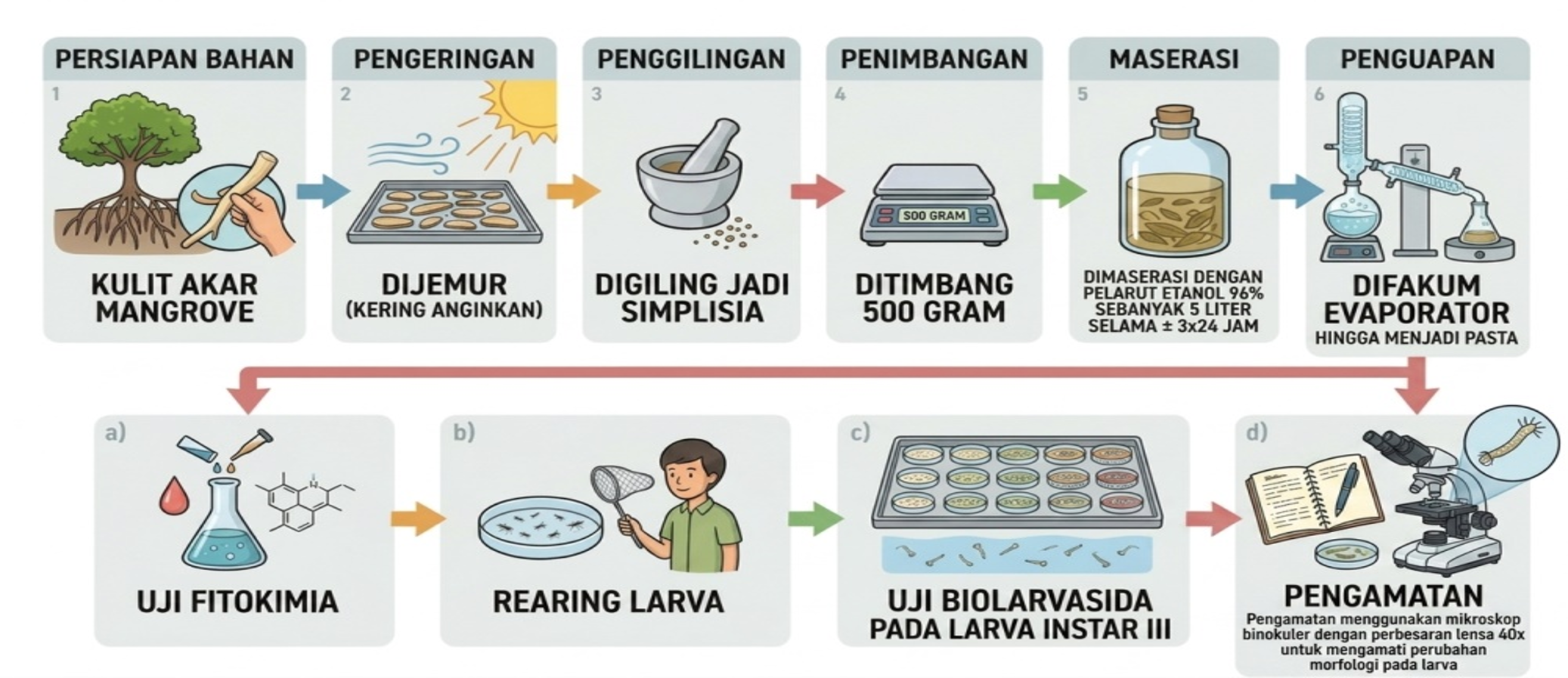
The Aedes aegypti L. Mosquito is the primary vector causing Dengue Hemorrhagic Fever (DHF), with cases surging during the rainy season due to stagnant water serving as breeding sites. Although synthetic larvicides are effective, they pose potential negative impacts on health and the environment, necessitating safer alternatives such as the biolarvicide from the ethanol extract of Avicennia marina root bark. This study aimed to identify the secondary metabolites in A. marina root bark, determine the effectiveness of its ethanol extract against Ae. aegypti larvae, and observe its effects on the morphological changes of Ae. aegypti. This experimental study utilized five treatments (10%, 12%, 14%, positive control, and negative control) with four replications, each containing 20 third-instar Ae. aegypti larvae treated with the ethanol extract of A. marina root bark. Observations were conducted at 6, 12, 24, 48, and 72 hours post-treatmen. Data were analyzed using probit analysis to calculate the Lethal Concentration₅₀ (LC₅₀) and Lethal Time₅₀ (LT₅₀) values. The results showed that the ethanol extract of A. marina root bark contains secondary metabolites, including alkaloids, flavonoids, phenolics, tannins, and terpenoids. The extract was effective at a 14% concentration, yielding an LC₅₀ value of 13.949% and an LT₅₀ value of 75.133 hours. Furthermore, the ethanol extract of A. marina root bark caused morphological damage to the larval head, thorax, abdomen, and siphon, as well as a decrease in larval motility.
References
Ahdiyah, I., & Purwani, K. I. (2015). Pengaruh Ekstrak Daun Mangkokan (Nothopanax scutellarium) sebagai Larvasida Nyamuk Culex sp. Jurnal sains dan Seni ITS, 4(2), 32-36. https://doi.org/10.12962/j23373520.v4i2.10804
Anggraini, D. R., Huda, S., & Agushybana, F. (2021). Faktor Perilaku dengan Kejadian Demam Berdarah Dengue (DBD) di Daerah Endemis Kota Semarang. Jurnal Ilmu Keperawatan Dan Kebidanan, 12(2), 344-349. https://doi.org/10.26751/jikk.v12i2.1080
Annasya, B. S., & Soleha, T. U. (2025). Kandungan Senyawa Aktif Metabolit Sekunder dalam Biolarvasida. Jurnal Medula (Medical Journal of Lampung University), 9(1), 12-18. https://doi.org/10.53089/medula.v15i1.1252
Aprilianti, S., Sernita, Aulya, M. S., & Idris, K. (2025). Distribusi dan Kemelimpahan Telur Nyamuk Aedes Sp. pada Ovitrap dan Kerentanan Larva Terhadap Abate di Kelurahan Wua-Wua Kota Kendari. Klinikal Sains: Jurnal Analis Kesehatan, 13(1), 91-100. https://doi.org/10.36341/klinikalsains.v13i1.5986
Bella, B. T. S., Marcellia, S., & Nofita, N. (2022). Uji Efektivitas Ekstrak Kulit Buah Mahoni (Swietenia mahagoni L.) Sebagai Larvasida Aedes aegypti dengan Metode Sokletasi. Journal of Pharmacy and Tropical Issues, 2(2), 54-61. https://doi.org/10.56922/pti.v2i02.282
Cania, E., & Setyaningrum, E. (2013). Uji Efektivitas Larvasida Ekstrak Daun Legundi (Vitex trifolia) Terhadap Larva Aedes aegypti. Medical Journal of Lampung University, 2(4), 52-60. https://www.academia.edu/102675878/Uji_Efektivitas_Larvasida_Ekstrak_Daun_Legundi_Vitex_Trifolia_Terhadap_Larva_Aedes_Aegypti
Dhenge, N. F., Pakan, P. D., & Lidia, K. (2021). Uji Efektivitas Larvasida Ekstrak Daun Pepaya (Carica papaya) Terhadap Mortalitas Larva Vektor Demam Berdarah Dengue Aedes aegypti. Cendana Medical Journal, 9(1), 156-163. https://doi.org/10.35508/cmj.v9i1.4950
Elsyana, V., & Chusniasih, D. (2020). Uji Potensi Ekstrak Limbah Kulit Bawang Merah Sebagai Biolarvasida Nyamuk Demam Berdarah (Aedes aegypti). Jurnal Analis Farmasi, 5(1), 25-29. https://doi.org/10.33024/jaf.v5i1.3975
Eriani, E., Effendi, I., & Yoswaty, D. (2019). Effectivity Of Extract Leaf, Fruit, Root Mangrove Avecennia marina On Aedes aegypti. Asian Journal of Aquatic Sciences, 2(3), 206-213. https://pdfs.semanticscholar.org/b2d6/59924d825d3d883f133a5b895bf6f3041337.pdf
Fadilla, Z., Hadi, U. K., & Setiyaningsih, S. (2015). Bioekologi Vektor Demam Berdarah Dengue (DBD) Serta Deteksi Virus Dengue Pada Aedes aegypti (Linnaeus) dan Ae. albopictus (Skuse) (Diptera: Culicidae) di Kelurahan Endemik DBD Bantarjati, Kota Bogor. Jurnal Entomologi Indonesia, 12(1), 31-31. https://doi.org/10.5994/jei.12.1.31
Hamiddani, R., Dilla, A.R., Karmila, G., & Mukhlis, A.Z.R. (2026). Efek Larvasida Daun Lengkuas (Alpinia galanga) Terhadap Larva Nyamuk Aedes aegypti. Sains Medisina, 4(4), 459-465. https://doi.org/10.63004/snsmed.v4i4.1034
Hasibuan, N. E., Azka, A., Basri, B., & Mujiyanti, A. (2022). Skrining Fitokimia Ekstrak Etanol Daun Avicennia marina dari Kawasan Bandar Bakau Dumai. Aurelia Journal, 4(2), 137-142. https://doi.org/10.15578/aj.v4i2.11626
Kartikasari, D., Rahman, I. R., & Ridha, A. (2022). Uji Fitokimia Pada Daun Kesum (Polygonum minus Huds.) dari Kalimantan Barat. Jurnal Insan Farmasi Indonesia, 5(1), 35-42. https://doi.org/10.36387/jifi.v5i1.912
Ketierteu, D. C., “Uji Efektivitas Larvasida Ekstrak Kulit Batang Bakau Minyak (Rhizophora apiculata) Terhadap Larva Aedes aegypti,” Skripsi. Fakultas Kedokteran Universitas Lampung, Lampung, 2022.
Maulana, F., Asnani, A., & Haslianti, H. (2021). Uji Fitokimia Dan Aktivitas Antioksidan Dari Rumput Laut Sargassum sp. Dengan Metode Pengeringan Yang Berbeda. Jurnal Fish Protech, 4(1), 86. http://dx.doi.org/10.33772/jfp.v4i1.18147
Mentari, S. A. F. B., (2023). Faktor Risiko Demam Berdarah di Indonesia. Jurnal Manajemen Kesehatan Yayasan RS. Dr. Soetomo, 9(1), 22-36. https://doi.org/10.29241/jmk.v9i1.1255
Mudjianto, G. P. (2024). Perbedaan Mortalitas Dan Perubahan Morfologi Larva Aedes Aegypti Akibat Pemberian Ekstrak Daun Johar. Skripsi/Repository. Universitas Airlangga.
Muliana, H., & Azzahra, N. (2025). Efektivitas Fraksi Flavonoid Kulit Nanas Sebagai Larvasida Nyamuk Aedes aegypti. Jurnal Lentera Ilmiah Kesehatan, 4(1). https://doi.org/10.52120/jlik.v3i1.9
Putri, S. A. I., Santika, N. W. N., & Nuraini, I. (2021). Efektifitas Biolarvasida Ekstrak Kulit Batang Avicennia marina Terhadap Jentik Vektor Demam Berdarah (Aedes aegypti). Jurnal Ilmu Kedokteran dan Kesehatan, 8(1). https://doi.org/10.33024/jikk.v8i1.3957
Rahmania, N., Herpandi, H., & Rozirwan, R. (2018). Phytochemical test of mangrove Avicennia alba, Rhizopora apiculata and Sonneratia alba from Musi River Estuary, South Sumatera. BIOVALENTIA: Biological Research Journal, 4(2). https://doi.org/10.24233/BIOV.4.2.2018.116
Riwanti, P., & Izazih, I. (2019). Skrining Fitokimia Ekstrak Etanol 96% Sargassum polycystum dan Profile dengan Spektrofotometri Infrared. Acta Holistica Pharmaciana, 1(2), 34-41. https://doi.org/10.62857/ahp.v1i2.17
Saputri, G. A. R., Marcellia, S., & Eldianta, D. O. (2021). Uji Larvasida Ekstrak Etanol Batang Pepaya (Carica papaya L.) Terhadap Larva Aedes aegypti. Jurnal Ilmu Kedokteran dan Kesehatan, 8(4). https://doi.org/10.33024/jikk.v8i4.5264
Sari, S. R., & Fahru, A. R. S. (2025). Identifikasi fraksi bioaktif bawang merah Palu (Allium × wakegi Araki.) sebagai antibakteri terhadap Salmonella typhi dan MRSA melalui KLT-bioautografi. Jurnal Biologi Babasal, 4(1), 1–15. https://doi.org/10.32529/jbb.v4i01.3967
Susanti, S., Primadiamanti, A., & Ulfa, A. M. (2022). Evaluasi Fisik Sediaan Salep Ekstrak Akar Putri Malu (Mimosa Pudica L.) Dengan Variasi Konsentrasi. Jfm (Jurnal Farmasi Malahayati), 5(2), 188-202. https://doi.org/10.33024/jfm.v5i2.6967
Usman, Megawati, Malik, M., Ekwand, R. R. M., & Hariyanti, T. (2020). Toksisitas Ekstrak Etanol Mangrove Sonneratia alba Terhadap Larva Nyamuk Aedes aegypti. Jurnal Sains dan Kesehatan, 2(3), 222-227. https://jsk.ff.unmul.ac.id/index.php/JSK/article/view/150
WHO. (2005). Guidelines for Laboratory and Field Testing of Mosquito Larvicides. In World Health Organization. https://www.who.int/publications/i/item/WHO-CDS-WHOPES-GCDPP-2005.13
Downloads
Published
How to Cite
Issue
Section
License
Copyright (c) 2026 BIO-EDU: Jurnal Pendidikan Biologi

This work is licensed under a Creative Commons Attribution-ShareAlike 4.0 International License.
The Authors submitting a manuscript do so on the understanding that if accepted for publication, the copyright of the article shall be assigned to BIO-EDU: Jurnal Pendidikan Biologi and Departement of Biology Education, Universitas Timor as the publisher of the journal. Copyright encompasses rights to reproduce and deliver the article in all form and media, including reprints, photographs, microfilms, and any other similar reproductions, as well as translations.
BIO-EDU journal and Departement Biology Education, Universitas Timor, and the Editors make every effort to ensure that no wrong or misleading data, opinions, or statements be published in the journal. In any way, the contents of the articles and advertisements published in BIO-EDU are the sole and responsibility of their respective authors and advertisers.
Users of this website will be licensed to use materials from this website following the Creative Commons Attribution-ShareAlike 4.0 International License.