
Detection of Parasitic Contamination in Nile Tilapia (Oreochromis niloticus) and Fresh Spinach (Amaranthus hybridus) from Pramuka Market, Samarinda
DOI:
https://doi.org/10.32938/jbe.v11i2.11156Keywords:
Biological food safety, Tircodina sp, Fasciola sp, Nile tilapia, Fresh spinach, Traditional marketAbstract
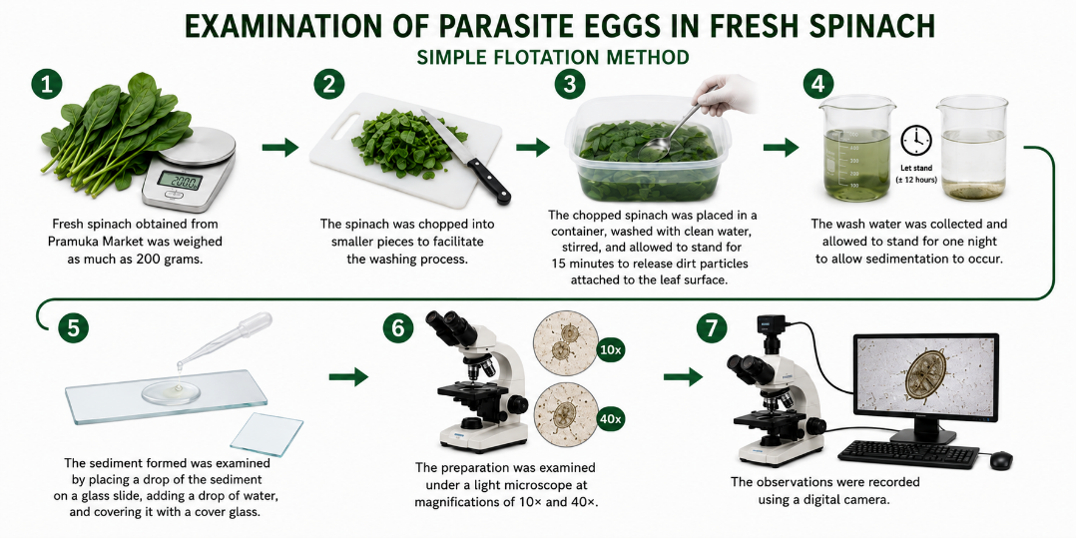
This preliminary study aimed to detect parasitic contamination in Nile tilapia (Oreochromis niloticus) and fresh spinach (Amaranthus hybridus) sold at Pramuka Market, Samarinda, as part of an effort to assess biological food safety at the local market level. A descriptive observational design was employed. Samples comprised three Nile tilapia and 200 grams of spinach obtained from Pramuka Market, Samarinda. Ectoparasite examination in fish was conducted using the mucus-scraping method on the body surface and gills, while parasite egg examination in spinach was performed using the simple flotation method. Parasite identification was based on morphological characteristics observed under a light microscope. Results of the three Nile tilapia examined, one fish (33.3%) was found to harbor the ectoparasite Trichodina sp. on the gill mucus. In the 200‑gram spinach sample, a single egg presumed to be Fasciola sp. was detected, identified by its oval shape, yellowish‑brown color, and the presence of an operculum. This study detected indications of parasitic contamination in both fish and spinach samples from Pramuka Market, Samarinda, suggesting a potential biological risk in fresh food commodities sold at the market. However, due to the limited sample size and the absence of molecular confirmation, these results should be interpreted as indicative rather than conclusive and cannot be generalized. Further studies with larger sample sizes and molecular confirmation (e.g., polymerase chain reaction) are recommended to support more comprehensive food safety surveillance.
References
Arsyad, N. S., Atma, C. D., Dharmawibawa, I. D., & Rahmawati, S. E. (2025). Deteksi Ektoparasit pada Ikan Nila (Oreochromis niloticus) di Balai Benih Ikan (BBI) Desa Aik Bukak Kecamatan Batukliang Utara Kabupaten Lombok Tengah. Biocaster : Jurnal Kajian Biologi, 5(3), 119–125. https://doi.org/10.36312/biocaster.v5i3.408
Atma, C. D., Libra, Y., Afifah, F. U., Purwanti, N. L. L., Janah, M., Munawaroh, M., & Dharmawibawa, I. D. (2025). Deteksi ektoparasit pada ikan nila (Oreochromis niloticus) di Desa Perian Kecamatan Montong Gading Kabupaten Lombok Timur. Mandalika Veterinary Journal, 5(1), 26-32. https://doi.org/10.33394/mvj.v5i1.15365
Azizah, H. N., Nugraha, A. B., Juniantito, V., & Cahyaningsih, U. (2022). Exploration of parasites Nile tilapia (Oreochromis niloticus) from the local fish seller in Dramaga, Bogor. Jurnal Kajian Veteriner, 10(2), 153-164. https://doi.org/10.35508/jkv.v10i2.7973
Gabriël, S., Dorny, P., Saelens, G., & Dermauw, V. (2023). Foodborne parasites and their complex life cycles challenging food safety in different food chains. Foods, 12(1), 1-27. https://doi.org/10.3390/foods12010142
Gawdat, S. S., & Elmosalamy, A. (2023). Parasitic contamination in five leafy vegetables collected from open marketplaces in Giza, Egypt. Egyptian Journal of Food Science, 10(1), 13-20. https://doi.org/10.18502/jfqhc.10.1.11984
Harlina, A., Herlina, S., & Darmono. (2023). Inventarisasi parasit pada ikan nila merah (Oreochromis niloticus) di kolam unit budidaya Politeknik Seruyan. Jurnal Belida Indonesia, 3(2), 1-5. https://doi.org/10.59900/pbelida.v3i2.152
Khoirunnisa, A., Rosa, E., & Susanto, G. N. (2022). Analisis ektoparasit pada ikan nila (Oreochromis niloticus) di kolam rakyat Rajabasa Bandar Lampung. Seminar Nasional Konservasi, 265-270.
Loginova, O., Efeykin, B., Krutikova, A., Mizin, I., & Spiridonov, S. (2024). Fasciola hepatica: Updates on egg morphology, host range, and distribution. Food and Waterborne Parasitology, 36(3), 1-10. https://doi.org/10.1016/j.fawpar.2024.e00237
Norizuki, M., Sasahara, T., Gomi, H., Morisawa, Y., Takamura, N., Kenzaka, T., Kobayashi, T., Fujiya, Y., Kato, Y., & Matsuoka, H. (2015). A case of fascioliasis treated successfully without sequelae in a Japanese expatriate living in Jakarta. Journal of Global Infectious Diseases, 7(2), 61-63. https://doi.org/10.4103/0974-777X.157171
Risal, M. J. S., & Mursalim, M. F. (2025). Detection of Trichodina sp. in Nile tilapia (Oreochromis niloticus) cultivated in Tanjung Bunga Lake, Makassar City. Journal of Vocational Innovation, Achievement and Education, 1(1), 1-7. https://journal.unhas.ac.id/index.php/voice/en/article/view/44118/13176
Sanggita, B. D., Atma, C. D., Atma, C. D., Atma, C. D., Janah, M., Atma, C. D., … Janah, M. (2023). Deteksi Ektoparasit Pada Ikan Nila (Orechromis niloticus) Di balai Budidaya Ikan Air Tawar Desa Lingsar Kabupaten Lombok Barat. Mandalika Veterinary Journal, 3(2), 29–33. https://doi.org/10.33394/mvj.v3i2.9311
Sari, A. P., Koesdarto, S., Lestari, T. D., Hastutiek, P., Yunus, M., Bimo, E., Herupradoto, A., Khairullah, A. R., Ayuti, S. R., Hasib, A., Aryaloka, S., & Moses, I. B. (2024). Prevalence of ectoparasites in tilapia (Oreochromis niloticus) in Sidoarjo, Indonesia. Veterinary Parasitology Regional Studies and Reports, 7(2), 370-381. https://doi.org/10.20473/jmv.vol7.iss2.2024.370
Smith, S. A., & Schwarz, M. H. (2024). Dealing with Trichodina and Trichodina-like species (Publication No. 600-205 CNRE-38P). Virginia Cooperative Extension.
World Health Organization. (2023). Breaking new ground: Piloting risk-based food inspection in five districts for better food safety. https://www.who.int/indonesia/news-room/item/02-11-2023-breaking-new-ground--piloting-risk-based-food-inspection-in-five-districts-for-better-food-safety
World Health Organization. (2024). Managing food safety in traditional food markets: WHO pilots Five Keys strategy to raise hygiene and sanitation standards. Link
World Health Organization. (2025). Fasciola: Background document for the WHO guidelines for drinking-water quality and the WHO guidelines on sanitation and health. https://www.who.int/publications/i/item/B09245
Zeynudin, A., Degefa, T., Belay, T., Mumicha, J. B., Husen, A., Yasin, J., Abamecha, A., & Wieser, A. (2024). Parasitic contamination of fresh vegetables and fruits sold in open-air markets in peri-urban areas of Jimma City, Oromia, Ethiopia: A community-based cross-sectional study. PLOS ONE, 19(3), 1-12. https://doi.org/10.1371/journal.pone.0290655
Downloads
Published
How to Cite
Issue
Section
License
Copyright (c) 2026 BIO-EDU: Jurnal Pendidikan Biologi

This work is licensed under a Creative Commons Attribution-ShareAlike 4.0 International License.
The Authors submitting a manuscript do so on the understanding that if accepted for publication, the copyright of the article shall be assigned to BIO-EDU: Jurnal Pendidikan Biologi and Departement of Biology Education, Universitas Timor as the publisher of the journal. Copyright encompasses rights to reproduce and deliver the article in all form and media, including reprints, photographs, microfilms, and any other similar reproductions, as well as translations.
BIO-EDU journal and Departement Biology Education, Universitas Timor, and the Editors make every effort to ensure that no wrong or misleading data, opinions, or statements be published in the journal. In any way, the contents of the articles and advertisements published in BIO-EDU are the sole and responsibility of their respective authors and advertisers.
Users of this website will be licensed to use materials from this website following the Creative Commons Attribution-ShareAlike 4.0 International License.