
Oil Content and Relationships of Kepuh (Sterculia foetida L.) Seeds in Bali and Rote Ndao, East Nusa Tenggara
DOI:
https://doi.org/10.32938/jbe.v11i2.11189Keywords:
Sterculia foetida L, Morphological characteristics, Oil content, Phylogenetic relationships, Bali, Rote (East Nusa Tenggara)Abstract
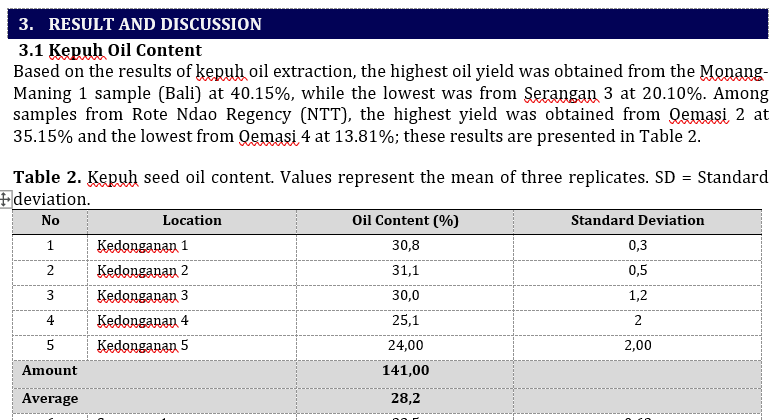
Kepuh is a plant belonging to the Malvaceae family, widely distributed in tropical regions, including Indonesia. It is a perennial tree that grows in lowlands, particularly in arid areas. The tree is known by various local names, such as halumpang (Batak); kepuh and kepoh (Bali); and kepo and kelompan (East Nusa Tenggara). Kepuh trees are commonly found in sacred sites, such as cemeteries. Sterculia foetida L. (Kepuh) is a tropical plant with potential as a source of alternative vegetable oil. This study aimed to determine the oil content of Kepuh seeds and analyze the phylogenetic relationships among Kepuh populations from Badung Regency, Denpasar City, and Rote Regency (East Nusa Tenggara). The research was conducted from June 2025 to January 2026, employing field observations, measurements of morphological characteristics (stem, leaf, and seed), and oil content analysis via Soxhlet extraction. Morphological and oil content data were analyzed using cluster analysis with PAST software to generate a dendrogram of phylogenetic relationships. The results revealed variations in morphological characteristics and oil content across locations. Among the Bali samples, the highest oil content was found in Monang-Maning 1 (40.15%), while the lowest was in Serangan 3 (20.10%). For the Rote samples, the highest oil content was observed in Oemasi 2 (35.15%) and the lowest in Oemasi 4 (13.81%). Cluster analysis showed that the 50 Kepuh samples formed two main groups with a similarity index of 93.5%, indicating a high degree of morphological similarity among populations despite their different geographical origins. The findings demonstrate that variations in oil content are influenced by differences in morphological characteristics and environmental conditions, and they identify Kepuh populations with the potential for development as alternative vegetable oil sources.
References
Arpiwi, N. L., Yan, G., Barbour, E. L., Plummer, J. A. (2013). Genetic Diversity, Seed Traits and Salinity Tolerance of Millettia pinnata (L.) Panigrahi, a Biodisel Tree. Genetic Resource & Crop Evolution. 60: 677 – 692. DOI: https://doi.org/10.1007/s10722-012-9866-y
Dini, N. A. R., Azizah, E., Samaullah, MY., Susanto, U. (2023). Kinship Relationships Among Several Selected Superior Rice (Oryza sativa L.) Varieties Based on Morphological Markers. Jurnal Agroplasma, Vol. 10 No. 1: 25-34. DOI: https://doi.org/10.36987/agroplasma.v10i1.3672
Gao, G., Zhang, L., Tong, P., Yan, G and Wu, X. (2025). Enhancing Oil Content in Oilseed Crops: Genetic Insights, Molecular Mechanisms, and Breeding Approaches. International Journal of Molecular Sciences. 26(15), 1-16; https://doi.org/10.3390/ijms26157390
Liu, H., Zhao, C., Chen, F., et al. (2025). Enhancing oil content in oilseed crops: Genetic insights, molecular mechanisms, and breeding approaches. International Journal of Molecular Sciences, 26(15), 7390; https://doi.org/10.3390/ijms26157390
Metananda, A. A., Zuhud, E. A. M., & Hikmat, A. (2015). Population, Distribution, and Association of Kepuh (Sterculia foetida L.) in Sumbawa Regency, West Nusa Tenggara. Conservation Media. 20(3). https://doi.org/10.29244/medkon.20.3.%25p
Nuva, N., Fauzi, A., Dharmawan, A. H., & Putri, E. I. K. (2019). The Political Economy of Renewable Energy and Regional Development: Issues in Biodiesel Development in Indonesia. Sodality: Journal of Rural Sociology, 7(2). 110-118 DOI: https://doi.org/10.22500/sodality.v7i2.19727.
Prasetiyo, D. H. T., Ilminnafik, N., Muhammad. A. (2022). The Effect of the Transesterification Process Using KOH Catalyst on the Characteristics of Biodiesel from Sterculia Foetida Seeds as an Alternative Fuel. Journal of Agricultural Engineering.10(3): 253-267. DOI: https://doi.org/10.19028/jtep.010.3.253-267
Rasyad. A dan Idwar. (2010). Genotype x Environment Interaction and Yield Component Stability of Various Soybean Genotypes in Riau Province. J. Agron. Indonesia, 38(1) : 25 – 29. DOI: https://doi.org/10.24831/jai.v38i1.1673
Sivakumar, P., Parthiban, K. S., Sivakumar, P., Vinoba, M., Renganathan, S. (2012). Optimization of Extraction Process and Kinetics of Sterculia foetida Seed Oil and Its Process Augmentation for Biodiesel Production. Ind. Eng. Chem. Res. 51 (26): 8992–8998. https://doi.org/10.1021/ie300882t
Sousa, V. F. O., Santos, G., Maia, J. M., Meneses, C. H. S. G., et al. (2019). Edaphoclimatic Conditions of the Brazilian Semi-Arid Region Affect the Productivity and Composition of Sunflower Oil. Journal of Agricultural Studies, 7(4), 309–323. DOI: https://doi.org/10.5296/jas.v7i4.15580
Sudradjat, R., Yogie, S., Hendra, D dan Setiawan, D. (2010). Production of Kepuh Seed Biodiesel via the Transesterification Process. Journal of Forest Products Research. Forest Products Research and Development Center. Bogor. DOI: https://doi.org/10.20886/jphh.2010.28.2.145-155
Sudrajat, D. J., Nurhasybi., Syamsuwida, D. (2011). Technology to Improve Seed Germination of Kepuh (Sterculia foetida L.). Journal of Forest Plantation Research. 8(5):301-314. DOI: https://doi.org/10.20886/jpht.2011.8.5.301-314
Sudrajat. D. J., Suwandhi, I., Siregar, I. Z., Siregar, U. J. (2018). Variation in Seed Morpho Physiological and Biochemical Traits of Java Olive Populations Originated From Java, Bali, Lombok, And Timor Islands, Indonesia. Biodiversitas. 1004-1012. DOI: https://doi.org/10.13057/biodiv/d190332
Tjitrosoepomo, G. 2011. Morfologi Tumbuhan. Yogyakarta: Universitas Gadjah Mada. https://ugmpress.ugm.ac.id/en/product/pertanian/morfologi-tumbuhan
Zemour, K., Adda, A., Labdelli, A., Dellal, A., Cerny, M and Merah, O. (2021). Effects of Genotype and Climatic Conditions on the Oil Content and Its Fatty Acids Composition of Carthamus tinctorius L. Seeds. 11(10), 2048. 1-9. https://doi.org/10.3390/agronomy11102048
Downloads
Published
How to Cite
Issue
Section
License
Copyright (c) 2026 BIO-EDU: Jurnal Pendidikan Biologi

This work is licensed under a Creative Commons Attribution-ShareAlike 4.0 International License.
The Authors submitting a manuscript do so on the understanding that if accepted for publication, the copyright of the article shall be assigned to BIO-EDU: Jurnal Pendidikan Biologi and Departement of Biology Education, Universitas Timor as the publisher of the journal. Copyright encompasses rights to reproduce and deliver the article in all form and media, including reprints, photographs, microfilms, and any other similar reproductions, as well as translations.
BIO-EDU journal and Departement Biology Education, Universitas Timor, and the Editors make every effort to ensure that no wrong or misleading data, opinions, or statements be published in the journal. In any way, the contents of the articles and advertisements published in BIO-EDU are the sole and responsibility of their respective authors and advertisers.
Users of this website will be licensed to use materials from this website following the Creative Commons Attribution-ShareAlike 4.0 International License.