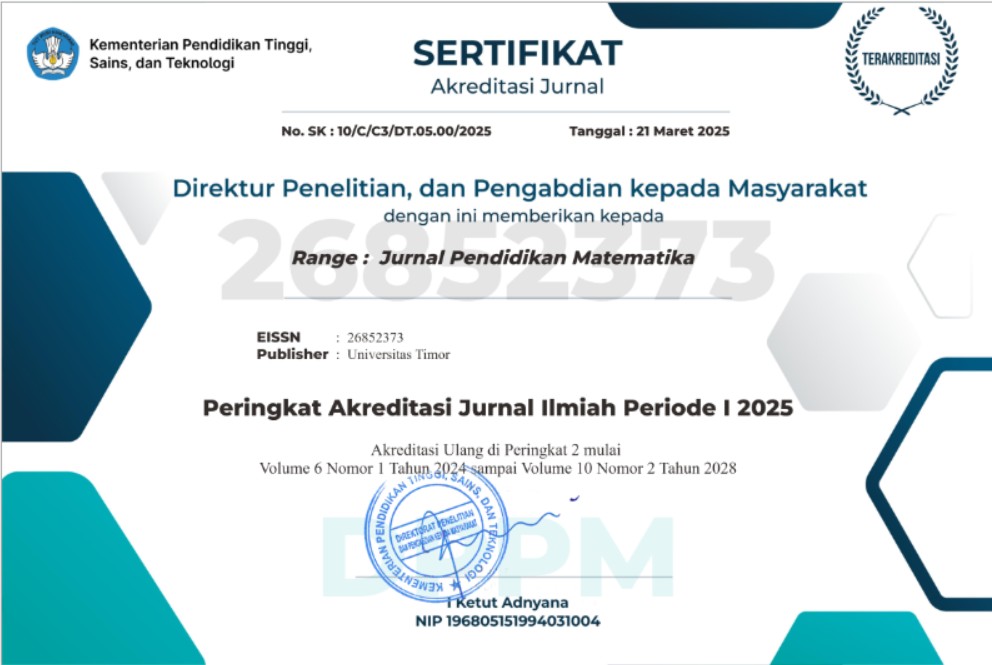
Certification of Accreditation
AI Policy
Policy on the Use of Artificial Intelligence (AI) and AI-Assisted Technologies
Range: Jurnal Pendidikan Matematika recognizes that artificial intelligence (AI), including generative AI and AI-assisted technologies, can support authors, reviewers, and editors in the scholarly publishing process. The use of AI is permitted when applied responsibly, transparently, and in accordance with the principles of academic integrity. This policy applies to all authors, reviewers, and editors involved in the publication process of Range: Jurnal Pendidikan Matematika.
AI tools and AI-assisted technologies cannot be listed as authors or co-authors of a manuscript. Authorship and all scholarly responsibilities remain with the human authors. Authors are fully responsible for the content of their manuscripts, including the accuracy, originality, integrity, and appropriate attribution of the work. Any content produced or modified with the assistance of AI should be carefully checked and verified by the authors before submission.
Authors may use AI-assisted tools to support the preparation of manuscripts, particularly for language-related purposes such as improving grammar, spelling, punctuation, clarity, readability, and overall language quality. When AI is used to generate or substantially develop the intellectual or substantive content of a manuscript, such as scientific arguments, interpretations, analyses, or other substantive material, its use should be disclosed by the authors. The disclosure should indicate the AI tool used and the purpose of its use. Routine functions such as basic spelling or grammar checking do not require disclosure.
When AI, machine learning, or related computational technologies constitute an integral part of the research methodology or analysis, their use must be clearly described in the manuscript. Authors should provide sufficient information about the tools, models, software, or procedures used to allow readers to understand and, where applicable, reproduce the research.
Authors remain responsible for the accuracy, originality, and ethical use of images, figures, tables, and other materials included in their manuscripts. AI-generated or AI-assisted visual materials should not be used to fabricate or improperly manipulate research data or results. Where AI is used to create substantive figures or illustrations, authors should disclose such use and ensure that the resulting material does not infringe copyright, intellectual property, or other applicable rights.
Reviewers must maintain the confidentiality of all submitted manuscripts and review materials. Manuscripts, unpublished data, reviewer comments, or other confidential materials should not be uploaded to external AI tools when such use could compromise confidentiality or intellectual property rights. Reviewers remain responsible for their own assessment and scientific judgment. AI tools should not be used as a substitute for the reviewer's independent evaluation of the manuscript.
Editors and editorial board members must protect the confidentiality of submitted manuscripts, reviewer reports, and communications with authors. Confidential materials should not be entered into AI platforms when adequate confidentiality cannot be ensured. Editorial decisions must remain based on the independent judgment and responsibility of the editor. AI tools may assist editorial work where appropriate but must not replace human oversight and decision-making.
Policy Updates
As AI technologies and standards for responsible scholarly publishing continue to evolve, Range: Jurnal Pendidikan Matematika will periodically review this policy and make updates when necessary to ensure the responsible and ethical use of AI in scholarly publishing.









This work is licensed under a Creative Commons Attribution 4.0 International License.