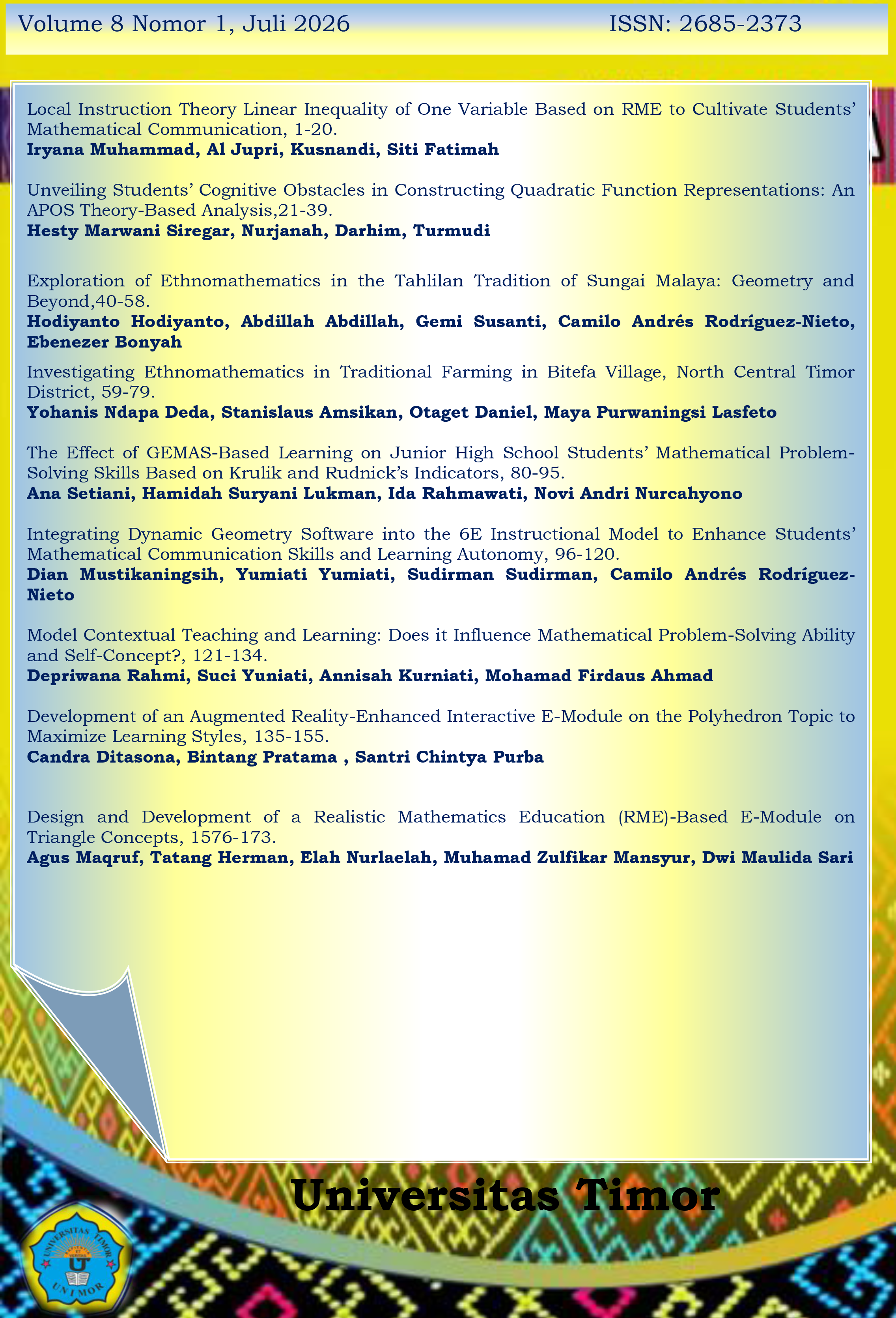
Development of an Augmented Reality-Enhanced Interactive E-Module on the Polyhedron Topic to Maximize Learning Styles
DOI:
https://doi.org/10.32938/jpm.v8i1.10135Keywords:
interactive e-module, flipbook, learning style, augmented reality, research and development, polyhedronAbstract
When studying polyhedron, learning sources that are predominantly verbalistic can lead to difficulties in understanding the concept. Learners have diverse learning preferences for absorbing and processing information, known as learning styles. Therefore, learning media is required to accommodate features oriented towards the learning needs of the students encompass text, audio, video, animations, images, and augmented reality. This research aims to develop a valid and suitable e-module on polyhedron for maximizes students’ learning styles. This research is included in the limited research type that only focus-es on the development and validation stages without involving testing. The model supporting this level of this research is proposed by Richey and Klein, wherein the research phase is limited to evaluation. Throughout the research and development phases, the e-module is validated by content and media ex-perts. During the evaluation stage, every element produced in the e-module for flat-sided of three-dimensional shapes is found to be valid and highly suitable for accommodating students learning style. The result allows the identification of how each feature in the e-module supports visual, auditory, and kinesthetic learning styles.
References
Alessi, S. M., & Trollip, S. R. (2001). Multimedia for Learning: Methods and Development. In A Pearson Education Company (3rd ed.).
Antonioli, M., Blake, C., & Sparks, K. (2016). Augmented Reality Applications in Education. The Journal of Technology Studies, 40(1), 96–107.
Ayu Made Manu Okta Priantini, D., & Luh Gede Karang Widiastuti, N. (2021). How Effective is Learning Style Material with E-modules During The COVID-19 Pandemic? Jurnal Ilmiah Sekolah Dasar, 5(2), 307–314.
Baya’a, N., Daher, W., & Anabousy, A. (2019). The Development of In-Service Mathematics Teachers’ Integration of ICT in a Community of Practice: Teaching-in-Context Theory. International Journal of Emerging Technologies in Learning, 14(1), 125–139. https://doi.org/10.3991/ijet.v14i01.9134
Broadbent, D. (2020). Not Another Survey! Use Interviews Instead to Understand Needs in Your Library. Library Leadership and Management, 35(1), 1–12. https://doi.org/10.5860/LLM.V35I1.7447
Cogan, L. S., Schmidt, W. H., & Guo, S. (2018). The influence of cooperative learning models on learning outcomes based on students’ learning styles. Journal of Curriculum Studies, 1–24. https://doi.org/10.1080/00220272.2018.1533998
Cohen, L., Lawrence, M., & Morrison, K. (2018). Research Methods in Education (8th ed.). Routledge.
DePorter, B., & Hernacki, M. (2007). Quantum learning: Membiasakan Belajar Nyaman dan Menyenangkan (S. Meutia (ed.); A. Abdurrahman (trans.)). PT Mizan Publika.
Dinayusadewi, N. P., & Agustika, G. N. S. (2020). Development Of Augmented Reality Application As A Mathematics Learning Media In Elementary School Geometry Materials. Journal of Education Technology, 4(2), 204. https://doi.org/10.23887/jet.v4i2.25372
Ditasona, C. (2017). Penerapan Pendekatan Differentiated Instruction dalam Peningkatan Kemampuan Penalaran Matematis Siswa SMA. Jurnal EduMatSains, 2(1), 43–54.
El-Sabagh, H. A. (2021). Adaptive e-learning environment based on learning styles and its impact on development students’ engagement. International Journal of Educational Technology in Higher Education, 18(1). https://doi.org/10.1186/s41239-021-00289-4
Elvadiningsih, S., & Jazwinarti. (2021). Pengembangan E-Modul Menggunakan Flip PDF Profesional Untuk Materi Bangun Ruang Sisi Datar Pada Kelas VIII di SMPN 2 Kec. Akabiluru. Jurnal Edukasi Dan Penelitian Matematika, 10(4), 222–227.
Fajarwati, A. (2022). Pengembangan E-Module Audiovisual Berbasis Aplikasi Android Untuk Siswa Smp Pada Mata Pelajaran Matematika. In Repository IAIN Bengkulu. Universitas Islam Negeri Fatmawati Sukarno Bengkulu.
Fanoni, F., & Suryowati, E. (2022). Junior High School Student’s Understanding Mathematics Concepts in Solving Problems of Flat-Sided Three Dimensional. Journal of Education and Learning Mathematics Research (JELMaR), 3(2), 109–118. https://doi.org/10.37303/jelmar.v3i2.81
Fatmianeri, Y., Hidayanto, E., & Susanto, H. (2021). Pengembangan Modul Elektronik Berbasis Differentiated Instruction untuk Pembelajaran Blended Learning. JIPM (Jurnal Ilmiah Pendidikan Matematika), 10(1), 50. https://doi.org/10.25273/jipm.v10i1.8709
Felder, R. M., & Brent, R. (2005). Understanding Student Differences. Journal of Engineering Education, 94(1), 57–72. https://doi.org/10.1002/j.2168-9830.2005.tb00829.x
Fleming, N., & Baume, D. (2006). Learning Styles Again: VARKing up the right tree! Educational Developments, 7, 4–7.
Hasibuan, E. K. (2018). Analisis Kesulitan Belajar Matematika Siswa Pada Pokok Bahasan Bangun Ruang Sisi Datar di SMP Negeri 12 Bandung. AXIOM : Jurnal Pendidikan Dan Matematika, 7(1), 18–30. https://doi.org/10.30821/axiom.v7i1.1766
Hidayatulloh, M., Wiryokusumo, I., & Walujo, D. A. (2019). Developing Electrical Circuits Flipbook Using Flipbuilder. International Journal for Innovation Education Dan Research, 7(2), 124–134. https://doi.org/https://doi.org/10.31686/ijier.Vol7.Iss2.1331 Page.124-134
İbili, E., Çat, M., Resnyansky, D., Şahin, S., & Billinghurst, M. (2020). An assessment of geometry teaching supported with augmented reality teaching materials to enhance students’ 3D geometry thinking skills. International Journal of Mathematical Education in Science and Technology, 51(2), 224–246. https://doi.org/10.1080/0020739X.2019.1583382
Indraningtias, D. A., & Wijaya, A. (2017). Pengembangan Perangkat Pembelajaran Berbasis Pendekatan Matematika Realistik Materi Bangun Ruang Sisi Datar Beorientasi pada Kemampuan Berpikir Kritis Siwa Kelas VIII SMP. Jurnal Pendidikan Matematika, 6(5), 24–36.
Kosasih, E. (2021). Pengembangan Bahan Ajar (B. S. Fatmawati (ed.)). Bumi Aksara.
Kurniawan, M. R. (2017). Analisis Karakter Media Pembelajaran Berdasarkan Gaya Belajar Peserta Didik. JINoP (Jurnal Inovasi Pembelajaran), 3(1), 491–506. https://doi.org/10.22219/jinop.v3i1.4319
Lawrence, J. E., & Tar, U. A. (2018). Factors that Influence Teachers’ Adoption and Integration of ICT in Teaching/Learning Process. Educational Media International, 55(1), 79–105. https://doi.org/10.1080/09523987.2018.1439712
Lumbantoruan, J. H., & Ditasona, C. (2024). Development of a Mathematics Module on Circle Material Based on the Small Group Discussion Model. Journal of Education and Learning (EduLearn), 18(1), 18–25. https://doi.org/10.11591/edulearn.v18i1.20920
Majeed, B. H., & ALRikabi, H. T. S. (2022). Effect of Augmented Reality Technology on Spatial Intelligence among High School Students. International Journal of Emerging Technologies in Learning, 17(24), 131–143. https://doi.org/10.3991/ijet.v17i24.35977
Mertayasa, I. N. E. (2019). E-Modul Interaktif Berorientasi VAK Content Mata Pelajaran Komunikasi Data. Jurnal Nasional Pendidikan Teknik Informatika, 8(3), 208–217. https://doi.org/https://doi.org/10.23887/janapati.v8i3.19320
Muhsyanur, Rahmatullah, A. S., Misnawati, Dumiyati, & Ghufron, S. (2021). The Effectiveness of “Facebook” As Indonesian Language Learning Media for Elementary School Student: Distance Learning Solutions in the Era of the COVID-19 Pandemic. Multicultural Education, 7(04), 38–47. https://doi.org/https://doi.org/10.1234/me.v7i04.8
Mulia, H. R. (2019). Pembelajaran Berbasis Multimedia: Dalam Memahami Keberagaman Gaya Belajar Anak. Jurnal Penjaminan Mutu, 5(2), 144–154. https://doi.org/10.25078/jpm.v5i2.857
Murtadho, M. H., Praherdhiono, H., & Wedi, A. (2022). Pengembangan Modul Adaptif Untuk Melayani Keanekaragaman Gaya Belajar Berbasis Universal Design For Learning. JKTP: Jurnal Kajian Teknologi Pendidikan, 5(3), 245–253. https://doi.org/10.17977/um038v5i32022p245
Murtikusuma, R. P., Fatahillah, A., Oktavianingtyas, E., Hussen, S., & Lailiya, N. (2019). The Development of Interactive Mathematics Learning Media Based on Schoology and Visual Basic Through Industrial Revolution 4.0. IOP Conference Series: Earth and Environmental Science, 243(1), 1–6. https://doi.org/10.1088/1755-1315/243/1/012137
Rahman, A., & Ahmar, A. S. (2016). The Influence of Cooperative Learning Models on Learning Outcomes Based on Students’ Learning Styles. World Transactions on Engineering and Technology Education, 14(3), 425–430.
Raja, R., & Nagasubramani, P. C. (2018). Impact of Modern Technology in Education. Journal of Applied and Advanced Research, 3, 33–35. https://doi.org/10.21839/jaar.2018.v3is1.165
Richey, R. C., & Klein, J. D. (2014). Design and Development Research. Handbook of Research on Educational Communications and Technology: Fourth Edition, 141–150. https://doi.org/10.1007/978-1-4614-3185-5
Riyanto, Amin, M., Suwono, H., & Lestari, U. (2020). The New Face of Digital Books in Genetic Learning: A Preliminary Development Study for Students’ Critical Thinking. International Journal of Emerging Technologies in Learning, 15(10), 175–190. https://doi.org/10.3991/ijet.v15i10.14321
Safaati, P. N., & Yunianta, T. N. H. (2022). Pengembangan EDUGSIA (E-Modul Bangun Ruang Sisi Datar) Berbasis Android Sebagai Suplemen Belajar Peserta Didik SMP Kelas VIII. Jurnal Cendekia: Jurnal Pendidikan Matematika, 06(02), 1315–1324. https://doi.org/https://doi.org/10.31004/cendekia.v6i2.1336
Safitri, I. (2017). Pengembangan E-Module Dengan Pendekatan Pembelajaran Matematika Realistik Berbantuan Flipbook Maker Pada Materi Bangun Ruang Sisi Datar Kelas VIII SMP. Aksioma, 6(2), 1–10. https://doi.org/10.26877/aks.v6i2.1397
Saha, J., Ahmmed, S., Ali, M., Tamal, M. A., & Rezaul, K. M. (2020). ICT Based Mathematics Skill Development Program: An Initiative to Overcome Mathematics Anxiety. In International Journal of Emerging Technologies in Learning (iJET) (Vol. 15, Issue 14, p. 252). International Association of Online Engineering (IAOE). https://doi.org/10.3991/ijet.v15i14.14149
Serin, H. (2018). Perspectives on the Teaching of Geometry: Teaching and Learning Methods. Journal of Education and Training, 5(1), 1. https://doi.org/10.5296/jet.v5i1.12115
Seruni, R., Munawaroh, S., Kurniadewi, F., & Nurjayadi, M. (2019). Pengembangan Modul Elektronik (E-Modul) Biokimia Pada Materi Metabolisme Lipid Menggunakan Flip PDF Professional. Jurnal Tadris Kimiya, 4(1), 48–56.
Simbolon, K., Ditasona, C., & Setiawan, L. F. (2025). Improving Mathematical Understanding on Geometry for 9th Grade Students through Three-Dimensional Mathematics Learning Media Based on Virtual Reality. Brillo Journal, 4(1 SE-), 59–75. https://doi.org/10.56773/bj.v4i1.71
Strauss, V. (2013). Howard Gardner: “Multiple intelligences” are not “learning styles.” The Washington Post, 1–3.
Sugiyono. (2017). Metode Penelitian & Pengembangan Research and Development Untuk Bidang : Pendidikan Manajemen Sosial Teknik (S. Y. Suryandari (ed.); 3rd ed.). ALFABETA.
Suyatna, A. (2020). ICT Learning Media Comparative Studies: Simulation, E-modules, Videos. Journal of Physics: Conference Series, 1572(1), 1–10. https://doi.org/10.1088/1742-6596/1572/1/012036
Tomlinson, C. A. (2017). How to Differentiate Instruction in Academically Diverse Classrooms. In Alexandria, Virginia: ASCD (3rd ed.).
Tossavainen, T., Suomalainen, H., & Mäkäläinen, T. (2017). Student Teachers’ Concept Definitions of Area and Their Understanding About Two-Dimensionality of Area. International Journal of Mathematical Education in Science and Technology, 48(4), 520–532. https://doi.org/10.1080/0020739X.2016.1254298
Wahidah, N. I., Sari, W. R., Festiana, I., & Nasir. (2020). Game Based Learning: Design a Multimedia with DDD-E Model for Mathematics Education. International Journal of Emerging Technologies in Learning, 15(21), 277–284. https://doi.org/10.3991/ijet.v15i21.16353
Wangid, M. N., Putra, C. A., & Rudyanto, H. E. (2021). The Science-Math Stories Based on Digital Learning: Digital Literacy Innovation in Increasing Ability to Solve Problems. International Journal of Emerging Technologies in Learning, 16(9), 94–107. https://doi.org/10.3991/ijet.v16i09.22039
Wardani, I., Tolle, H., & Aknuranda, I. (2019). Evaluation of an educational media on cube nets based on learning effectiveness and gamification parameters. International Journal of Emerging Technologies in Learning, 14(14), 4–18. https://doi.org/10.3991/ijet.v14i14.10505
Downloads
Published
Issue
Section
License
Copyright (c) 2026 RANGE: Jurnal Pendidikan Matematika

This work is licensed under a Creative Commons Attribution-NonCommercial-ShareAlike 4.0 International License.
RANGE: Jurnal Pendidikan Matematika