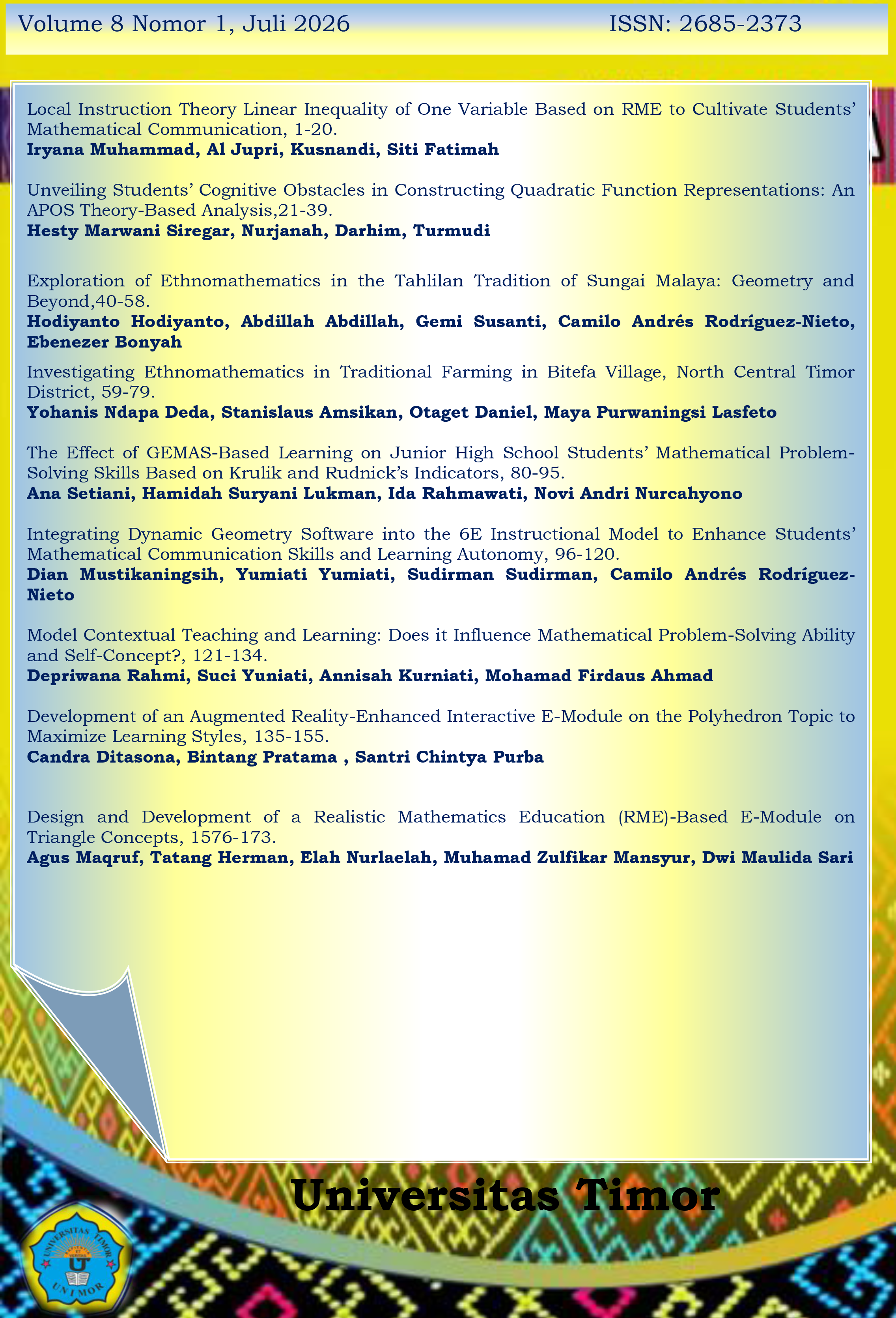
Model Contextual Teaching and Learning: Does it Influence Mathematical Problem-Solving Ability and Self-Concept?
DOI:
https://doi.org/10.32938/jpm.v8i1.10323Keywords:
CTL, KPMM, Self-concept, StatisticsAbstract
The Contextual Teaching and Learning (CTL) model is considered one of the approaches capable of integrating and simultaneously improving mathematical problem-solving abilities (KPMM). KPMM itself has a positive and significant relationship with self-concept. This research is an experiment with a factorial design. The purpose of experimental research is to determine whether or not there is an effect from the variables selected in the study. The study population includes all eighth-grade students at SMPN 40 Pekanbaru. The sample was selected using the cluster random sampling technique, resulting in class VIII A being chosen as the experimental class and class VIII B as the control class. Data collection was done thru tests, questionnaires, and observation. Data analysis was performed using a two-way ANOVA test. The research results indicate no difference in mathematical problem-solving ability (KPMM) between students who followed CTL model learning and direct instruction. However, there was a significant difference in KPMM between students with high, medium, and low self-concepts. Additionally, no interaction was found between the CTL learning model and self-concept on students' KPMM. One factor suspected of causing the lack of significant influence of the CTL model on KPMM is students' time management in solving KPMM problems, a lack of practice in solving problem-solving questions, and students' low accuracy in creating mathematical models.
References
Adhyan, A., R, Sutirno, Sopiany, H., N. (2022). Pengaruh Model Pembelajaran CTL terhadap Kemampuan Pemecahan Masalah matematis Siswa kelas VII SMP. Jurnal Pembelajaran Matematika Inovatif. 3(5). 559-566. https://doi.org/10.22460/jpmi.v5i6.1749-1760
Afiyanti, Y., Warniasih, K., & Utami, N. W. (2020). Problem Solving with Guided Inquiry Learning: An Analysis of Student’s Problem-Solving Ability. Journal of Physics: Conference Series, 1(1). https://doi.org/10.1088/17426596/1581/1/012035
Apriyani, Ramalis, T. R., & Suwarma, I. R. (2019). Analyzing Student’s Problem-Solving Abilities of Direct Current Electricity in STEM-based Learning. Journal of Science Learning, 2(3), 85-91. https://doi.org/10.17509/jsl.v2i3.1 7559
Ekowati, Ch. Krisnandari, Darwis, Muhammad, Upa, H. M. D. Pua; Tahmir, Suradi. (2015). The Application of Contextual Approach in Learning Mathematics to Improve Students Motivation at SMPN 1 Kupang. Jurnal International Education Studies. 8(8).12-13.
Fadillah, A., Dewi, N., P., Ridho, D. Nurkholis, M., Prastiwi, M., N. (2017). The Effect of Application of Contextual Teaching and Learning (CTL) Model Based on Lesson Study with Mind Mapping Media to Assess Student Learning Outcomes on Chemistry on Colloid Systems. International Journal of Science and Applied Science: Conference Series. 1(2). 101-108. https://doi.org/10.20961/ijsascs.v1i2.5128
Febrianti, V., Chotimah, S. (2020). Analisis Kesulitan pada Materi Statistika Kelas VIII Siswa SMP. Jurnal Pembelajaran Matematika Inovatif. 3(5). 559-566. https://doi.org/10.22460/jpmi.v3i5.559-566
Fitria, N., F., N., Nurul, H, Hendriana, H. Risma, A. (2018). Analisis Kemampuan Pemecahan Masalah Matematik Siswa SMP dengan Materi Segitiga dan Segiempat. Edumatica: Jurnal Pendidikan Matematika. 8(1). 49-57.
Haditia, N, C., Nurrahmah, A., & Nasution, S. (2022). Pengaruh Self-Concept terhadap Kemampuan Pemecahan Masalah Matematika Siswa Kelas VII di SMP Negeri 275 Jakarta. Prosiding Diskusi Panel Nasional Pendidikan Matematika. 1-6
Handayani, U. F. (2022). Kreativitas Siswa Kemampuan Tinggi dalam Memecahkan Masalah Matematika Kontekstual. Pi: Mathematics Educations Journal, 4(2), 91–101. https://doi.org/10.21067/pmej.v4i2.5757
Harahap, Nur Hajijah. (2019). Pengaruh Penerapan Pembelajaran Kontekstual terhadap Kemampuan Pemecahan Masalah Matematis Siswa Kelas XI MAN Barumun Tengah. MathEdu (Mathematic Education Journal. 2. 28–32
Lestari, I., Y. (2023). Kemampuan Pemecahan Masalah Matematika Melalui Model Pembelajaran Kontekstual ditinjau dari Kecerdasan Visual Spasial. Jurnal Ilmiah Matematika Realistik. 4(2). 297-304.
Mamartohiroh, S., Muhandaz, R., & Revita, R. (2020). Pengaruh Model Contextual Teaching and Learning Terhadap Kemampuan Pemecahan Masalah Matematis Berdasarkan Kemandirian Belajar Siswa SMP/MTs. Tarbawi: Jurnal Ilmu Pendidikan, 16(1), 46–58. https://doi.org/10.32939/tarbawi.v16i01.524
Mediyani, D., & Mahtuum, Z. A. (2020). Analisis Kesulitan Siswa dalam Menyelesaikan Soal Materi Statistika pada Siswa SMP Kelas VIII. Jurnal Pembelajaran Matematika Inovatif, 3(4), 385. https://doi.org/10.32528/gammath.v5i1.3189
Mulhamah & Putrawangsa, S. (2017). Penerapan Pembelajaran Kontekstual dalam Meningkatkan Kemampuan Pemecahan Masalah Matematika. Jurnal Pendidikan Matematika. 10(1). https://doi.org/10.22342/jpm.10.1.3279.58-80
Muslihah, N., N & Suryaningrat, E. F. (2021). Model Pembelajaran Contextual Teaching and Learning terhadap Kemampuan Pemecahan Masalah Matematis. Plusminus: Jurnal Pendidikan Matematika, 1(3). 553-564. https://journal.institutpendidikan.ac.id/index.php/plusminus
Musriandi, R. (2017). Hubungan antara Self-concept dengan Kemampuan Pemecahan Masalah Matematis Siska. Jurnal Dedikasi. 1(2). 150-160
Nartani, C. I, Hidayat, R. A. & Sumiyati, Y. (2015). Communication In Mathematics Contextual. International Journal of Innovation and Research in Educational Sciences. 2(4). 284-287
Nugroho, A.A., & Dwijayanti, I. (2019). Analisis Kemampuan Pemecahan Masalah Mahasiswa Calon Guru Matematika Pada Mata Kuliah Program Linier. AKSIOMA: Jurnal Matematika dan Pendidikan Matematika. 10 (2), 277-284
Nuraulia, N., Uswatun, D. A., Nurrochman, A. (2020). Analisis Kemampuan Pemecahan Masalah Matematika Siswa melalui Soal Kelas II SDN 1 Selabintana. JIKAP PGSD: Jurnal Ilmiah Ilmu Kependidikan. 4(3). 247-256.
Patmaniar, Amin, S. M., & Sulaiman, R. (2021). Student’s Growing Understanding In Solving Mathematics Problem Based on Gender Elaborating Folding Back. Journal on Mathematics Education, 12(3), 507–530. https://doi.org/10.22342/JME.12.3 .14267.507-530
Permatasari, C. P., Yerizon, Y., Arnawa, I. M., & Musdi, E. (2020). Improving Students’ Problem-Solving Ability through Learning Tools Based on Problem Based Learning. Journal of Physics: Conference Series, 1554(1). https://doi.org/10.1088/1742- 6596/1554/1/012017
Polya, G. (1973). How to Solve it. In Stochastic Optimization in Continuous Time. https://doi.org/10.1017/cbo9780511616747.007
Priyastutik, Syela, Huri Suhendri, and Soeparlan Kasyadi. (2019). Pengaruh Kemandirian dan Konsep Diri terhadap Pemecahan Masalah Matematika Siswa. JKPM (Jurnal Kajian Pendidikan Matematika). 4(1) https://doi.org/10.30998/jkpm.v4i1.2826
Purwasi, L. A., & Fitriyana, N. (2019). Pengembangan Lembar Kerja Siswa Berbasis Pendekatan Open-Ended untuk Melatih Kemampuan Pemecahan Masalah Matematis Siswa SMP. Kreano: Jurnal Matematika Kreatif-Inovatif, 10(1), 18-26.
Ramadhani, R. (2018). The Enhancement of Mathematical Problem-Solving Ability and Self-confidence of Students Through Problem Based Learning. Jurnal Riset Pendidikan Matematika, 5(1), 127–134. https://doi.org/10.21831/jrpm.v5i1.13269
Reski, R., Hutapea, N., & Saragih, S. (2019). Peranan Model Problem Based Learning (PBL) terhadap Kemampuan Pemecahan Masalah Matematis dan Kemandirian Belajar Siswa. JURING (Journal for Research in Mathematics Learning), 2(1), 049-057.
Rija, Legina Alma, and Kusnandi. (2021). Analisis Kemampuan Pemecahan Masalah Matematis Siswa ditinjau dari Self-Concept. Journal on Mathematics Education Research. 2(1). 21–34.
Risnawati. (2013). Keterampilan Belajar Matematika. Yogyakarta: Aswaja Pressindo,
Septiyani, N. O., & Alyani, F. (2021). Analisis Konsep Diri terhadap Kemampuan Pemahaman Matematis Siswa di SMA. Vygotsky: Jurnal Pendidikan Matematika dan Matematika, 3(2), 133-144.
Sugiyono. (2020). Metode Penelitian Pendidikan. Alfabeta.
Zuliyanti, P & Pujiastuti, H. (2020). Model Contextual Teaching Learning (CTL) untuk Meningkatkan Kemampuan Pemecahan Masalah Matematis Siswa SMP. Jurnal Prisma. 9(1). 98-107
Downloads
Published
Issue
Section
License
Copyright (c) 2026 RANGE: Jurnal Pendidikan Matematika

This work is licensed under a Creative Commons Attribution-NonCommercial-ShareAlike 4.0 International License.
RANGE: Jurnal Pendidikan Matematika