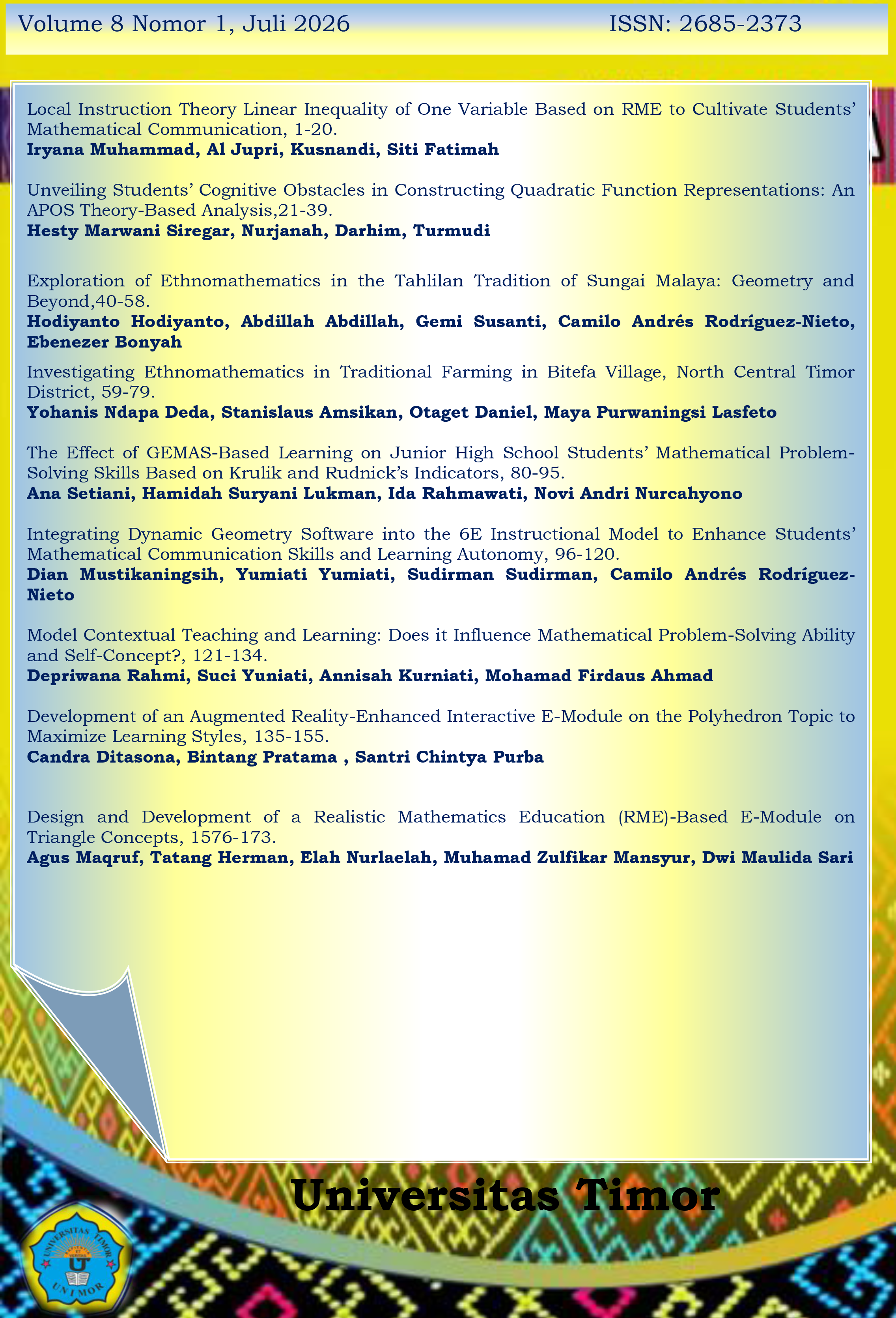
Local Instruction Theory Linear Inequality of One Variable Based on RME to Cultivate Students’ Mathematical Communication
DOI:
https://doi.org/10.32938/jpm.v8i1.10325Keywords:
Local Instruction Theory; Linear Inequality of One Variable;, Realistic Mathematics Education;, Mathematical Communication SkillsAbstract
Mathematical communication is a fundamental competency that allows students to interpret, represent, and convey mathematical ideas effectively. This study aims to examine the achievement of students' mathematical communication skills through the application of Local Instructional Theory (LIT) to one-variable linear inequality material within the framework of Realistic Mathematics Education (RME). The research uses a design research approach carried out through two teaching experiments, namely TE-1 with 31 students and TE-2 with 26 students at one of the junior high schools in Lhokseumawe. The results showed a significant increase from TE-1 to TE-2 in three indicators of mathematical communication ability, namely: (1) describing graphs into mathematical sentences (58% → 77%); (2) describe or explain mathematical ideas in writing (45% → 96%); and (3) expressing the situation into mathematical language or symbols and developing a solution strategy (39% → 77%). This increase is influenced by the revision of the learning design, which is carried out cyclically and reflectively, so that students better understand the context of the problem, can reflect on the thinking process, and convey solutions mathematically. These findings provide the implication that LIT-based learning design with an RME approach can be a practical reference for teachers and curriculum developers in designing learning activities that systematically and contextually encourage students' mathematical communication skills. This research also affirms the potential of design research in developing local instructional theories that bridge theoretical insights with classroom learning practices.
References
Akker, J. van den, Bannan, B., Kelly, A. E., Nieveen, N., & Plomp, T. (2007). An introduction to educational design research. An Introduction to Educational Design Research.
Bakker, A. (2018). Design Research in Education: A Practical Guide for Early Career Researchers. In Routledge (Issue 68). Taylor & Francis. https://doi.org/10.1049/ic:19990398
Baroody, A. J. (1998). Fostering Children ’ s Mathematical Power : An Investigative Approach to K-8 Mathelllatics Instruction. https://doi.org/10.4324/9781410602084
Çiloğlu, R., Korkmaz, H., & Mut, A. İ. (2025). Evaluation of 6th Grade Students ’ Mathematical Communication Levels within the Framework of Realistic Mathematics Education Approach. Bartın University Journal of Faculty of Education, 14(3). https://doi.org/10.14686/buefad.1687206
Corebima, M. A. Y., Garak, S. S., & Samo, D. D. (2020). Pengaruh Problem Based Learning Terhadap Kemampuan Pemecahan Matematis Siswa Kelas XI SMA. Jurnal Pendidikan Matematika, 2(1), 56–65.
Corebima, M., Garak, S., & Samo, D. (2020). Pengaruh Model Problem Based Learning Terhadap Kemampuan Komunikasi Matematis Siswa Pada Materi Program Linear. RANGE: Jurnal Pendidikan Matematika, 2, 56–65. https://doi.org/10.32938/jpm.v2i1.569
Dwi Indriani, W., & Pasaribu, L. H. (2022). Peningkatan Kemampuan Komunikasi Matematis Siswa Menggunakan Model Pembelajaran Hybrid Learning. 06(01), 291–299.
Faot, E. I. M., Leton, S. I., & Dosinaeng, W. B. N. (2020). Pengaruh Model Pembelajaran Peer Tutoring Untuk Meningkatkan Kemampuan Komunikasi Matematis Siswa. RANGE: Jurnal Pendidikan Matematika, 1(2), 157–163. https://doi.org/10.32938/jpm.v1i2.412
Gravemeijer, K., & Cobb, P. (2006). Design Research From a Learning Design Perspective. Educational Design Research, May, 17–51. https://doi.org/10.4324/9780203088364-12
Gravemeijer, K., & Eerde, H. A. A. (2009). Design Research as a Means for Building a Knowledge Base for Teachers and Teaching in Mathematics Education. Elementary School Journal, 109. https://doi.org/10.1086/596999
Hidayat, S. R., Ermawati, D., & Rondli, W. S. (2023). Analisis Kemampuan Komunikasi Matematis Siswa Sekolah Dasar. Edukatif : Jurnal Ilmu Pendidikan, 5(2), 1677–1684. https://doi.org/10.31004/edukatif.v5i2.5478
Kamid, Rusdi, M., Fitaloka, O., Basuki, F. R., & Anwar, K. (2020). Mathematical Communication Skills Based on Cognitive Styles and Gender. International Journal of Evaluation and Research in Education, 9(4), 847–856. https://doi.org/10.11591/ijere.v9i4.20497
Mahadewi, N. K. N., Ardana, I. M., & Mertasari, N. M. S. (2020). Kemampuan Komunikasi Matematis Melalui Model Reciprocal Teaching Berbantuan Media Interaktif. JNPM (Jurnal Nasional Pendidikan Matematika), 4(2), 338. https://doi.org/10.33603/jnpm.v4i2.3606
Maryati, I., Suzana, Y., Harefa, D., & Maulana, I. T. (2022). Analisis Kemampuan Komunikasi Matematis dalam Materi Aljabar Linier. PRISMA, 11(1), 210. https://doi.org/10.35194/jp.v11i1.2044
Muhammad, I., Herizal, H., Marhami, M., Rizkiana, S. T., & Lianti, V. (2023). Pengembangan Buku Matematika SMP Kelas VIII Berbasis Etnomatematika Terintegrasi Kemampuan Komunikasi Matematis. AKSIOMA: Jurnal Program Studi Pendidikan Matematika, 12(1), 882. https://doi.org/10.24127/ajpm.v12i1.6522
Muhammad, I., Juandi, D., & Jupri, A. (2025). Implementation of Ethnomathematics Realistic Mathematic Education (Ethno-RME) in Mathematics Learning: Systematic Literature Review (SLR). AIP Conference Proceedings, March 2025. https://doi.org/https://doi.org/10.1063/5.0262106
NCTM. (2000). Principles and Standards for School Mathematics. In School Science and Mathematics , 47(8).
Prahmana, R. C. I., Sagita, L., Hidayat, W., & Utami, N. W. (2020). Two Decades of Realistic Mathematics Education Research in Indonesia: A Survey.
Putri, N. S., Juandi, D., & Jupri, A. (2022). The implementation effect of realistic mathematics education and contextual teaching and learning approaches on the students ’ mathematical communication ability : A meta-analysis. Al-Jabar: Jurnal Pendidikan Matematika, 13(2), 383–400. https://doi.org/http://dx.doi.org/10.24042/ajpm.v13i2.13562
Rohid, N., Suryaman, & Rusmawati, R. D. (2019). Students’ Mathematical Communication Skills (MCS) in Solving Mathematics Problems : A Case in Indonesian Context. Anatolian Journal of Education, 4(2), 19–30. https://doi.org/https://doi.org/10.29333/aje.2019.423a
Sari, R., Maharani, I., & Harahap, Y. N. (2025). Pengaruh Model Pembelajaran Realistic Mathematic Education untuk Meningkatkan Kemampuan Komunikasi Matematis Siswa Berbantuan Wordwall. Pendas: Jurnal Ilmiah Pendidikan Dasar, 10(1), 223–234.
Setiawati, R., Netriwati, N., & Nasution, S. P. (2018). Desain Model Pembelajaran Gerlach Dan Ely Yang Berciri Nilai-Nilai Ke-Islaman Untuk Meningkatkan Kemampuan Komunikasi Matematis. AKSIOMA: Jurnal Program Studi Pendidikan Matematika, 7(3), 371–379. https://doi.org/10.24127/ajpm.v7i3.1593
Simon, M. A. (1995). Reconstructing Mathematics Pedagogy from a Constructivist Perspective. Journal for Research in Mathematics Education, 26(2), 114–145. https://doi.org/10.5951/jresematheduc.26.2.0114
Siswantari, Sabon, S. S., Listiawati, N., Wirda, Y., Zulkardi, & Riyanto, B. (2025). Bridging mathematics and communication: Implementing realistic mathematics education principles for skill development. Journal on Mathematics Education, 16(2), 729–752. https://doi.org/10.22342/jme.v16i2.pp729-752
Suhenda, L., & Munandar, D. (2023). Kemampuan Komunikasi Matematis Siswa dalam Pembelajaran Matematika. Jurnal Education FKIP UNMA, 9, 1100–1107. https://doi.org/10.31949/educatio.v9i2.5049
Downloads
Published
Issue
Section
License
Copyright (c) 2026 RANGE: Jurnal Pendidikan Matematika

This work is licensed under a Creative Commons Attribution-NonCommercial-ShareAlike 4.0 International License.
RANGE: Jurnal Pendidikan Matematika