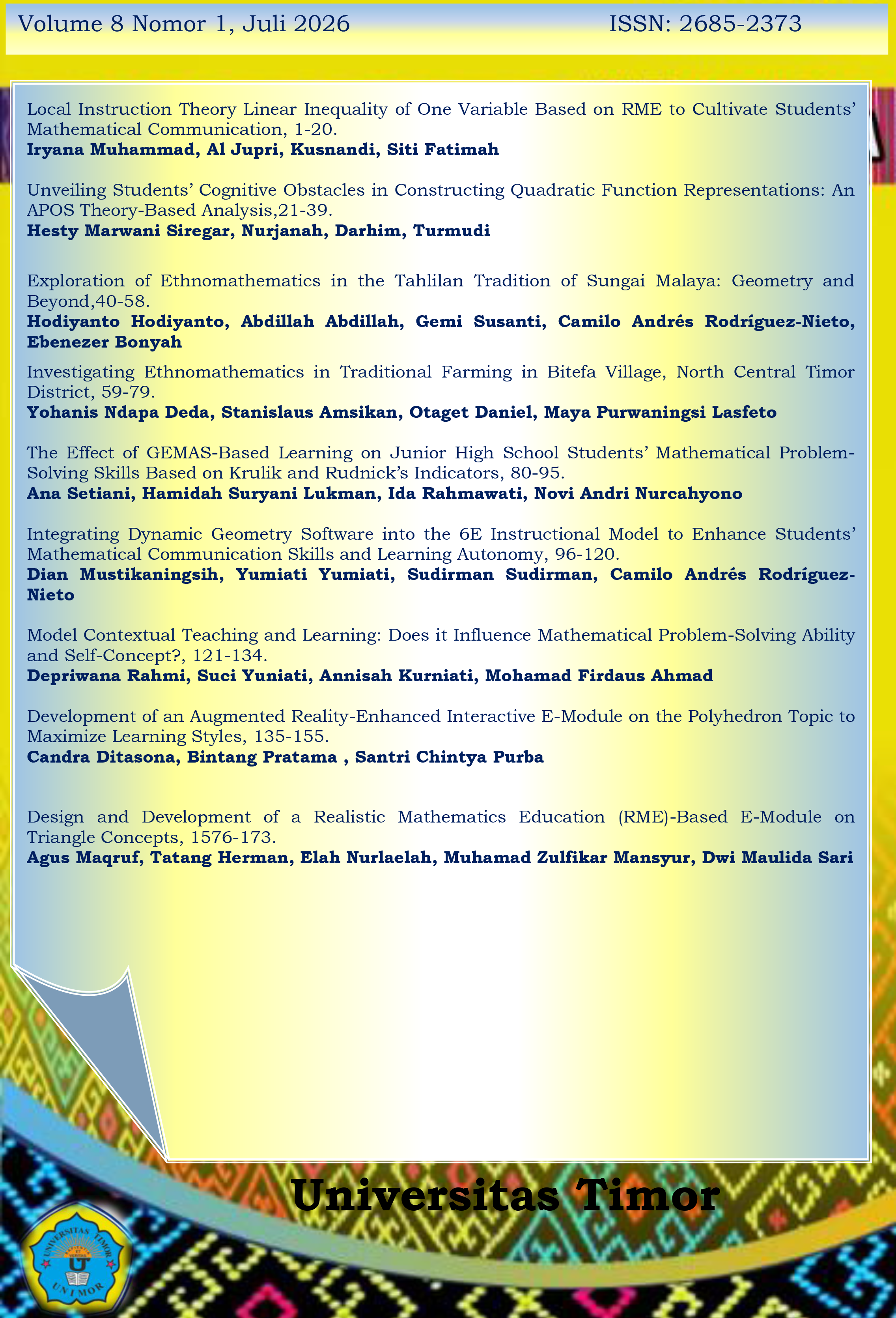
Unveiling Students’ Cognitive Obstacles in Constructing Quadratic Function Representations: An APOS Theory-Based Analysis
DOI:
https://doi.org/10.32938/jpm.v8i1.10390Keywords:
APOS, cognitive obstacle, mathematical representation, quadratic functionAbstract
Quadratic functions are a fundamental topic in the high school curriculum; however, many students struggle to construct and connect various forms of mathematical representation. These difficulties are not merely procedural but manifest as cognitive obstacles, namely, when prior knowledge that is usually sufficient becomes irrelevant in a new context. This study employs the APOS theory (Action, Process, Object, Schema) to systematically map students’ cognitive obstacles. The research used a descriptive qualitative approach involving 35 tenth-grade students at a public high school in Pekanbaru. This study employed two research instruments: a mathematical representation test, encompassing visual, symbolic, and verbal indicators, and semi-structured interviews. Data were analysed using Miles and Huberman’s model through reduction, display, and conclusion drawing. The findings indicate that students’ cognitive obstacles emerged in almost all stages of APOS, with a predominance at the early stages, resulting in most students not reaching the Object or Schema stages. Visual representations were generally stronger than symbolic and verbal ones, but remained procedural rather than conceptual. Students also struggled to recognise their misconceptions, resulting in repeated errors. These findings underscore the need for instructional strategies that facilitate transitions across APOS stages, reinforced by reflective practices and the integration of multiple representations. The study recommends the development of quadratic function instruction that emphasises meaningful connections among symbolic, visual, and verbal representations, as well as further research on the effectiveness of APOS-based strategies in other mathematical topics.
References
Akhsani, L., & Nurhayati, E. (2020). The Error In Drawing Graphic Of Quadratic Function In PBL Model By Using True Or False Strategy With GeoGebra-Assisted. AlphaMath : Journal of Mathematics Education, 6(2), 135–142. https://doi.org/10.30595/alphamath.v6i2.8059
Antonijević, R. (2016). Cognitive Activities in Solving Mathematical Tasks: The role of a Cognitive Obstacle. Eurasia Journal of Mathematics, Science & Technology Education, 12(9), 2503–2515. https://doi.org/10.12973/eurasia.2016.1306a
Asipi, L. S., Rosalina, U., & Nopiyadi, D. (2022). The Analysis of Reading Habits Using Miles and Huberman Interactive Model to Empower Students’ Literacy at IPB Cirebon. International Journal of Education and Humanities (IJEH), 2(3), 117–125. https://doi.org/https://doi.org/10.58557/ijeh.v2i3.98
Azizah, N. N., Susiswo, & Sisworo. (2021). Analytical Thinking Process of Students in Solving Mathematical Problems of Quadratic Functions. AKSIOMA: Jurnal Program Studi Pendidikan Matematika, 10(1), 328–338. https://doi.org/https://doi.org/10.24127/ajpm.v10i1.3440
Bauk, P., Mamoh, O., & Simarmata, J. E. (2022). Analisis Kesalahan Siswa Menggunakan Tahapan Kastolan Dalam Menyelesaikan Soal Cerita. RANGE: Jurnal Pendidikan Matematika, 4(1), 28–39. https://doi.org/10.32938/jpm.v4i1.2478
Bete, H. (2019). Analisis Kesalahan Siswa SMP dalam Menyelesaikan Soal Berbentuk Higher Order Thinking (HOT) Pada Materi Aljabar. RANGE: Jurnal Pendidikan Matematika, 1(1), 32–40. https://doi.org/https://doi.org/10.32938/jpm.v1i1.188
Bicer, A. (2021). Multiple Representations and Mathematical Creativity. Thinking Skills and Creativity, 42, 1–17. https://doi.org/https://doi.org/10.1016/j.tsc.2021.100960
Borji, V., Alamolhodaei, H., & Radmehr, F. (2018). Application of the APOS-ACE Theory to Improve Students’ Graphical Understanding of Derivative. Eurasia Journal of Mathematics, Science and Technology Education, 14(7), 2947–2967. https://doi.org/10.29333/ejmste/91451
Chew, S. L., & Cerbin, W. J. (2020). The Cognitive Challenges of Effective Teaching. Journal of Economic Education, 52(1), 17–40. https://doi.org/10.1080/00220485.2020.1845266
Díaz, V., Aravena, M., & Fores, G. (2020). Solving Problem Types Contextualized to the Quadratic Function and Error Analysis: A Case Study. Eurasia Journal of Mathematics, Science and Technology Education, 16(11), 1–16. https://doi.org/https://doi.org/10.29333/ejmste/8547
Erdem, E., Zengin, Ş., & Erdem, H. (2022). Students’ Ability to Make Sense of Algebraic Expressions and Their Verbal Equivalents. European Journal of Education Studies, 9(1), 284–304. https://doi.org/10.46827/ejes.v9i1.4124
Gagatsis, A., Deliyianni, E., Elia, I., Panaoura, A., & Michael-Chrysanthou, P. (2016). Fostering Representational Flexibility in the Mathematical Working Space of Rational Numbers. Bolema: Boletim de Educação Matemática, 30(54), 287–307. https://doi.org/http://dx.doi.org/10.1590/1980-4415v30n54a14
Hoon, T. S., Singh, P., & Halim, U. K. A. (2018). Understanding of Function and Quadratic Function among Secondary School Students in Selangor. Asian Journal of University Education, 14(1), 77–88.
Islamiyah, W., Suryadi, D., & Gulvara, M. A. (2023). Kesalahan Siswa pada Soal Cerita Fungsi Kuadrat Berdasarkan Teori Nolting. Edumatica: Jurnal Pendidikan Matematika, 13(3), 191–202. https://doi.org/https://doi.org/10.22437/edumatica.v13i03.26254
Kabar, M. G. D. (2018). Secondary School Students’ Conception of Quadratic Equations with One Unknown. International Journal for Mathematics Teaching and Learning, 19(1), 112–129. https://doi.org/https://doi.org/10.4256/ijmtl.v19i1.94
Kartinah, Nusantara, T., Sudirman, & Daniel, T. (2020). Preliminary Study of Cognitive Obstacle on the Topic of Finite Integral Among Prospective Teacher. In E. Nofiyanto & P. M. Handayani (Eds.), Proceedings of the 2nd International Conference on Education and Social Science Research (ICESRE 2019) (pp. 43–46). Atlantis Press. https://doi.org/10.2991/assehr.k.200318.008
Kartinah, Nusantara, T., Sudirman, & Daniel, T. (2021). Identifying Cognitive Obstacle on the Topic of Definite Integral among Prospective Teacher. Ilkogretim Online - Elementary Education Online, 20(3), 186–192. https://doi.org/10.17051/ilkonline.2021.03.18
Memnun, D. S., Aydın, B., Dinç, E., Çoban, M., & Sevindik, F. (2015). Failures and Inabilities of High School Students about Quadratic Equations and Functions. Journal of Education and Training Studies, 3(6), 50–60. https://doi.org/10.11114/jets.v3i6.918
Nisa, L. C., Waluya, S. B., Kartono, & Mariani, S. (2019). Cognitive Obstacles in Interiorization of the Riemann’s Sum Concept Through APOS Approach. 5th International Conference on Mathematics, Science and Education 2018 (5th ICMSE2018), 1–5. https://doi.org/10.1088/1742-6596/1321/2/022131
Nurrahmawati, Sa’dijah, C., Sudirman, & Muksar, M. (2021). Assessing Students’ Errors in Mathematical Translation: From Symbolic to Verbal and Graphic Representations. International Journal of Evaluation and Research in Education (IJERE), 10(1), 115–125. https://doi.org/10.11591/ijere.v10i1.20819
Rahman, T. F. binti A., & Foad, M. S. bin M. (2021). Quadratic Functions in Additional Mathematics and Mathematics: An Analysis on Students’ Errors. Academic Journal of Business and Social Sciences, 5(1), 1–16.
Ramírez, R., Cañadas, M. C., & Damián, A. (2022). Structures and Representations Used by 6th Graders When Working with Quadratic Functions. ZDM Mathematics Education, 54, 1393–1406. https://doi.org/https://doi.org/10.1007/s11858-022-01423-w
Safitri, R. F., Qohar, A., & Sisworo. (2025). Students’ Errors in Translating Mathematical Representations from Symbolic to Graphical Form in Quadratic Functions. AKSIOMA: Jurnal Program Studi Pendidikan Matematika, 14(2), 496–508. https://doi.org/https://doi.org/10.24127/ajpm.v14i2.10822
Saputra, A., Jupri, A., & Priatna, N. (2018). Various Student Strategies in Making Graph of Quadratic Functions. International Conference on Mathematics and Science Education, 751–755. http://science.conference.upi.edu/proceeding/index.php/ICMScE/issue/view/3
Shinariko, L. J., Hartono, Y., Yusup, M., Hiltrimartin, C., & Araiku, J. (2021). Mathematical Representation Ability on Quadratic Function Through Proof Based Learning. 4th Sriwijaya University Learning and Education International Conference, 653–659. https://doi.org/10.2991/assehr.k.201230.177
Sholahudin, U., Oktaviyanthi, R., & Garcia, M. L. B. (2025). Analyzing Students’ Cognitive Processes on Trigonometric Functions beyond 90 Degrees through the DAPIC Framework. Range: Jurnal Pendidikan Matematika, 7(1), 87–109. https://doi.org/https://doi.org/10.32938/jpm.v7i1.9683
Stahl, N. A., & King, J. R. (2020). Expanding Approaches for Research: Understanding and Using Trustworthiness in Qualitative Research. Journal of Developmental Education, 44(1), 26–28.
Syamsuri, S., & Marethi, I. (2018). APOS Analysis on Cognitive Process in Mathematical Proving Activities. International Journal on Teaching and Learning Mathematics, 1(1), 1–12. https://doi.org/10.18860/ijtlm.v1i1.5613
Tatira, B. (2022). Undergraduate Students’ Cognitive Obstacles in the Learning Power Series Concepts Using APOS. International Journal of Social Science Research and Review, 5(12), 415–433. https://doi.org/10.47814/ijssrr.v5i12.820
Tendere, J., & Mutambara, L. H. N. (2020). An Analysis of Errors and Misconceptions in the Study of Quadratic Equations. European Journal of Mathematics and Science Education, 1(2), 81–90. https://doi.org/10.12973/ejmse.1.2.81
Testa, I., & Catena, D. (2022). High School Students’ Performances in Transitions between Different Representations of Linear Relationships in Mathematics and Physics. Education Sciences, 12(11), 1–23. https://doi.org/https://doi.org/10.3390/ educsci12110776
Villamin, P., Lopez, V., Thapa, D. K., & Cleary, M. (2024). A Worked Example of Qualitative Descriptive Design: A Step-by-Step Guide for Novice and Early Career Researchers. Journal of Advanced Nursing, 81(8), 5181–5195. https://doi.org/https://doi.org/10.1111/jan.16481
Wilkie, K. J. (2024). Coordinating Visual and Algebraic Reasoning with Quadratic Functions. Mathematics Education Research Journal, 36, 27–63. https://doi.org/https://doi.org/10.1007/s13394-022-00426-w
Zentgraf, K., & Prediger, S. (2024). Demands and Scaffolds for Explaining the Connection of Multiple Representations: Revisiting the Bottle-Filling Task. Journal of Mathematical Behavior, 73, 1–21. https://doi.org/https://doi.org/10.1016/j.jmathb.2023.101118
Downloads
Published
Issue
Section
License
Copyright (c) 2026 RANGE: Jurnal Pendidikan Matematika

This work is licensed under a Creative Commons Attribution-NonCommercial-ShareAlike 4.0 International License.
RANGE: Jurnal Pendidikan Matematika