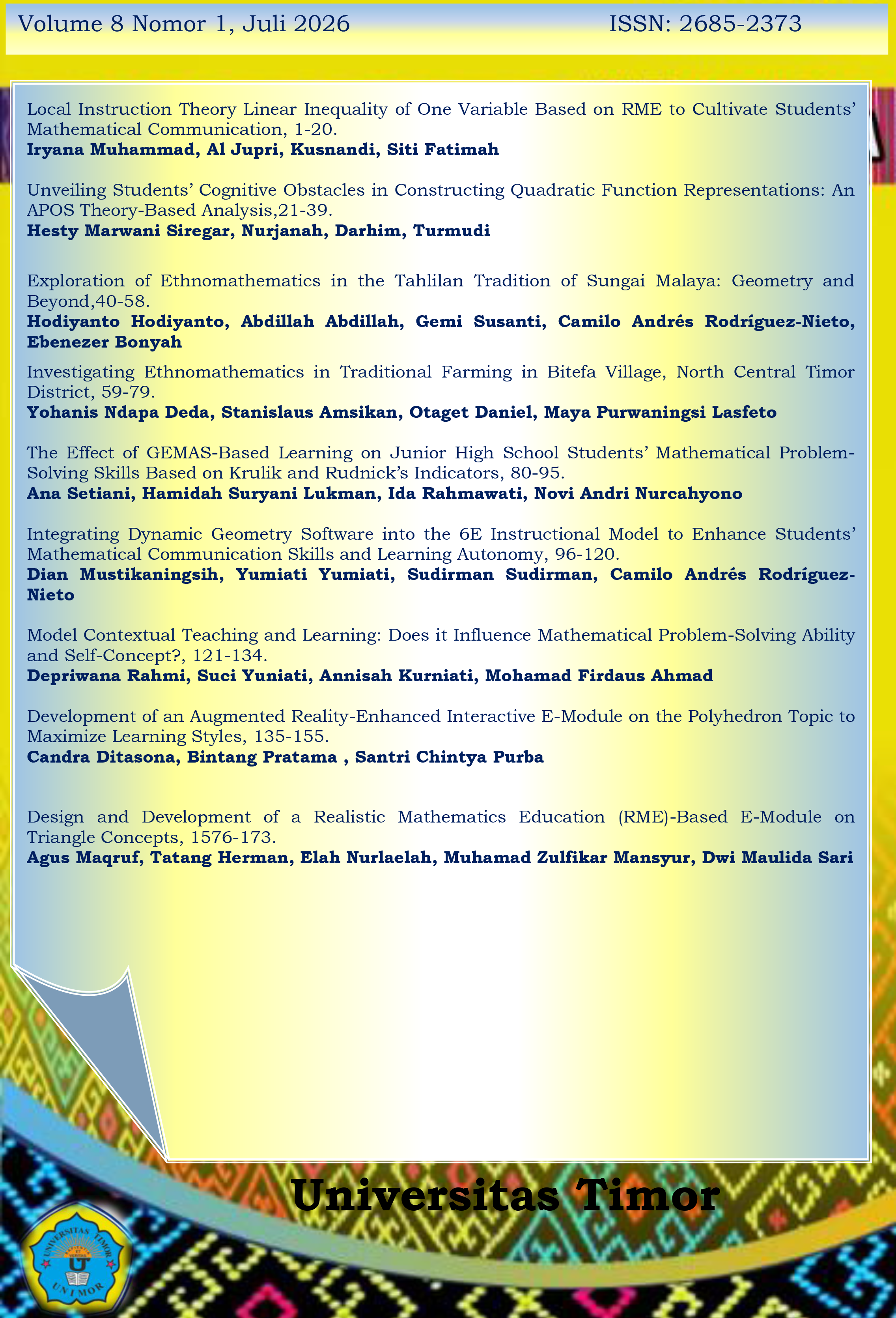
Design and Development of a Realistic Mathematics Education (RME)-Based E-Module on Triangle Concepts
DOI:
https://doi.org/10.32938/jpm.v8i1.10407Keywords:
Design, Development, E-Module, TriangleAbstract
In training students to be able to solve problems logically and systematically, there is a need for learning media. Digital learning media that covers a wide range of subject matter nowadays is e-modules. Several studies have stated that the e-modules needed in mathematics learning are e-modules that are closely related to students' daily lives so that they are easy and practical to learn or in mathematics education it is known as Realistic Mathematics Education (RME). The research method used is the Richey and Klein Design and Development model with three stages, namely design, production and evaluation. The research was conducted at one of the junior high schools in Bandung City. The research instrument is intended for experts as validators and students as users The results indicate that through the stages of design, production, and evaluation, the RME-based e-module on triangle material was successfully designed and developed as a highly feasible learning resource for junior high school students in Indonesia. Expert validation showed an overall score of 90.3 percent categorized as very feasible, while student responses reached 86.9 percent also categorized as very feasible, confirming both its effectiveness and usability while providing valuable input for future refinement and wider development of the e-module.
References
Aldrich, C. (2004). Simulations and the Future of Learning: an innovative (and perhaps revolutionary) approach to e-learning. Pfeiffer.
Ali, Q. I. (2024). Towards more effective summative assessment in OBE: a new framework integrating direct measurements and technology. Discover Education, 3(1). https://doi.org/10.1007/s44217-024-00208-5
Asrial, Syahrial, Kurniawan, D. A., Chan, F., Septianingsih, R., & Perdana, R. (2019). Multimedia innovation 4.0 in education: E-modul ethnoconstructivism. Universal Journal of Educational Research, 7(10), 2098–2107. https://doi.org/10.13189/ujer.2019.071007
Atuhurra, J., & Kaffenberger, M. (2022). Measuring education system coherence: Alignment of curriculum standards, examinations, and teacher instruction in Tanzania and Uganda. International Journal of Educational Development, 92. https://doi.org/10.1016/j.ijedudev.2022.102598
Bayley, S. H. (2022). Learning for adaptation and 21st-century skills: Evidence of pupils’ flexibility in Rwandan primary schools. International Journal of Educational Development, 93(July), 102642. https://doi.org/10.1016/j.ijedudev.2022.102642
Çakıroğlu, Ü., Güler, M., Dündar, M., & Coşkun, F. (2023). Virtual Reality in Realistic Mathematics Education to Develop Mathematical Literacy Skills. International Journal of Human–Computer Interaction, 0(0), 1–13. https://doi.org/10.1080/10447318.2023.2219960
Chao, T., Chen, J., Star, J. R., & Dede, C. (2016). Using Digital Resources for Motivation and Engagement in Learning Mathematics: Reflections from Teachers and Students. Digital Experiences in Mathematics Education, 2(3), 253–277. https://doi.org/10.1007/s40751-016-0024-6
Chen, L., & Liu, Q. (2023). Constructing a Teaching-Ability Evaluation System for Chinese Student Teachers using Delphi and Analytical Hierarchical Process Methods. International Journal of Learning, Teaching and Educational Research, 22(11), 150–169. https://doi.org/10.26803/ijlter.22.11.9
Clements, T. P., Friedman, K. L., Johnson, H. J., Meier, C. J., Watkins, J., Brockman, A. J., & Brame, C. J. (2022). “It made me feel like a bigger part of the STEM community”: Incorporation of Learning Assistants Enhances Students’ Sense of Belonging in a Large Introductory Biology Course. CBE Life Sciences Education, 21(2). https://doi.org/10.1187/CBE.21-09-0287
Do, T.-T., Kien Cong Hoang, Tung Do, Thao Phuong, Thi Trinh, Danh Nam Nguyen, Trung Tran, Trung Thien Bao, Thai Le, Thanh Chi Nguyen, & Tien-Trung Nguyen. (2021). Factors Influencing Teachers’ Intentions to Use Realistic Mathematics Education in Vietnam: An Extension of The Theory of Planned Behavior. Journal on Mathematics Education, 12.
Evans, C. (2008). The effectiveness of m-learning in the form of podcast revision lectures in higher education. Computers and Education, 50(2), 491–498. https://doi.org/10.1016/j.compedu.2007.09.016
Fatonah, S. A., & Pranata, K. (2022). Meningkatkan Kreativitas Berpikir Tingkat Tinggi Melalui Media Audio Visual Berbasis STEAM pada Siswa SD. Primary: Jurnal Pendidikan Guru Sekolah Dasar, 11(6), 1773. https://doi.org/10.33578/jpfkip.v11i6.9058
Fitrio, B. D., & Merliza, P. (2023). Pengembangan Bahan Ajar E-Modul Matematika Interaktif dengan Pendekatan Kontekstual untuk Siswa Kelas VIII SMP. Suska Journal of Mathematics Education, 9(2), 121. https://doi.org/10.24014/sjme.v9i2.18071
Hamim, T., Benabbou, F., & Sael, N. (2022). Student profile modeling using boosting algorithms. International Journal of Web-Based Learning and Teaching Technologies, 17(5). https://doi.org/10.4018/IJWLTT.20220901.oa4
Hikayat, C., Suparman, Hairun, Y., & Suharna, H. (2020). Design of realistic mathematics education approach to improve critical thinking skills. Universal Journal of Educational Research, 8(6), 2232–2244. https://doi.org/10.13189/ujer.2020.080606
Holmes, B., & Gardner, J. (2006). e-Learning: Concepts and Practice (1st ed.). Sage Publications.
Karenina, A., Widoretno, S., & Prayitno, B. A. (2019). Profile of integration of problem-solving aspects with analytical-thinking aspects in human respiratory system topic. AIP Conference Proceedings, 2194(December). https://doi.org/10.1063/1.5139779
Karlimah, K., Hamdu, G., Pratiwi, V., Herdiansah, H., & Kurniawan, D. (2021). The development of motion comic storyboard based on digital literacy and elementary school mathematics ability in the new normal era during covid-19 pandemic. Journal of Physics: Conference Series, 1987(1). https://doi.org/10.1088/1742-6596/1987/1/012026
Kemdikbud. (2017). Panduan Praktis Penyusunan e-Modul.
Leidel, M., Niemann, S., Saliha, A. H., Cullmann, J., Seidel, N., Borchardt, D., Krebs, P., & Bernhofer, C. (2013). IWRM education: e-learning module on Integrated Water Resources Management. Environmental Earth Sciences, 68(2), 609–613. https://doi.org/10.1007/s12665-012-2059-3
Maqruf, A., Sudirman, & Muksar, M. (2023). Karakteristik Proses Berpikir Analitis Siswa dalam Memecahkan Permasalahan Himpunan. AKSIOMA: Jurnal Program Studi Pendidikan Matematika, 12(1), 563–572.
Montaku, S. (2011). Results of analytical thinking skills training through students in system analysis and design course. Proceedings of the IETEC’11 Conference, 1934, 13.
Novita, R., & Herman, T. (2021). Digital technology in learning mathematical literacy, can it helpful? Journal of Physics: Conference Series, 1776(1). https://doi.org/10.1088/1742-6596/1776/1/012027
Omer, S. M. S., Evers, K., Wang, C. Y., & Chen, S. (2025). Technology-enhanced mathematics learning: review of the interactions between technological attributes and aspects of mathematics education from 2013 to 2022. Humanities and Social Sciences Communications, 12(1), 1–13. https://doi.org/10.1057/s41599-025-05475-7
Palmberg, B., Granberg, C., Andersson, C., & Palm, T. (2024). A multi-approach formative assessment practice and its potential for enhancing student motivation: a case study. Cogent Education, 11(1). https://doi.org/10.1080/2331186X.2024.2371169
Richey, R. C., & Klein, J. D. (2007). Design and Development Research. Routledge Taylor & Francis Group .
Rohmatulloh, R., Pujiastuti, H., & Fathurrohman, M. (2022). Integrasi E-Modul dalam Pembelajaran Matematika : Systematic Literature Review. Edukatif : Jurnal Ilmu Pendidikan, 4(6), 7828–7839. https://doi.org/10.31004/edukatif.v4i6.4238
Rukayah, Daryanto, J., Atmojo, I. R. W., Ardiansyah, R., Saputri, D. Y., & Salimi, M. (2022). Augmented Reality Media Development in STEAM Learning in Elementary Schools. Ingenierie Des Systemes d’Information, 27(3), 463–471. https://doi.org/10.18280/isi.270313
Salam, R. (2018). Utilization of Learning Media in Motivating Student Learning. Advances in Social Science, Education and Humanities Research.
Setiawati, Huda, A., Ismaniar, & Ardi, N. (2023). Design and Development of Android-Based E-Modul Application to Improve Prosocial Early Children by Family. International Journal of Online and Biomedical Engineering, 19(12), 111–126. https://doi.org/10.3991/ijoe.v19i12.40905
Syahrial, Asrial, Melinda, L. G., Fajar, M. R., Jannah, N., Puspitasari, T. O., & Putri, Y. E. (2020). Impact E-Modul Ethnoconstructivism: Attitude & Motivation. International Journal of Scientific & Technology Research, 9(04). www.ijstr.org
Syarif, R., & Achmad, S. (2020). Design of E-Module With RME Approach to Improve The Creative Thinking Ability of Students. International Journal of Scientific & Technology Research, 9(3). www.ijstr.org
Tosun, N., & Altintas, S. (2024). An Evaluation of Teachers’ Views on Open Educational Resources. Turkish Online Journal of Distance Education-TOJDE, 25.
Umbara, U., & Nuraeni, Z. (2019). Implementation of Realistic Mathematics Education Based on Adobe Flash Professional CS6 to Improve Mathematical Literacy. Infinity Journal, 8(2), 167–178. https://doi.org/10.22460/infinity.v8i2.p167-178
Wahyudi, D. (2019). Pengembangan E-Modul dalam Pembelajaran Matematika SMA Berbasis Android. GAUSS: Jurnal Pendidikan Matematika, 2(2), 1. https://doi.org/10.30656/gauss.v2i2.1739
Wijaya, A. P., Nusantara, T., Sudirman, & Hidayanto, E. (2023). How Are Students’ Prior Knowledge Differentiate Analytical Thinking Process in Identifying the Convergence of Real Number Sequences? International Journal of Instruction, 16(1), 205–218. https://doi.org/10.29333/iji.2023.16112a
Yamasari, Y. (2010). Pengembangan Media Pembelajaran Matematika Berbasis ICT yang Berkualitas. Seminar Nasional Pascasarjana X-ITS.
Zanten, M. Van, & Heuvel-Panhuizen, M. Van Den. (2021). Mathematics curriculum reform and its implementation in textbooks: Early addition and subtraction in realistic mathematics education. Mathematics, 9(7). https://doi.org/10.3390/math9070752
Zhang, Z., Cao, T., Shu, J., & Liu, H. (2022). Identifying key factors affecting college students’ adoption of the e-learning system in mandatory blended learning environments. Interactive Learning Environments, 30(8), 1388–1401. https://doi.org/10.1080/10494820.2020.1723113
Downloads
Published
Issue
Section
License
Copyright (c) 2026 RANGE: Jurnal Pendidikan Matematika

This work is licensed under a Creative Commons Attribution-NonCommercial-ShareAlike 4.0 International License.
RANGE: Jurnal Pendidikan Matematika