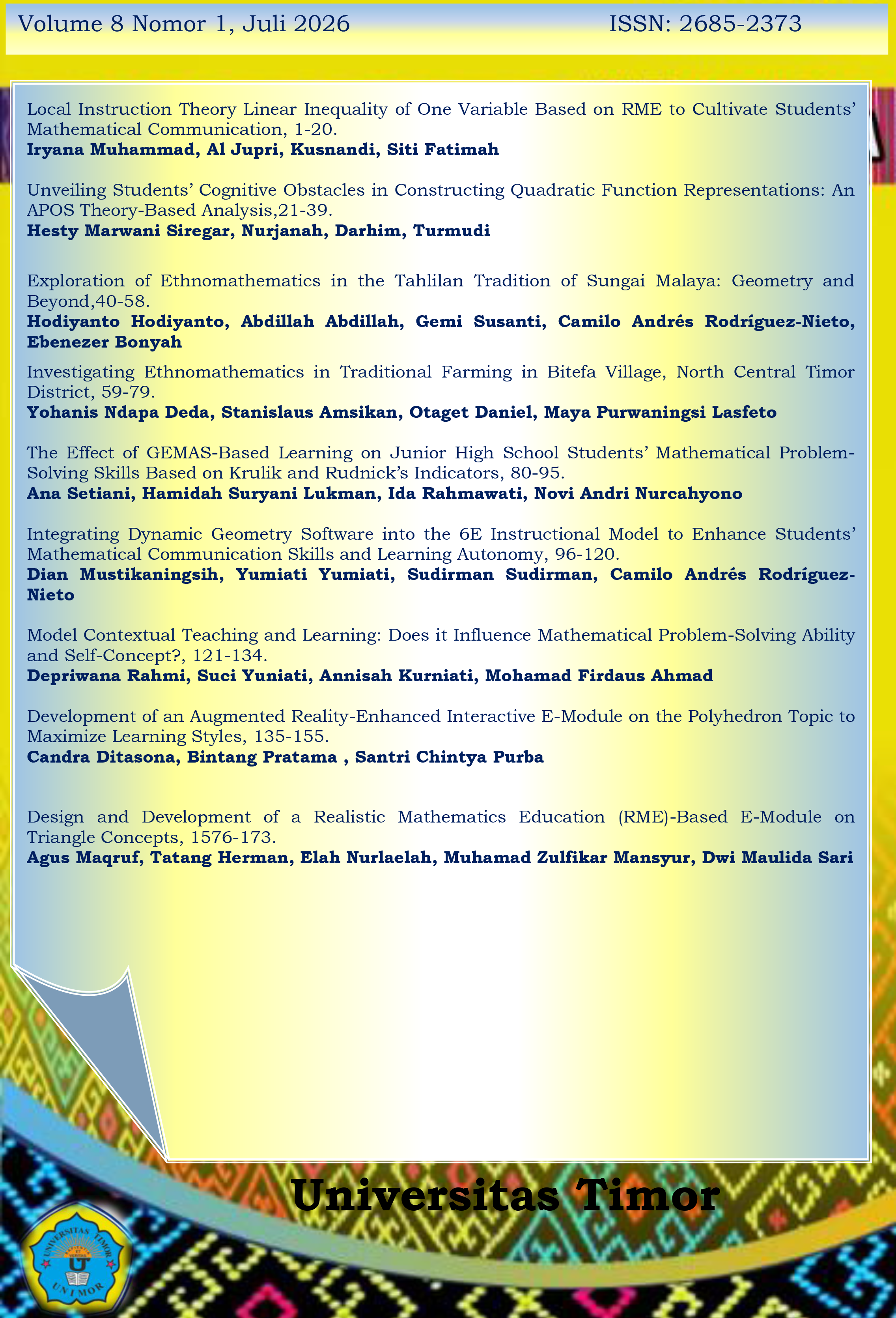
Integrating Dynamic Geometry Software into the 6E Instructional Model to Enhance Students’ Mathematical Communication Skills and Learning Autonomy
DOI:
https://doi.org/10.32938/jpm.v8i1.10412Keywords:
Mathematical Communication, Independent Learning, 6E Instructional ModelAbstract
The integration of technology into mathematics instruction is increasingly acknowledged as a means to foster 21st-century competencies, particularly mathematical communication and independent learning. This study investigates the effects of the 6E instructional model combined with Dynamic Geometry Software (DGS) on these two aspects. A quasi-experimental design was conducted with tenth-grade students from a vocational school in Sukoharjo, Central Java. The sample included 35 students in the experimental group and 34 students in the control group, selected randomly. Mathematical communication was measured using essay-based pre- and post-tests, while learning autonomy was assessed through questionnaires administered before and after the intervention. Normality and homogeneity tests using Kolmogorov–Smirnov and Levene’s confirmed the assumptions for parametric analysis. Data were analyzed using the Independent Sample T-test. Results indicated that significance values for both mathematical communication and learning autonomy were below 0.05, showing statistically significant differences between groups. The experimental group achieved an average post-test score of 82.40, higher than the control group’s 74.24, indicating improved mathematical communication under the 6E model with DGS integration. Similarly, the experimental group’s average final questionnaire score of 105.11 exceeded the control group’s 90.38, reflecting greater learning autonomy. These findings demonstrate that embedding GeoGebra within the 6E instructional model substantially enhances students’ ability to articulate mathematical ideas and promotes independent learning. The study provides empirical support for technology-enhanced learning designs in mathematics education, highlighting their potential to strengthen key competencies and contribute to more effective instructional practices.
References
‘Ulya, W., Sudirman, S., & Rahardjo, S. (2021). Kemampuan komunikasi matematis siswa dalam menyelesaikan masalah sistem persamaan linear tiga variabel. Jurnal Pendidikan: Teori, Penelitian, Dan Pengembangan, 6(5), 816. https://doi.org/10.17977/jptpp.v6i5.14859
Arnanda, A. N., Dafik, D., Oktavianingtyas, E., Harmi, H., & Firmani, I. (2021). Analisis penerapan media pembelajaran geogebra dalam mengembangkan kemampuan komunikasi matematis siswa pokok bahasan sistem persamaan linier dua variabel. Journal of Mathematics Education and Learning, 1(1), 38. https://doi.org/10.19184/jomeal.v1i1.24374
Asyriah N. (2018). Kemampuan komunikasi matematis siswa dalam proses pembelajaran matematikadengan pendekatan saintifik. Jurnal Ilmiah Keagamaan Dan Kemasyarakatan, 11(2), 279–302. https://jurnal.iaidukandangan.ac.id/index.php/annahdhah/article/view/39
Balaka, M. Y. (2022). Metode penelitian kuantitatif. Metodologi penelitian pendidikan kualitatif, 1, 130.
Etikan, I. (2017). Sampling and sampling methods. Biometrics & Biostatistics International Journal, 5(6), 215–217. https://doi.org/10.15406/bbij.2017.05.00149
Firmansyah, D., & Dede. (2022). Teknik pengambilan sampel umum dalam metodologi. Jurnal Ilmiah Pendidikan Holistik (JIPH), 1(2), 85–114. https://sl1nk.com/kqulz
Fricticarani, A., Hayati, A., R, R., Hoirunisa, I., & Rosdalina, G. M. (2023). Strategi pendidikan untuk sukses di era teknologi 5.0. Jurnal Inovasi Pendidikan Dan Teknologi Informasi (JIPTI), 4(1), 56–68. https://doi.org/10.52060/pti.v4i1.1173
Ghufron, A., & Sutama. (2011). Tes, pengukuran, asesmen, dan evaluasi, peran dan fungsinya dalam pembelajaran. Evaluasi pembelajaran matematika, 1–27. http://repository.ut.ac.id/id/eprint/4387
Guven, B. (2012). Using dynamic geometry software to improve eight grade students’ understanding of transformation geometry. Australasian Journal of Educational Technology, 28(2), 364–382. https://doi.org/10.14742/ajet.878
Hasibuan, Y. R., Khairani, N., & Surya, E. (2023). Pengaruh kemampuan awal matematis dan model learning cycle 5E berbantuan geogebra untuk meningkatkan kemampuan pemecahan masalah matematis siswa dan kemandirian belajar matematis siswa. Jurnal Cendekia : Jurnal Pendidikan Matematika, 7(1), 740–750. https://doi.org/10.31004/cendekia.v7i1.2168
Inayah, F., Mariani, S., & Negeri Semarang, U. (2024). Pengaruh kemandirian belajar terhadap literasi matematika dengan menerapkan model pembelajaran PBL berpendekatan STEAM-PMRI. Symmetry | Pasundan Journal of Research in Mathematics Learning and Education, 9(1), 86–96. https://doi.org/10.23969/symmetry.v9i1.14857
Istikomah, E., Zetriuslita, Z., & Nofriandi, N. (2021). Improving students’ mathematics communication ability through geogebra. Pedagogia : Jurnal Pendidikan, 10(2), 113–126. https://doi.org/10.21070/pedagogia.v10i2.1266
Izah, S. C., Sylva, L., & Hait, M. (2024). Cronbach’s alpha: a cornerstone in ensuring reliability and validity in environmental health assessment. ES Energy and Environment, 23, 1–14. https://doi.org/10.30919/esee1057
Jelatu, S., Jundu, R., Jehadus, E., Nendi, F., Makur, A. P., Ningsi, G. P., & Sugiarti, L. (2020). Penguatan kompetensi pedagogik guru melalui penggunaan dynamic geometry software dalam pembelajaran matematika. Jurnal Pengabdian Pada Masyarakat, 5(4), 1025–1034. https://doi.org/10.30653/002.202054.400
Kholifah, S. (2024). Analisis kemampuan komunikasi matematis ditinjau dari tipe kepribadian pada model 9E learning cycle berpendekatan STEAM. Jurnal Pedagogi Matematika, 10(2), 157–167. https://doi.org/10.21831/jpm.v10i2.21910
Lubis, R., Harahap, M. S., & Rambe, D. (2023). Efektivitas model pembelajaran learning cycle 5E terhadap kemampuan komunikasi matematis siswa SMP Negeri 9 Padangsidimpuan. JURNAL MathEdu (Mathematic Education Journal), 6(2), 120–130. https://journal.ipts.ac.id/index.php/MathEdu/article/view/5003%0Ahttps://journal.ipts.ac.id/index.php/MathEdu/article/download/5003/3016
Maulyda, M. A. (2020). Paradigma pembelajaran matematika NCTM. Paradigma pembelajaran.
Nasution, D. P., & Ahmad, M. (2018). Penerapan pembelajaran matematika realistik untuk meningkatkan kemampuan komunikasi matematis siswa. Mosharafa: Jurnal Pendidikan Matematika, 7(3), 389–400. https://doi.org/10.31980/mosharafa.v7i3.521
Nurfazlin Nova, Irwan, & Abdurrahman. (2024). Pengembangan perangkat pembelajaran matematika dengan model learning cycle-5E untuk meningkatkan kemampuan komunikasi matematis siswa kelas X SMA. Jurnal Pengabdian Masyarakat Dan Riset Pendidikan, 2(4), 387–390. https://doi.org/10.31004/jerkin.v2i4.294
Nuritha, C., & Tsurayya, A. (2021). Pengembangan video pembelajaran berbantuan geogebra untuk meningkatkan kemandirian belajar siswa. Jurnal Cendekia : Jurnal Pendidikan Matematika, 5(1), 48–64. https://doi.org/10.31004/cendekia.v5i1.430
Nurochmah, Arifin, S., & Surgandini, A. (2021). The application of learning cycle 7E model to improve a mathematics communication skills of junior high school students. AIP Conference Proceedings, 2331(April). https://doi.org/10.1063/5.0041644
Paisal, Satyahadewi, N., & Perdana, H. (2021). Pengembangan aplikasi statistika berbasis web interaktif untuk analisis uji T. Buletin Ilmiah Math. Stat. Dan Terapannya (Bimaster), 10(3), 331–340. https://jurnal.untan.ac.id/index.php/jbmstr/article/view/47655
Rahadyan, A., & Halimatussa’diah. (2020). Penerapan dynamic software geogebra dan cabri 3D dalam pembelajaran matematika. Jurnal Pemikiran Dan Penelitian Pendidikan Matematika (JP3M), 2(2), 154–172. https://doi.org/10.36765/jp3m.v2i2.34
Rahmatika, A., Batubara, I. H., Sari, I. P., Muhammadiyah, U., Utara, S., Muhammadiyah, U., Utara, S., & Matematis, K. K. (2022). Penerapan software geogebra dalam kemampuan komunikasi matematis mahasiswa pada mata kuliah trigonometri. EduTech: Jurnal Ilmu Pendidikan Dan Ilmu Sosial, 8(2), 162–167. https://doi.org/10.30596/edutech.v8i2.10581
Rahmy, S. N., Usodo, B., & Slamet, I. (2020). Students’ mathematical communication ability using 7E learning cycle based on students thinking style. Journal of Physics: Conference Series, 1469(1). https://doi.org/10.1088/1742-6596/1469/1/012154
Robiana, A., & Handoko, H. (2020). Pengaruh penerapan media unomath untuk meningkatkan kemampuan komunikasi matematis dan kemandirian belajar siswa. Mosharafa: Jurnal Pendidikan Matematika, 9(3), 521–532. https://doi.org/10.31980/mosharafa.v9i3.772
Siregar, N. F. (2016). Pemahaman dan komunikasi matematis dalam pembelajaran matematika realistik. Logaritma, IV(01), 17–36. https://web.archive.org/web/20180411072443id
Sumarni, M. . T. K. . G. . (2014). Penerpan learning cycle 5E untuk meningkatkan komunikasi matematis siswa. JUrnal Pendidikan Matematika, 3(1), 12–16. https://ejournal.upi.edu/index.php/SIGMADIDAKTIKA/article/view/31977/13872
Widiastuti, B., Pujiastuti, H., & Fathurrohman, M. (2023). Systematic literatur review: efektifitas model learning cycle 5e terhadap kemampuan komunikasi matematis. JIIP - Jurnal Ilmiah Ilmu Pendidikan, 6(1), 499–504. https://doi.org/10.54371/jiip.v6i1.1268
Zubaidah. (2016). Keterampilan abad ke-21: keterampilan yang diajarkan melalui pembelajaran. Seminar Nasional Pendidikan, 2(2), 1-17. https://sl1nk.com/uYssk
Downloads
Published
Issue
Section
License
Copyright (c) 2026 RANGE: Jurnal Pendidikan Matematika

This work is licensed under a Creative Commons Attribution-NonCommercial-ShareAlike 4.0 International License.
RANGE: Jurnal Pendidikan Matematika