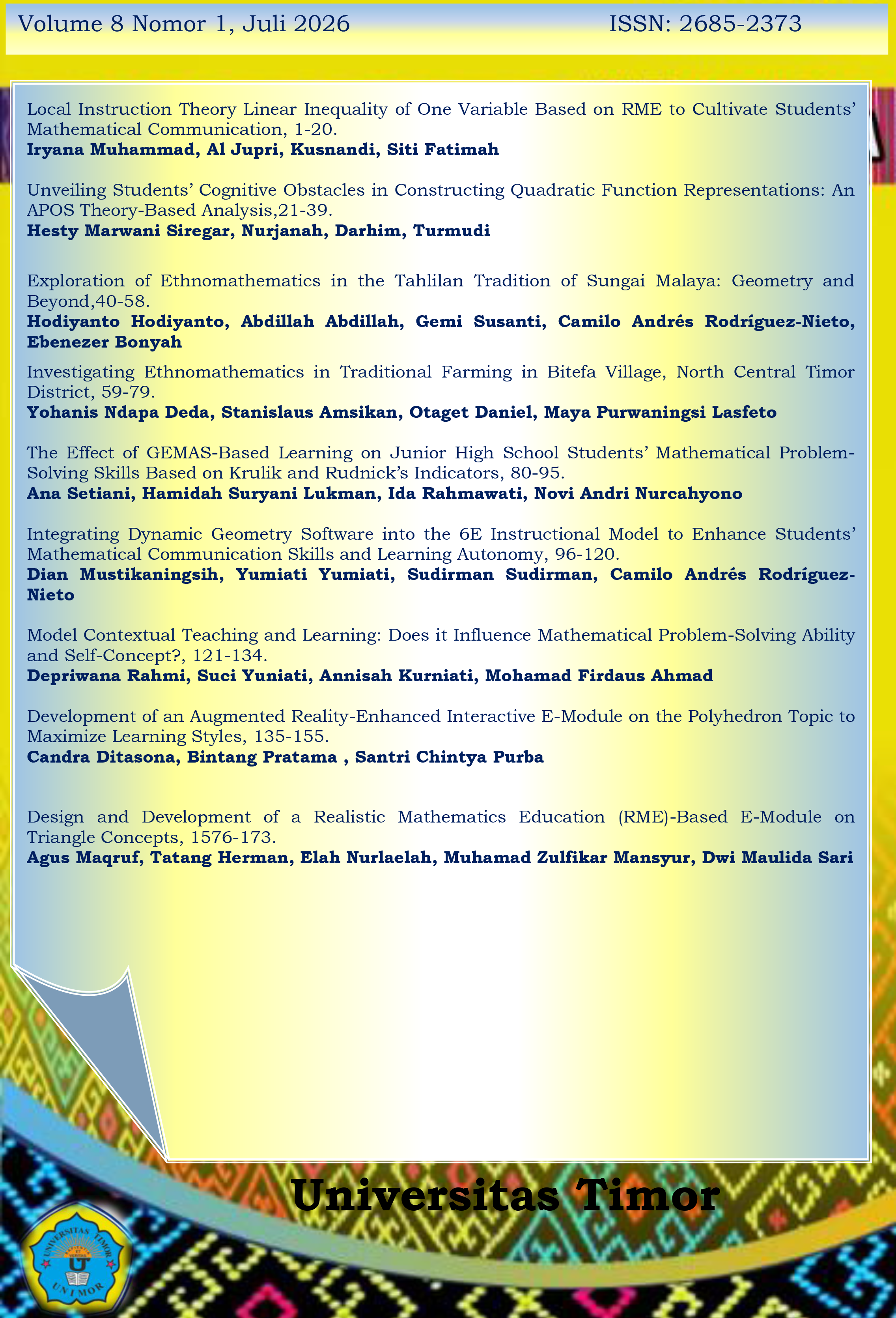
The Effect of GEMAS-Based Learning on Junior High School Students’ Mathematical Problem-Solving Skills Based on Krulik and Rudnick’s Indicators
DOI:
https://doi.org/10.32938/jpm.v8i1.10664Keywords:
GEMAS, junior high school, Krulik & Rudnick, Mathematics Learning, problem -solvingAbstract
The PISA 2022 results indicate that Indonesian students’ mathematical performance remains below the OECD average, which calls for instructional innovations that support mathematical problem-solving at the junior high school level. This study examined the use of the Mathematics Educational Game (GEMAS) in supporting students’ mathematical problem-solving skills on linear equations in one variable (LEOV), systems of linear equations in two variables (SLETV), and combined linear equation problems. GEMAS was designed as a game-based learning medium that integrates mathematical tasks with problem-solving stages based on Krulik and Rudnick’s framework, namely read and think, explore and plan, select a strategy, locate and answer, and reflect and extend. This study employed a quantitative approach with a one-group pretest-posttest quasi-experimental design involving 60 students of SMPN 12 Sukabumi in the second semester of the 2024/2025 academic year. The instruments consisted of a mathematical problem-solving test and semi-structured interviews. Data were analyzed using paired-sample t-tests and normalized gain scores. The results showed statistically significant differences between students’ pretest and posttest scores across the three topics: LEOV, SLETV, and combined problems, with moderate normalized gain scores ranging from 0.3901 to 0.5465. These findings suggest that the use of GEMAS was associated with moderate improvement in students’ mathematical problem-solving skills. The study contributes to the development of mathematics educational games by aligning game-based activities with explicit problem-solving indicators, making GEMAS a potential learning medium to support the implementation of the Merdeka Curriculum.
References
Alotaibi, M. S. (2024). Game-based learning in early childhood education: a systematic review and meta-analysis. Frontiers in Psychology, 15(4). https://doi.org/https://doi.org/10.3389/fpsyg.2024.1307881
Angwarmasse, P., & Wahyudi, W. (2021). Pengembangan Game Edukasi Labirin Matematika untuk Meningkatkan Kemampuan Pemecahan Masalah Siswa Kelas VI Sekolah Dasar. Jurnal EDUCATIO: Jurnal Pendidikan Indonesia, 7(1), 46. https://doi.org/https://doi.org/10.29210/120212953
Ardiyani, W., Rohana, R., & Dhony, N. N. A. (2024). Kemampuan Pemecahan Masalah Matematis Melalui Game Edukasi Berbasis Wordwall. JEMS: Jurnal Edukasi Matematika Dan Sains, 12(2), 127–133. https://doi.org/https://doi.org/10.25273/jems.v12i2.20426
Ayyasy, H. Y., & Asrul. (2024). The Effect of Game Based Learning with Math Bingo in Reducing Math Anxiety to Improve Students’ Mathematics Learning Outcomes in Data Presentation Materials. Desimal: Jurnal Matematika, 7(2), 383–394. https://doi.org/https://doi.org/10.24042/djm
Campbell, D. T., & Stanley, J. C. (1966). Experimental and Quasi-Experimental Designs for Research. Houghton Mifflin.
Creswell, J. W., & Creswell, J. D. (2018). Research design: Qualitative, Quantitative, and Mixed Methods Approaches (5th ed.). SAGE Publications.
Dan, N. N., Trung, L. T. B., Nga, N. T., & Dung, T. M. (2024). Digital Game-Based Learning in Mathematics Education at Primary School Level: A Systematic Literature Review. Eurasia Journal of Mathematics, Science and Technology Education, 20(4). https://doi.org/https://doi.org/10.29333/ejmste/14377
Debrenti, E. (2024). Game-Based Learning Experiences in Primary Mathematics Education. Frontiers in Education, 9(1). https://doi.org/https://doi.org/10.3389/feduc.2024.1331312
Fadilah, M. W., Subanti, S., & Usodo, B. (2023). Analisis Kemampuan Pemecahan Masalah Matematika Serupa PISA Siswa dengan Gaya Belajar Visual Berdasarkan Langkah Krulik-Rudnick. AKSIOMA: Jurnal Program Studi Pendidikan Matematika, 12(1), 1594. https://doi.org/https://doi.org/10.24127/ajpm.v12i1.5372
Fardian, D., Herman, T., Suryadi, D., & Prabawanto, S. (2024). Gamifying Mathematics: A Hermeneutic Phenomenological Study Focused on Role-Playing Games in Linear Equations. PYTHAGORAS Jurnal Pendidikan Matematika, 19(1), 37–52. https://doi.org/https://doi.org/10.21831/pythagoras.v19i1.74146
Frenanto, A., Fatqurhohman, F., & Rhomdani, R. W. (2023). Identification of HOTS Problem Solving Ability of High School Students Using Two Tier Diagnostic. Journal of Education and Learning Mathematics Research (JELMaR), 4(2), 120–126. https://doi.org/https://doi.org/10.37303/jelmar.v4i2.115
Hake, R. R. (1998). Interactive-Engagement Versus Traditional Methods: A Six-Thousand-Student Survey of Mechanics Test Data for Introductory Physics Courses. American Journal of Physics, 66(1), 67–74. https://doi.org/https://doi.org/10.1119/1.18809
Hidayat, R., Qi, T. Y., Ariffin, P. N. B. T., Hadzri, M. H. B. M., Chin, L. M., Ning, J. L. X., & Nasir, N. (2024). Online game-based learning in mathematics education among Generation Z: A systematic review. International Electronic Journal of Mathematics Education, 19(1). https://doi.org/https://doi.org/10.29333/iejme/14024
Khairunnisa. (2024). Analysis of Student’s Mathematical Problem Solving Abilities Based on Heuristic Strategy of Krulik and Rudnick Types. International Journal Of Humanities Education And Social Sciences (IJHESS), 3(4), 2257–2265. https://ijhess.com/index.php/ijhess/
Krulik, S., & Rudnick, J. A. (1995). The New Sourcebook for Teaching Reasoning and Problem Solving in Elementary School. Allyn & Bacon.
Lindy, I., Sitompul, S. S., Oktavianty, E., Sirait, J., & Hidayatullah, M. M. S. (2023). Implementasi Strategi Pemecahan Masalah Krulik-Rudnick untuk Meningkatkan Kemampuan Peserta Didik dalam Menyelesaikan Soal. Edukatif : Jurnal Ilmu Pendidikan, 5(3), 1524–1533. https://doi.org/https://doi.org/10.31004/edukatif.v5i3.3844
Lukman, H. S., Agustiani, N., & Setiani, A. (2023). Gamification of mathematics teaching materials: Its validity, practicality and effectiveness. International Journal of Emerging Technologies in Learning (IJET), 18(20), 4–22. https://doi.org/https://doi.org/10.3991/ijet.v18i20.36189
Lukman, H. S., & Setiani, A. (2025). The Effect of Analytical Thinking and Critical Thinking on Mathematical Problem Solving Ability. JTAM (Jurnal Teori Dan Aplikasi Matematika), 9(2), 587–599. https://doi.org/https://doi.org/10.54371/jiip.v8i2.6666
Muqoddaroh, F., Misriah, Z., & Pangura, A. A. (2024). Game Edukasi dalam Pembelajaran Matematika. JRPM (Jurnal Review Pembelajaran Matematika), 9(1), 20–32. https://doi.org/https://doi.org/10.15642/jrpm.2024.9.1.20-32
OECD. (2023). PISA 2022 Results (Volume I): The State of Learning and Equity in Education. OECD Publishing.
Polya, G. (1973). How to solve it: A new aspect of mathematical method (2nd ed.). Princeton University Press.
Pramuditya, S. A., Noto, M. S., & Azzumar, F. (2022). Characteristic of Students’ Mathematical Problem Solving Abilities in Open-Ended-Based Virtual Reality Game Learning. Infinity Journal of Mathematics Education, 11(2), 255–272. https://doi.org/https://doi.org/10.22460/infinity.v11i2.p255-272
Radityastuti, E. Y., Lukman, H. S., & Agustiani, N. (2023). Implementasi digital game-based learning untuk meningkatkan kemampuan berpikir kritis dan pemecahan masalah matematis siswa SMP. AXIOM: Jurnal Pendidikan Dan Matematika, 12(1), 96–105. https://doi.org/https://doi.org/10.30821/axiom.v12i1.16047
Rahmah, A., Mardiyana, & Saputro, D. R. S. (2021). High School Students’ Mathematical Problem Solving Skills Based on Krulik and Rudnick Steps Reviewed from Thinking Style. IOP Conference Series: Earth and Environmental Science, 1808(1). https://doi.org/https://doi.org/10.1088/1742-6596/1808/1/012058
Rahmatania, D. D., & Setiawan, Y. (2021). Pengembangan Media Poly Game pada Pembelajaran Matematika dalam Meningkatkan Kemampuan Pemecahan Masalah di Sekolah Dasar. Jurnal Basicedu., 5(4), 2449–2460. https://doi.org/https://doi.org/10.31004/basicedu.v5i4.1249
Riyadi, Syarifah, T. J., & Nikmaturrohmah, P. (2021). Profile of Students’ Problem-Solving Skills Viewed From Polya’s Four-Steps Approach and Elementary School Students. European Journal of Educational Research, 10(4), 1625–1638. https://doi.org/https://doi.org/10.12973/EU-JER.10.4.1625
Setiani, A., Lukman, H. S., & Agustiani, N. (2024). Analisis Kemampuan Pemecahan Masalah Matematis Siswa SMP Berdasarkan Indikator Krulik Dan Rudnick Ditinjau Dari Motivasi Belajar. AKSIOMA: Jurnal Program Studi Pendidikan Matematika, 13(2), 656. https://doi.org/https://doi.org/10.24127/ajpm.v13i2.8612
Setiani, A., Yulianti, Y., Agustiani, N., Septiani, E., & Muhassanah, N. (2025). Experimentation of PBL and PJBL Learning Models on Junior High School Students’ Mathematical Problem-Solving Ability in Driving Schools. PRISMA, 14(1), 45. https://doi.org/https://doi.org/10.35194/jp.v14i1.4928
Sholihatinnisa, I., Suryani Lukman, H., & Agustiani, N. (2024). Media Belajar Mandiri Untuk Meningkatkan Kemampuan Berpikir Komputasi Siswa SMP. JIPMat, 9(1), 75–89. https://doi.org/https://doi.org/10.26877/jipmat.v9i1.382
Sitohang, P. E., & Suwanto, F. R. (2025). Pengaruh Pendekatan Realistik Berbantuan Game Edukasi Gimkit terhadap Kemampuan Pemecahan Masalah Matematis Siswa SMPN 4 Tanjung Morawa. Pedagogy: Jurnal Pendidikan Matematika, 10(1), 65–74. https://doi.org/https://doi.org/10.30605/pedagogy.v10i1.5705
Sulistyanto, H., Djumadi, D., Sumardjoko, B., Haq, M. I., Zakaria, G. A. N., Narimo, S., Astuti, D., Adhantoro, M. S., Setyabudi, D. P., Sidiq, Y., & Ishartono, N. (2023). Impact of Adaptive Educational Game Applications on Improving Student Learning: Efforts to Introduce Nusantara Culture in Indonesia. Indonesian Journal on Learning and Advanced Education (IJOLAE), 5(3), 249–261. https://doi.org/https://doi.org/10.23917/ijolae.v5i3.23004
Tokac, U., Novak, E., & Thompson, C. G. (2019). Effects of game-based learning on students’ mathematics achievement: A meta-analysis. Journal of Computer Assisted Learning, 35(3), 407–420. https://doi.org/https://doi.org/10.1111/jcal.12347
Widiana, W. (2022). Game Based Learning dan Dampaknya terhadap Peningkatan Minat Belajar dan Pemahaman Konsep Siswa dalam Pembelajaran Sains di Sekolah Dasar. Jurnal Edutech Undiksha, 10(1), 1–10. https://doi.org/https://doi.org/10.23887/jeu.v10i1.48925
Ziliwu, F., & Mahmudi, A. (2025). Mathematical Problem-Solving and Self-Efficacy in the Context of Algebraic Derivatives: A High School Study. Pedagogia: Jurnal Ilmiah Pendidikan, 17(1), 139–150. https://doi.org/https://doi.org/10.55215/pedagogia.v17i1.51
Downloads
Published
Issue
Section
License
Copyright (c) 2026 RANGE: Jurnal Pendidikan Matematika

This work is licensed under a Creative Commons Attribution-NonCommercial-ShareAlike 4.0 International License.
RANGE: Jurnal Pendidikan Matematika