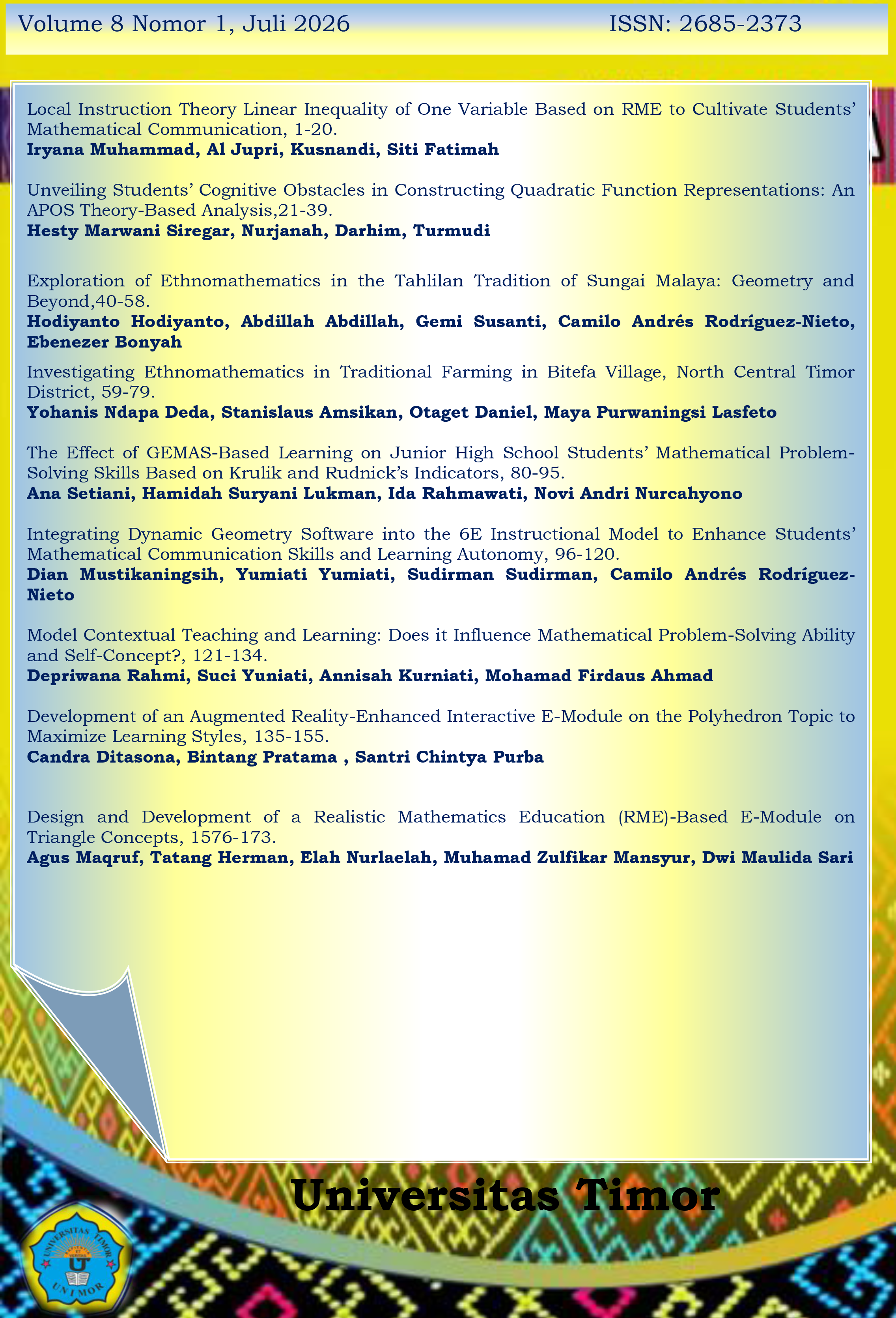
Exploration of Ethnomathematics in the Tahlilan Tradition of Sungai Malaya: Geometry and Beyond
DOI:
https://doi.org/10.32938/jpm.v8i1.10743Keywords:
Cultural, ethnographic, Ethnomathematics, Geometry, Mathematical ConceptsAbstract
This study aims to explore the ethnomathematical elements embedded in the cultural practice of Tahlilan, particularly those related to geometric concepts. The research employed a qualitative approach with an ethnographic design. The participants consisted of community members directly involved in the implementation of Tahlilan, with the research conducted in settings where this tradition is commonly practised. Data were collected through observation, interviews, documentation review, and a literature study. The data were then analyzed through data reduction, data display, interpretation, and conclusion drawing. The findings indicate that Tahlilan is a religious and social tradition passed down across generations and continues to be preserved to this day. The practice involves a series of activities, including the preparation of traditional foods, repeated recitation of prayers, distribution of food packages (berkat), and social interactions among participants. The ethnomathematical aspects identified include representations of three-dimensional geometric solids in Tahlilan foods, such as cylinders, cones, truncated cones, and pyramids; number patterns reflected in the sequence of days of the Tahlilan observance; proportionality in the distribution of food; and combinatorial structures evident in the handshaking activities among participants. These findings demonstrate a strong connection between the cultural practice of Tahlilan and mathematical concepts, revealing the presence of mathematical thinking within community traditions. Furthermore, this study contributes to the development of culturally based mathematics learning, particularly in the areas of geometry.
References
Abdullah, A. A., Richardo, R., Mubarok, M. N., & Bayu, W. S. (2025). Ethnomathematics: Mathematical Activities of Hand-drawn Batik Craftsmen Community in Giriloyo, Yogyakarta, Indonesia. Journal of Education Culture and Society, 16(1), 433–449. https://doi.org/10.15503/jecs2025.2.433.449
Acharya, B. R., Kshetree, M. P., Khanal, B., Panthi, R. K., & Belbase, S. (2021). Mathematics Educators’ Perspectives on Cultural Relevance of Basic Level Mathematics in Nepal. Journal on Mathematics Education, 12(1), 17–48.
Ascher, M. (2018). Mathematics elsewhere: An exploration of ideas across cultures.
Barton, B. (2008). The language of mathematics: Telling mathematical tales. Springer.
Batiibwe, M. S. K. (2024). The role of ethnomathematics in mathematics education: A literature review. Asian Journal for Mathematics Education, 3(4), 383–405. https://doi.org/10.1177/27527263241300400
Boadu, S. K., & Boateng, F. O. (2024). Enhancing students’ achievement in mathematics education in the 21st century through technology integration, collaborative learning, and student motivation: The mediating role of student interest. Eurasia Journal of Mathematics, Science and Technology Education, 20(11), em2534. https://doi.org/10.29333/ejmste/15622
Cifarelli, V. V. (2021). Generalization of Students’ Enactive Metaphorizing: The Handshake Problem and Beyond. Constructivist Foundations, 16(3), 278–280.
Cohen, L., Manion, L., & Morrison, K. (2018). Research Methods in Education (0 ed.). Routledge. https://doi.org/10.4324/9780203224342
d’Entremont, Y. (2015). Linking mathematics, culture and community. Procedia-Social and Behavioral Sciences, 174, 2818–2824.
D’Ambrosio, U. (2020). Ethnomathematics: Past and future. Revemop, 2, e202002. https://doi.org/10.33532/revemop.e202002
D’Ambrosio, U., & Rosa, M. (2017). Ethnomathematics and Its Pedagogical Action in Mathematics Education. In M. Rosa, L. Shirley, M. E. Gavarrete, & W. V. Alangui (Eds.), Ethnomathematics and its Diverse Approaches for Mathematics Education (pp. 285–305). Springer International Publishing. https://doi.org/10.1007/978-3-319-59220-6_12
Dominikus, W. S., Udil, P. A., Nubatonis, O. E., & Blegur, I. K. S. (2023). Exploration of the weaving activities in Timor Island for mathematics learning. Ethnomathematics Journal, 4(1), 1–18. https://doi.org/10.21831/ej.v4i1.58473
Firdaus, M., & Hodiyanto, H. (2019). Eksplorasi Etnomatematika Islami pada Tradisi Makan Besaprah. AKSIOMA: Jurnal Program Studi Pendidikan Matematika. https://doi.org/10.24127/ajpm.v8i3.2385
Ginga, U. A., & Zakariya, Y. F. (2020). Impact of a Social Constructivist Instructional Strategy on Performance in Algebra with a Focus on Secondary School Students. Education Research International, 2020, 1–8. https://doi.org/10.1155/2020/3606490
Günay, K., & Takunyaci, M. (2023). Examining the Effect of Teaching with Ethnomathematics on Students’ Problem-Solving Skills on Transformation Geometry. Journal of Interdisciplinary Education: Theory and Practice, 5(2), 86–106. https://doi.org/10.47157/jietp.1384160
Han, J., Peura, P., Ford, C. J., Butz, A. R., & Usher, E. L. (2024). Opportunities and obstacles: Using profile analysis to examine sources of reading self-efficacy in early adolescence. Learning and Individual Differences, 116, 102573. https://doi.org/10.1016/j.lindif.2024.102573
Hidayat, A. R., Buna’i, B., Zulaekah, Z., & Harisah, H. (2024). The Ontological Meanings of Dhunnya: Principles of Socio-Religious Harmony in the Lives of Madurese Migrants in Malaysia. Teosofi: Jurnal Tasawuf Dan Pemikiran Islam, 14(2), 119–142. https://doi.org/10.15642/teosofi.2024.14.2.119-142
Hodiyanto, Budiarto, M. T., Ekawati, R., Susanti, G., Setiawan, B., & Roma, K. (2025). Students’ abstraction in constructing the relationships of parallelograms and rectangles. AIP Conference Proceedings, 3316(1), 110012.
Hodiyanto, H., Bertadinata, K., Susanti, G., Ramlan, A. M., Hartono, H., Prihatin, I., Susiaty, U. D., Firdaus, M., Darwanto, D., Sumarno, S., & Marlina, A. (2022). Ethnomathematics in Wedding Traditions of Dayak Ethnic: Eighth Southeast Asia Design Research (SEA-DR) & the Second Science, Technology, Education, Arts, Culture, and Humanity (STEACH) International Conference (SEADR-STEACH 2021). https://doi.org/10.2991/assehr.k.211229.036
Hodiyanto, Mega Teguh Budiarto, Ekawati, R., Susanti, G., Jeonghyeon, K., & Bonyah, E. (2024). How abstraction of a pre-service teacher in constructing relationships among quadrilaterals. Journal on Mathematics Education, 15(2), 337–360. https://doi.org/10.22342/jme.v15i2.pp339-362
Iffah, R. D. L., Subanti, S., Usodo, B., & Nurhasanah, F. (2025). Systematic Literature Review: Ethnomathematics Research in Indonesia. Journal of Research and Advances in Mathematics Education, 10(1), 28–40.
Jainuddin, J., & Herman, T. (2025). Developing Spatial Ability through Ethnomathematics-Based Project Learning: A Geometry Study on Pre-Service Mathematics Teachers. European Journal of Mathematics and Science Education, 6(4), 211–221. https://doi.org/10.12973/ejmse.6.4.211
Jaizul, A., & Putra, D. (2025). Ethnomathematics in Traditional Weaving: The Potential for Contextualizing Geometry Material in Elementary School Learning in West Papua. International Journal of Ethno-Sciences and Education Research, 5(3), 115–121.
Kesumawati, N., Ningsih, Y. L., Octaria, D., & Rohana. (2025). Integration of Ethnomathematics-Project-Based-Learning to Enhance Understanding of Geometric Transformations. Kreano, Jurnal Matematika Kreatif-Inovatif, 16(2), 445–461. https://doi.org/10.15294/kreano.v16i2.36267
Kurniawan, H., Purwoko, R. Y., & Setiana, D. S. (2023). Integrating cultural artifacts and tradition from remote regions in developing mathematics lesson plans to enhance mathematical literacy. Journal of Pedagogical Research, 8(1), 61–74.
Kyeremeh, P., Kwadwo Awuah, F., & Dorwu, E. (2023). Integration of ethnomathematics in teaching geometry: A systematic review and bibliometric report. Journal of Urban Mathematics Education, 16(2), 68–89. https://doi.org/10.21423/jume-v16i2a519
Mandala, I., Witro, D., & Kurdi, A. J. (2025). Qurʾanic Recitation in the Procession of Analyzing Seven Days of Death: The Case Study of Living Qurʾan-Hadith in Koto Padang Village. Al-Bayan: Journal of Qur’an and Hadith Studies, 23(2), 189–212. https://doi.org/10.1163/22321969-20250171
Mansilla, L. E., Castro, A. N., & Rodríguez-Nieto, C. A. (2023). Conexiones etnomatemáticas en el aula: Implementación de una secuencia etnomatemática basada en la pesca del sur de Chile. Información Tecnológica, 34(2), 53–64.
Mansilla-Scholer, L. E., Castro-Inostroza, Á. N., & Rodríguez-Nieto, C. A. (2022). Exploring the mathematical knowledge of fishermen in the bay of Puerto Montt, Chile. Praxis & Saber, 13(32).
Massarwe, K., Verner, I., & Bshouty, D. (2012). Ethnomathematics and multi-cultural education: Analysis and construction of geometric ornaments. Journal of Mathematics and Culture, 6(1), 344–360.
Miles, B. M., Micheal, A. H., & Saldana, J. (2014). Qualitative data analysis. A methods sourcebook. SAGE Publications.
Nasir, M. A. (2019). Revisiting the Javanese Muslim Slametan: Islam, Local Tradition, Honor and Symbolic Communication. Al-Jami’ah: Journal of Islamic Studies, 57(2), 329–358. https://doi.org/10.14421/ajis.2019.572.329-358
Olivero-Acuña, R. R., Rodríguez-Nieto, C. A., Font Moll, V., Cantillo-Rudas, B. M., & Rodríguez-Vásquez, F. M. (2025). Ethnomathematical connections between the production of coastal cheese, geometric solids, measurements, and proportionality: A study with a Colombian merchant. Eurasia Journal of Mathematics, Science and Technology Education, 21(4), em2608. https://doi.org/10.29333/ejmste/16081
Payadnya, I. P. A. A., Wulandari, I. G. A. P. A., Puspadewi, K. R., & Saelee, S. (2024). The significance of ethnomathematics learning: A cross-cultural perspectives between Indonesian and Thailand educators. Journal for Multicultural Education, 18(4), 508–522. Scopus. https://doi.org/10.1108/JME-05-2024-0049
Pradana, K. C., Rizki Putra, A., & Rahmawati, Y. (2022). Ethnomathematics on Traditional Culture: A Bibliometric Mapping Analysis and Systematic Review on Database Scopus. International Journal Corner of Educational Research, 1(1), 1–8. https://doi.org/10.54012/ijcer.v1i1.61
Prahmana, R. C. I., & D’Ambrosio, U. (2020). Learning geometry and values from patterns: Ethnomathematics on the batik patterns of yogyakarta, indonesia. Journal on Mathematics Education, 11(3), 439–456. https://doi.org/10.22342/jme.11.3.12949.439-456
Purba, P. B., & Nurwijaya, S. (2024). Integrating Ethnomathematics Through Traditional Maluku Snacks to Enhance Geometric Understanding of Junior High Students. JTAM (Jurnal Teori Dan Aplikasi Matematika), 8(3), 811. https://doi.org/10.31764/jtam.v8i3.20526
Quispe, V. P., & Janto, E. Y. (2022). Estrategias de enseñanza y aprendizaje de etnomatemática en los pueblos andinos. Revista De Investigación Científica, 1(1), 165–190.
Rodríguez-Nieto, C. A. (2021). Conexiones etnomatemáticas entre conceptos geométricos en la elaboración de las tortillas de Chilpancingo, México. Revista de Investigación, Desarrollo e Innovación, 11(2), 273–296. https://doi.org/10.19053/20278306.v11.n2.2021.12756
Rodríguez-Nieto, C. A., & Escobar-Ramírez, Y. C. (2022). Conexiones Etnomatemáticas en la Elaboración del Sancocho de Guandú y su Comercialización en Sibarco, Colombia. Bolema: Boletim de Educação Matemática, 36(74), 971–1002. https://doi.org/10.1590/1980-4415v36n74a02
Rodríguez-Nieto, C. A., Pabón-Navarro, M. L., Cantillo-Rudas, B. M., Sudirman, & Font Moll, V. (2025). The potential of ethnomathematical and mathematical connections in the pre-service mathematics teachers’ meaningful learning when problems-solving about brick-making. Infinity Journal, 14(2), 419–444. https://doi.org/10.22460/infinity.v14i2.p419-444
Rodríguez-Nieto, C., García, G. M., & Araújo, A. A. (2019). Dos sistemas de medidas no convencionales en la pesca artesanal con cometa en Bocas de Cenizas. Revista Latinoamericana de Etnomatemática, 12(1), 6–24.
Ryandi, R. B., Somakim, S., & Susanti, E. (2018). Learning Combinations Through “Handshake.” International Journal on Emerging Mathematics Education, 2(1), 105. https://doi.org/10.12928/ijeme.v2i1.8693
Sari, N. H. M., & Fahmy, A. F. R. (2022). Ethnomathematics in Javanese Death Commemoration: Etnomatematika Pada Peringatan Kematian Masyarakat Jawa. Quadratic: Journal of Innovation and Technology in Mathematics and Mathematics Education, 2(1), 1–9.
Sobhan, S., Ritonga, M., & Kholidah, K. (2023). Reconciling Two Contradictory Understandings about the Law of Tahlilan on Social Media Indonesia. Information Sciences Letters, 12(3), 1739–1748. https://doi.org/10.18576/isl/120357
Sudirman, Rodríguez-Nieto, C. A., & Bonyah, E. (2024). Integrating ethnomathematics and ethnomodeling in Institutionalization of school mathematics concepts: A study of fishermen community activities. Journal on Mathematics Education, 15(3), 835–858. https://doi.org/10.22342/jme.v15i3.pp835-858
Sunzuma, G., & Maharaj, A. (2021). In-service Zimbabwean teachers’ obstacles in integrating ethnomathematics approaches into the teaching and learning of geometry. Journal of Curriculum Studies, 53(5), 601–620. Scopus. https://doi.org/10.1080/00220272.2020.1825820
Sunzuma, G., & Umbara, U. (2025). Ethnomathematics-based technology in Indonesia: A systematic review. Asian Journal for Mathematics Education, 4(1), 129–153. https://doi.org/10.1177/27527263241305812
Taneo, P. N., Nurlaelah, E., & Fatimah, S. (2025). Ethnomathematics in Oko Mama Woven Craft of the Amanuban Community: A Geometric Study. RANGE: Jurnal Pendidikan Matematika, 7(1), 158–171.
Toyibah, D., Hidayah, N., Ruswandi, B., Mushoffa, E., Sajaroh, W. S., & Iqbal, A. M. (2025). Being Tolerant in Diaspora: Indonesian Islamic Religiosity, Islamism, and Attitude Towards Other Groups Among Indonesian Community in Australia. Islamic Guidance and Counseling Journal, 8(1). https://doi.org/10.25217/0020258564000
Umbara, U., Prabawanto, S., & Jatisunda, M. G. (2023). Combination of mathematical literacy with ethnomathematics: How to perspective sundanese culture. Infinity Journal, 12(2), 393–414. https://doi.org/10.22460/infinity.v12i2.p393-414
Villarin, J., Dolino, C., Fin, R., Miñoza, M. L., Ubay, R., & Kilag, O. K. (2024). Unlocking Mathematical Learning: Exploring Ethnomathematics’ Impact on Student Engagement, Conceptual Understanding, and Equity in Mathematics Education. International Multidisciplinary Journal of Research for Innovation, Sustainability, and Excellence (IMJRISE), 1(3), 157–163.
Wulandari, A. F., Hakim, A. R., & Kasyadi, S. (2024). Exploration of Ethnomathematics in Banyumas Traditional Food in Sokaraja Area, Central Java. Edumatica : Jurnal Pendidikan Matematika, 14(2), 173–185. https://doi.org/10.22437/edumatica.v14i2.36947
Wulandari, D. U., Mariana, N., Wiryanto, W., & Amien, M. S. (2024). Integration of ethnomathematics teaching materials in mathematics learning in elementary school. IJORER: International Journal of Recent Educational Research, 5(1), 204–218.
Zainovi, P. S., Mariana, N., Istiq’faroh, N., Wiryanto, W., & Muhimmah, H. A. (2025). Integrating Ethnomathematics in Geometry Learning to Enhance Primary Students’ Numeracy Skills: A Systematic Literature Review. Journal of Innovation and Research in Primary Education, 4(3), 1044–1053. https://doi.org/10.56916/jirpe.v4i3.1467
Zuliana, E., Dwiningrum, S. I. A., Wijaya, A., & Purnomo, Y. W. (2023). The geometrical patterns and philosophical value of Javanese traditional mosque architecture for mathematics learning in primary school: An ethnomathematic study. Journal of Education Culture and Society, 14(2), 512–532.
Downloads
Published
Issue
Section
License
Copyright (c) 2026 RANGE: Jurnal Pendidikan Matematika

This work is licensed under a Creative Commons Attribution-NonCommercial-ShareAlike 4.0 International License.
RANGE: Jurnal Pendidikan Matematika