AI-Based Interactive Media Creation Training Using Curipod for High School Teachers: Strengthening Digital Literacy
DOI:
https://doi.org/10.32938/jpsh.v4i2.10620Keywords:
Active Learning, AI interactive media, Curipod, real-time feedback.Abstract
The lack of a real-time feedback mechanism in the learning process can lead to undetected misconceptions, delayed reflection, and decreased student participation. This community engagement program is implemented to enrich AI-based interactive learning by utilizing Curipod as a real-time feedback platform, facilitating students' understanding and periodic evaluation. The intervention involved nine teachers (n=9) from multiple subject areas at a public senior high school in Pangandaran Regency, Indonesia. The program comprised three phases: 1) pre-activity, 2) training, and 3) monitoring and evaluation. The training followed a three-step sequence: presentation, live demonstration, and assistance. Evaluation included on-site observation during the training, a post-training test, and the interaction rate during the training. The results showed that the average test achievement reached 94,4% with a “very good” category, while the interaction level during the training reached 95%. Participants provided positive responses toward the activity, and eight out of nine participants have implemented Curipod in their classroom learning. Overall, the program was successful and made a tangible contribution to active learning practices. Overall, the program was successful and made a tangible contribution to active learning practices; eight of nine teachers subsequently integrated Curipod into their classroom instruction.
References
133
AI-Based Interactive Media Creation Training Using Curipod for High School Teachers: Strengthening Digital Literacy
Hani Sulsilah*1, Ernita Susanti2, Rahmat Rizal3, Ifa Rifatul Mahmudah4
1Pendidikan Fisika, Universitas Siliwangi, Indonesia, [email protected]
2Pendidikan Fisika, Universitas Siliwangi, Indonesia, [email protected]
3Pendidikan Fisika, Universitas Siliwangi, Indonesia, [email protected]
3Pendidikan Fisika, Universitas Siliwangi, Indonesia, [email protected]
*Correspondence author
Received: Oct. 8, 2025|Revised: Oct. 25, 2025|Accepted: Oct. 29, 2025|Published online: Oct. 31, 2025
Abstract
The lack of a real-time feedback mechanism in the learning process can lead to undetected misconceptions, delayed reflection, and decreased student participation. This community engagement program was implemented to enrich AI-based interactive learning by utilizing Curipod as a real-time feedback platform, that supported students' understanding and periodic evaluation. The intervention involved nine teachers (n=9) from multiple subject areas at a public senior high school in Pangandaran Regency, Indonesia. The program comprised three phases: 1) pre-activity, 2) training, and 3) monitoring and evaluation. The training followed a three-step sequence: presentation, live demonstration, and assistance. Evaluation included on-site observation during the training, a post-training test, and the interaction rate during the training. The results showed that the average test achievement reached 94,4% with a “very good” category, while the interaction level during the training reached 95%. Participants provided positive responses toward the activity, and eight out of nine participants have implemented Curipod in their classroom learning. Overall, the program was successful and made a tangible contribution to active learning practices. Eight of nine teachers subsequently integrated Curipod into their classroom instruction. Keywords: Active Learning, AI interactive media, Curipod, real-time feedback.
Abstrak
Minimnya mekanisme pemberian real-time feedback dalam pembelajaran akan menyebabkan miskonsepsi yang tidak terdeteksi sejak awal, keterlambatan refleksi dan menurunnya partisipasi belajar. Kegiatan pengabdian ini bertujuan untuk menambah pengetahuan tentang pembelajaran interaktif berbasis kecerdasan buatan (AI) melalui penggunaan Curipod sebagai platform feedback real-time. Pengabdian dilakukan kepada 9 orang guru dari berbagai mata pelajaran di salah satu SMAN di Kabupaten Pangandaran. Kegiatan ini dilaksanakan dalam tiga tahap yaitu (1) pra-kegiatan, (2) pelatihan, (3) monitoring dan evaluasi. Pelatihan dilakukan melalui tahapan presentasi, demonstrasi, dan pendampingan. Evaluasi dilakukan dengan observasi selama pelatihan, tes dan angket pasca pelatihan. Hasil menunjukkan bahwa rata-rata hasil ketercapaian tes peserta yaitu 94,4% dengan kategori “sangat baik”, sedangkan interaksi selama pelatihan mencapai 95%. Peserta memberikan respon positif terhadap kegiatan ini dan sebanyak 8 dari 9 peserta telah menerapkan Curipod dalam pembelajaran mereka. Dengan demikian, kegiatan pengabdian dinilai berhasil serta memberikan kontribusi nyata dalam mendukung pelaksanaan pembelajaran aktif di sekolah.
Kata Kunci: Media Interactive AI, pembelajaran aktif, real-time feeedback
How to Cite: Sulsilah, et.al. (2026). AI-Based Interactive Media Creation Training Using Curipod for High School Teachers: Strengthening Digital Literacy. Jurnal pengabdian sains dan humaniora, 4 (2), page 133-142.
https://jurnal.unimor.ac.id/index.php/JPSH Vol. 4, No. 2, 2025, pp. 133-142
e-ISSN: 2961-7901
https://doi.org/10.32938/jpsh.v4i2.10620
Sulsilah, et.al., AI-Based Interactive Media Creation Training Using Curipod for High School.... 134
This creation is distributed below Lisensi Creative Commons Atribusi 4.0 Internasional
Introduction
Several studies consistently show that Indonesian students' literacy scores have remained low in recent years (OECD, 2022, 2023). According to the 2022 PISA results, Indonesian students scored 383 in science, 359 in reading, and 366 in mathematics, still below the OECD averages of 485, 476, and 472, respectively (OECD, 2023). Although the Ministry of Education, Culture, Research and Technology (Kemenbudristek) reported an improvement of 5-6 ranks compared to 2018, Indonesia remains in the lower quartile, ranked 69th out of 81 participating countries. A possible reason for this low performance is the dominance of passive learning methods, such as teacher-centric teaching and minimal interactive engagement. Numerous studies indicate that engagement in learning significantly enhances student performance and learning outcomes, particularly in science, mathematics, and engineering (Freeman et al., 2014; Pahi et al., 2024; Sahito et al., 2025). It is a significant challenge for teachers to create an interactive classroom amidst the rapid development of information and technological advancements.
A meta-analysis study states three types of learning interactions: interaction between students and students, students and teachers, and students and content. These three types of interactions have been demonstrated to significantly improve learning outcomes compared to learning settings that lack adequate interaction (Bernard et al., 2009). In this regard, (Moore, 1989) highlighted the importance of purposefully designing all three types of interaction as a vital element for effective technology-driven education. The ICAP framework (Interactive – Constructive – Active – Passive) further claims that the interactive mode is the most effective type of engagement, since collaborative and dialogue activities promote a deeper understanding (Chi & Wylie, 2014; Wekerle et al., 2024). According to these studies, it can be concluded that promoting interactive learning is essential for teachers to create meaningful learning experiences and enhance students’ competencies across disciplines. Technological progress has exerted a profound influence across diverse domains, including the educational sector, by enhancing both productivity and efficacy of learning processes (Haleem et al., 2022; Widodo & Akbar, 2024). Integrating technological tools within the educational framework has become progressively prevalent, incorporating the implementation of Learning Management Systems (LMS), Virtual Lab, and video conferencing technologies (Rizal et al., 2024). Nevertheless, numerous investigations indicate that despite the extensive utilization of LMS platforms such as Google Classroom (GC), their actual engagement frequently remains one-directional, limited to uploading materials, posting announcements, and collecting assignments (Muslem et al., 2024; Rahmad et al., 2019).
The survey results from partner schools showed that all nine teachers had used Google Classroom (GC) mainly for announcements, assignment submissions, and assessments. Some teachers also reported providing feedback through GC, usually in the form of grades or brief comments on submitted work. However, the predominance of passive feature use, combined with time and workload constraints, resulted in low levels of real-time interaction and delayed feedback, thereby limiting pedagogical guidance during the learning process (Fabriz et al., 2021; Presley et al., 2023).
Some literature confirms that feedback, particularly immediate feedback, plays a crucial role in supporting the improvement of understanding, identifying misconceptions, accelerating work improvement, and increasing student motivation (Bewersdorff et al., 2023; Kochmar et
Sulsilah, et.al., AI-Based Interactive Media Creation Training Using Curipod for High School.... 135
This creation is distributed below Lisensi Creative Commons Atribusi 4.0 Internasional
al., 2020; Taxipulati & Lu, 2021; Wisniewski et al., 2020). An experimental study in the field of science education found that students who received direct feedback showed significant improvement compared to those who received delayed feedback (Plasencia, 2023). Other studies have shown that real-time corrections also make a significant contribution to student learning outcomes (Molin et al., 2021). Meanwhile, a practical study in Indonesian schools reveals that although teachers provide feedback, it is often indirect, resulting in missed opportunities to improve students' understanding and a tendency for mistakes to be repeated. Thus, the implementation of feedback is one of the strategic components that can support the improvement of learning quality and student outcomes.
Based on the description above, this Community Service offers Curipod as an AI-based interactive media as a solution to support the provision of real-time feedback while maintaining interaction in learning. Curipod, which includes interactive activities such as polls, quizzes, word clouds, drawings, and open-ended questions, enables teachers to receive students' responses directly during learning, allowing them to provide instant clarification and adjust evidence-based learning in the classroom. Curipod's integration is expected to complement the use of GC, ensuring GC remains functional for task management. At the same time, Curipod enriches the experience of using AI and quickly reinforces feedback cycles, supporting active learning in the classroom.
Method
The target group for this community service activity consisted of nine teachers from Public High Schools in Pangandaran Regency, representing various subject backgrounds. The community service program aimed to introduce the Curipod AI interactive media platform, supporting interactive learning processes. The community service activity was conducted using a training method through the following stages:
1.
Pre-activity
The community service team conducted a survey, coordinated with the school regarding scheduling availability. It held interviews and discussions with several relevant parties to identify issues and challenges facing the school that required assistance, improvement, or strengthening.
2.
Training
The Curipod training was carried out for one day. This training included several steps, including:
a.
Presentation. The presentation aimed to gather information about AI and its uses, introduce Curipod AI interactive media as a presentation tool and an AI-based assistant for evaluating learning.
b.
Demonstration. The presenters demonstrated how to use Curipod, including accessing it, creating an account, generating materials using AI, creating presentations, and creating quizzes with various question types. They also conducted Curipod simulations with all participants to gather feedback. Participants' responses were displayed, and AI feedback was provided.
c.
Mentoring. All participants created their own presentations using AI for their respective topics, including various quizzes, and directly tested them by having other participants join
Sulsilah, et.al., AI-Based Interactive Media Creation Training Using Curipod for High School.... 136
This creation is distributed below Lisensi Creative Commons Atribusi 4.0 Internasional
their Curipod presentations. This session provided mentoring from the initial creation stage to the simulation stage.
3.
Monitoring and Evaluation
The evaluation phase allows participants to provide feedback and reflection on the training. A series of questions will be given to assess participants' understanding after the Curipod training. The test on the utilization of Curipod, consisting of seven multiple-choice items. In addition, a questionnaire employing a four-point Likert scale was distributed to measure participants’ confidence and self-efficacy in using Curipod, as well as their responses toward the training and their plans for future use and implementation of Curipod within one to two months following the training. Both the test and the questionnaire were administered online through Google Forms.
The success indicator for this community service activity is that 70% of participants achieved a good level of achievement, as shown in Table 1.
Table 1. Achievement
Score (0–100)
Category
≥85
Very Good
70–84
Good
55–69
Fair
<55
Poor
(Rocliffe et al., 2024)
To support the result, observations were conducted during the training, and questionnaires were administered after the training concluded.
Results and Discussion
Results and discussion are organized according to the stages of the training program.
1.
Training
a.
Presentation
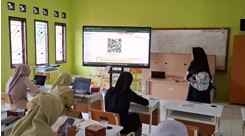
At this stage, participants were introduced to the Curipod through a brief presentation. The instructor then conducted a hands-on exercise in which participants responded to prompts displayed in Curipod using their own mobile devices or laptops.
Figure 1. Presentation
b.
Demonstration
In this session, the instructor first demonstrated how to access Curipod, create an account, and navigate to the initial blank interface. Subsequently, the instructor illustrated presentation authoring using both AI prompting and manual methods. Finally, the platform’s interactive
Sulsilah, et.al., AI-Based Interactive Media Creation Training Using Curipod for High School.... 137
This creation is distributed below Lisensi Creative Commons Atribusi 4.0 Internasional
features were introduced. These activities are documented in Figures 2a and 2b. Participants’ responses were observed by reviewing their outputs and interactions within Curipod.
a) b)
c) d)
Figure 2. a) Demonstration: Accessing Curipod; b) Simulation showing feedback;
c) Review of Curipod usage; d) Participant response rates
Throughout the training, the mean response rate across various activities attained a notable 95% (Figure 2d), signifying elevated levels of participation and engagement. In the context of the Curipod demonstration and simulation, the interactions were meticulously organized as temporally constrained tasks, encompassing open-ended inquiries, word clouds, polls, drawing assignments accompanied by AI-generated feedback, as well as additional open-ended questions with corresponding feedback. Instances in which response rates fell below 100% were generally characterized by a singular omitted item, which could be ascribed to factors such as time limitations, inadvertent oversight, or network-related issues.
c) Assistance
In this stage, participants independently explored Curipod’s features. They developed presentation materials using the AI-assisted tool and created several activities/ questions for trial. Peers then tested one another’s activities on their own phones or laptops. This stage prompted intensive instructor–participant interaction, evidenced by numerous queries regarding feature use, item modification, simulation requests, joining procedures, time-limit settings, and feedback display. The high level of interaction suggests that Curipod effectively stimulated discussion and heightened participants’ interest in hands-on experimentation.
2.
Monitoring and Evaluating
Sulsilah, et.al., AI-Based Interactive Media Creation Training Using Curipod for High School.... 138
This creation is distributed below Lisensi Creative Commons Atribusi 4.0 Internasional
Figure 3. Participants take the test after the training ends
The success of this community service program was measured through a post-training test. The test assessed general knowledge about using Curipod. The percentage of participants who completed the Curipod test is shown in Figure 4.
Figure 4. Achievement test
Figure 4 shows that 6 out of 9 participants were able to answer all questions about using Curipod correctly (100%). Meanwhile, two participants achieved 87.5% and only one participant achieved 75%. A perfect (100%) achievement indicates that 6 out of 9 participants achieved very good achievement. Meanwhile, 3 participants achieved good results (75% and 87.5%). In general, the average class achievement was 94.4%, which means that the community service activity was considered successful. This achievement is inseparable from the interactive activities that take place in the classroom. Based on Figure 2d, the average activity level among participants reached 95%. These community service results align with research (Suendarti & Virgana, 2022; Yavuz & Arslan, 2018), which suggests that learning methods incorporating high levels of learning activities can lead to a deeper understanding.
Although the quantitative data indicated good mastery of the material, exploration of the affective aspects through a questionnaire instrument administered after the study concluded revealed deeper complexities. These are shown in Figure 5 and Table 2. 75
100 100 100
87.5
100 100
87.5
100
20
40
60
80
100
120
P1 P2 P3 P4 P5 P6 P7 P8 P9
Percentage (%)
Participant code
Sulsilah, et.al., AI-Based Interactive Media Creation Training Using Curipod for High School.... 139
This creation is distributed below Lisensi Creative Commons Atribusi 4.0 Internasional
Figure 5. Attitude toward the Curipod training
Table 2. Follow-up questionnaire on the implementation of Curipod
P1 achieved only 75% achievement, but P1 consistently expressed a positive attitude towards using Curipod. This attitude encompassed self-confidence, confidence in creating media, and plans to implement interactive media (Curipod) in real-life learning. After conducting an ongoing questionnaire, P1 stated that he had implemented Curipod in class for learning reflection. Thus, P1 demonstrated that a sufficient level of knowledge (75%) can lead to concrete actions when driven by self-confidence and a strong positive attitude. Therefore, P1 appears to have high digital-readiness and is willing to try without waiting for perfect mastery.
The second pattern was found in participant P7. P7 had perfect achievement (100%). However, P7 gave a negative response (scale 2-3) (as shown in Figure 6), indicating doubt and lack of confidence. P7 still had a positive response related to the plan to implement creative learning media. However, after follow-up (as shown in Table 2), it was found that P7 had not yet reached the stage of implementing it in the classroom. P7's case is a paradoxical case of the 3 3
4 4 4 4
2
4 4
3
4
4 4 4
3
3
2
4
3
3
4 4 4
4
3
2
4
2
4
6
8
10
12
14
P1 P2 P3 P4 P5 P6 P7 P8 P9
Scale
Participant code
plan to implement interactive media
Self-efficacy in developing interactive media
Self-confidence in developing interactive media
Participant Code
Achievement (%)
Implementation of Curipod within 1–2 months after the training
Explanation of how Curipod was utilized in the learning process.
P1
75
Yes
Curipod for reflection
P2
100
Yes
Designing learning material and quizzes
P3
100
Yes
Designing learning material and quizzes
P4
100
Yes
Using Curipod for preliminary or diagnostic tests
P5
87,5
Yes
Applying the application similarly to PowerPoint
P6
100
Yes
Utilizing it for instructional presentations
P7
100
No
-
P8
87,5
Yes
Delivering diagram-based learning material
P9
100
Yes
Facilitating interaction between the teacher and students through Curipod
Sulsilah, et.al., AI-Based Interactive Media Creation Training Using Curipod for High School.... 140
This creation is distributed below Lisensi Creative Commons Atribusi 4.0 Internasional
Knowing-Doing Gap. One-hundred percent (100%) technical mastery was not converted into action because it was hampered by psychological factors (low self-confidence).
Figure 6. Duration and extension of the training program
Participant P7 reported a negative response (score 2) regarding the training duration but expressed a positive attitude toward continuing the program. This pattern suggests a hesitation likely rooted in a preference for complete mastery before taking action.
A third pattern emerged with Participant P8. Although P8 achieved a learning attainment of 87.5% (in the good category), they initially reported low self-confidence in using the interactive platform (Curipod) and weak intentions to implement it in class. Follow-up, however, indicated that P8 began implementing Curipod within 1–2 months post-training, including delivering content via diagrams (drawing). In contrast to P7, who achieved 100% but had not implemented it, P8 implemented it despite attaining 87.5%. These findings indicate that, for P8, the primary barrier was not knowledge, but rather self-efficacy; increased post-training confidence translated into the concrete implementation of Curipod in the classroom.
Conclusion
Based on the program’s findings, the training received highly favorable responses, with a mean attainment rate of 94.1%, indicating that Curipod contributed to fostering interactive learning. To broaden its impact, the program should be sustained and scaled; specifically, extended follow-up sessions could reinforce participants’ mastery by guiding them to design a complete, single-topic lesson sequence that includes all learning activities and a comprehensive evaluation.
Acknowledgement
The authors gratefully acknowledge Universitas Siliwangi for funding this community service program. We thank all lecturers and academic staff of the Physics Education Study Program for their dedicated support in organizing and delivering the activities. We are also
3
4 4 4 4 4
2
3
2
3
4 4 4 4 4
3
3
4
1
2
3
4
5
6
7
8
9
P1 P2 P3 P4 P5 P6 P7 P8 P9
Scale
Participant code
Duration od the training program Extension of the training program
Sulsilah, et.al., AI-Based Interactive Media Creation Training Using Curipod for High School.... 141
This creation is distributed below Lisensi Creative Commons Atribusi 4.0 Internasional
grateful to the partner schools (teachers and staff) for their active participation and collaboration.
References
Bewersdorff, A., Seßler, K., Baur, A., Kasneci, E., & Nerdel, C. (2023). Assessing student errors in experimentation using artificial intelligence and large language models: A comparative study with human raters. Computers and Education: Artificial Intelligence, 5, 1–18. https://doi.org/10.1016/j.caeai.2023.100177
Chi, M. T. H., & Wylie, R. (2014). The ICAP Framework: Linking Cognitive Engagement to Active Learning Outcomes. Educational Psychologist, 49(4), 219–243. https://doi.org/10.1080/00461520.2014.965823
Fabriz, S., Mendzheritskaya, J., & Stehle, S. (2021). Impact of Synchronous and Asynchronous Settings of Online Teaching and Learning in Higher Education on Students’ Learning Experience During COVID-19. Frontiers in Psychology, 12(October). https://doi.org/10.3389/fpsyg.2021.733554
Freeman, S., Eddy, S. L., McDonough, M., Smith, M. K., Okoroafor, N., Jordt, H., & Wenderoth, M. P. (2014). Active learning increases student performance in science, engineering, and mathematics. Proceedings of the National Academy of Sciences of the United States of America, 111(23), 8410–8415. https://doi.org/10.1073/pnas.1319030111
Haleem, A., Javaid, M., Qadri, M. A., & Suman, R. (2022). Understanding the role of digital technologies in education: A review. Sustainable Operations and Computers, 3(February), 275–285. https://doi.org/10.1016/j.susoc.2022.05.004
Kochmar, E., Vu, D. Do, Belfer, R., Gupta, V., Serban, I. V., & Pineau, J. (2020). Automated Personalized Feedback Improves Learning Gains in An Intelligent Tutoring System. Lecture Notes in Computer Science (Including Subseries Lecture Notes in Artificial Intelligence and Lecture Notes in Bioinformatics), 12164 LNAI(Ml), 140–146. https://doi.org/10.1007/978-3-030-52240-7_26
Molin, F., Haelermans, C., Cabus, S., & Groot, W. (2021). Do feedback strategies improve students’ learning gain?-Results of a randomized experiment using polling technology in physics classrooms. Computers and Education, 175(July), 104339. https://doi.org/10.1016/j.compedu.2021.104339
Moore, M. G. (1989). Editorial: Three Types of Interaction. American Journal of Distance Education, 3(2), 1–7. https://doi.org/10.1080/08923648909526659
Muslem, A., Mustafa, F., Rahayu, R. R., & Eridafithri. (2024). The Preferred Use of Google Classroom Features for Online Learning in Indonesian EFL Classes. Electronic Journal of E-Learning, 22(8), 76–92. https://doi.org/10.34190/ejel.22.8.2896
OECD. (2022). PISA PISA 2022 Results Malaysia. Journal Pendidikan, 10.
OECD. (2023). Education in Indonesia a decade on Transforming Education in Indonesia: Examining the landscape of current reforms. Directorate for Education and Skills, 88, 5.
Pahi, K., Hawlader, S., Hicks, E., Zaman, A., & Phan, V. (2024). Enhancing active learning through collaboration between human teachers and generative AI. Computers and Education Open, 6(February), 100183. https://doi.org/10.1016/j.caeo.2024.100183
Plasencia, J. (2023). Use of practice tests with immediate feedback in an undergraduate molecular biology course. Biochemistry and Molecular Biology Education, 51(1), 65–73. https://doi.org/10.1002/bmb.21695
Presley, R., Cumberland, D. M., & Rose, K. (2023). A Comparison of Cognitive and Social Presence in Online Graduate Courses: Asynchronous vs. Synchronous Modalities. Online Learning Journal, 27(2), 245–264. https://doi.org/10.24059/olj.v27i2.3046
Rahmad, R., Adria Wirda, M., Berutu, N., Lumbantoruan, W., & Sintong, M. (2019). Google classroom implementation in Indonesian higher education. Journal of Physics: Conference Series, 1175(1). https://doi.org/10.1088/1742-6596/1175/1/012153
Rizal, R., Surahman, E., Aripin, H., & Maulidah, R. (2024). Problem-Based Learning Management System (PBLMS): A Mobile Learning Application to Facilitate Creative Thinking Skills (CTS) of Prospective Physics Teachers. International Journal of Interactive Mobile Technologies (IJIM), 18(01), 97–109. https://doi.org/10.3991/ijim.v18i01.46417
Rocliffe, P., Tapia-Serrano, M. A., Garcia-Gonzalez, L., Adamakis, M., Walsh, L., Bannon, A., Mulhall, E., Sherwin, I., O’ Keeffe, B. T., Mannix-McNamara, P., & MacDonncha, C. (2024). The Impact of Typical School Provision of Physical Education, Physical Activity and Sports on Adolescent Physical Health: A Systematic Literature Review and Meta-Analysis. In Adolescent Research Review (Vol. 9, Issue 4). Springer International Publishing. https://doi.org/10.1007/s40894-023-00231-x
Sahito, Z. H., Khoso, F. J., & Phulpoto, J. (2025). The Effectiveness of Active Learning Strategies in Enhancing Student Engagement and Academic Performance. Journal of Social Sciences Review, 5(1), 110–127. https://doi.org/10.62843/jssr.v5i1.471
Suendarti, M., & Virgana, V. (2022). Elevating natural science learning achievement: Cooperative learning and learning interest. Journal of Education and Learning (EduLearn), 16(1), 114–120. https://doi.org/10.11591/edulearn.v16i1.20419
Taxipulati, S., & Lu, H. D. (2021). The Influence of Feedback Content and Feedback Time on Multimedia Learning Achievement of College Students and Its Mechanism. Frontiers in Psychology, 12(December), 1–14. https://doi.org/10.3389/fpsyg.2021.706821
Wekerle, C., Daumiller, M., Janke, S., Dickhäuser, O., Dresel, M., & Kollar, I. (2024). Putting ICAP to the test: how technology-enhanced learning activities are related to cognitive and affective-motivational learning outcomes in higher education. Scientific Reports, 14(1), 1–8. https://doi.org/10.1038/s41598-024-66069-y
Widodo, Y. B., & Akbar, K. F. (2024). Effectiveness of Technology Use in Indonesian High Schools: Student Engagement, School Capacity, Teacher Performance. International Journal of Business, Law, and Education, 5(1), 615–627. https://doi.org/10.56442/ijble.v5i1.442
Wisniewski, B., Zierer, K., & Hattie, J. (2020). The Power of Feedback Revisited: A Meta-Analysis of Educational Feedback Research. Frontiers in Psychology, 10(January), 1–14. https://doi.org/10.3389/fpsyg.2019.03087
Yavuz, O., & Arslan, A. (2018). Cooperative learning in acquisition of the english language skills. European Journal of Educational Research, 7(3), 591–600. https://doi.org/10.12973/eu-jer.7.3.591
Downloads
Published
How to Cite
Issue
Section
License
Copyright (c) 2025 Hani Sulsilah, Ernita Susanti, Rahmat Rizal, Ifa Rifatul Mahmudah

This work is licensed under a Creative Commons Attribution 4.0 International License.