Digital Anti-Cyberbullying Campaign through a Student Collaboration Project
DOI:
https://doi.org/10.32938/jpsh.v5i1.10666Keywords:
digital literacy, cyberbullying, collaborative project, social media, studentsAbstract
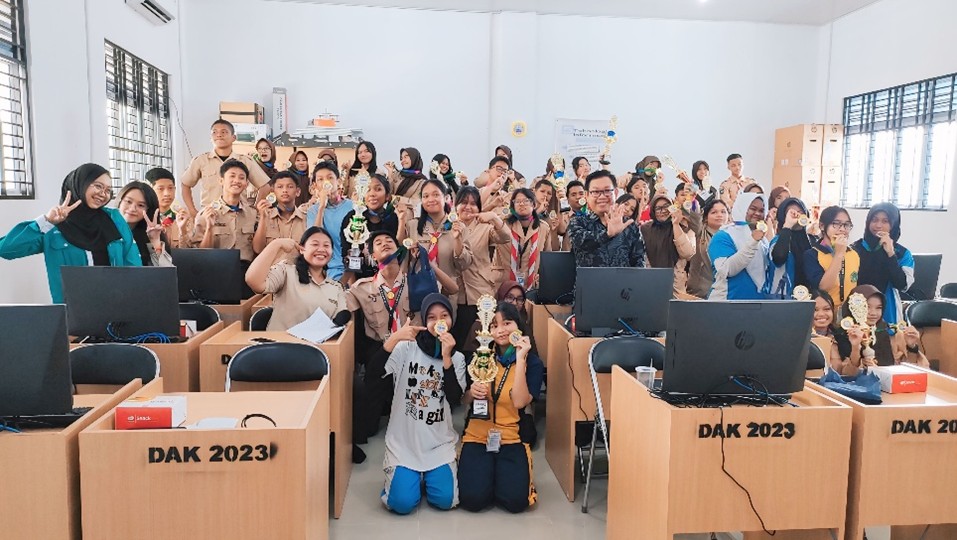
The rapid growth of social media has intensified adolescents’ digital interactions while increasing the risk of cyberbullying, which negatively affects students’ psychological well-being. Low digital literacy and limited understanding of online ethics are key factors contributing to adolescents’ vulnerability to online harassment. This community service program aimed to enhance students’ awareness and understanding of ethical and responsible social media use through a collaborative digital campaign project. The program employed a Participatory Action Research (PAR) approach consisting of observation, problem formulation, intervention, and evaluation. The participants were students of SMA Negeri 28 Batam from various grade levels. The intervention was conducted through poster design and digital content creation competitions focusing on cyberbullying prevention. The results indicate increased student engagement, improved understanding of online ethics, and greater awareness of the dangers of hoaxes and cyberbullying. In addition, the program contributed to the development of students’ soft skills, including teamwork, creativity, and communication. This collaborative project demonstrates its potential as a participatory and sustainable digital literacy education model for cyberbullying prevention among students.
References
Alfazri, M., & Syahputra, J. (2024). Literasi Digital dan Etika Komunikasi dalam Konteks Media Sosial. Jurnal Syiar-Syiar. https://doi.org/10.36490/syiar.v4i2.1555
Almulla, M. (2020). The Effectiveness of the Project-Based Learning (PBL) Approach as a Way to Engage Students in Learning. SAGE Open, 10. https://doi.org/10.1177/2158244020938702
Althibyani, H. A., & Al-Zahrani, A. M. (2023). Investigating the Effect of Students’ Knowledge, Beliefs, and Digital Citizenship Skills on the Prevention of Cybercrime. In Sustainability (Vol. 15, Issue 15, p. 11512). https://doi.org/10.3390/su151511512
Ayhan, N., Akman, E., & Narmamatova, T. (2025). Digital transformation and cyberbullying in education: an evaluation on children in Kyrgyzstan. International Journal of Adolescence and Youth, 30. https://doi.org/10.1080/02673843.2025.2498058
Chan, A. Y. W., & Sung, C. C. M. (2025). Enhancing students’ digital literacy skills through their technology use in a course-based research project: a Hong Kong case study. Asia Pacific Education Review. https://doi.org/10.1007/s12564-025-10038-1
Cornish, F., Breton, N., Moreno-Tabarez, U., Delgado, J., Rua, M., Aikins, D.-G., & Hodgetts, D. (2023). Participatory action research. Nature Reviews Methods Primers, 3. https://doi.org/10.1038/s43586-023-00214-1
Ehrenreich, S., George, M., Burnell, K., & Underwood, M. (2021). Importance of Digital Communication in Adolescents’ Development: Theoretical and Empirical Advancements in the Last Decade. Journal of Research on Adolescence : The Official Journal of the Society for Research on Adolescence, 31 4, 928–943. https://doi.org/10.1111/jora.12643
Gabrielli, S., Rizzi, S., Carbone, S., & Piras, E. M. (2021). School Interventions for Bullying–Cyberbullying Prevention in Adolescents: Insights from the UPRIGHT and CREEP Projects. In International Journal of Environmental Research and Public Health (Vol. 18, Issue 21, p. 11697). https://doi.org/10.3390/ijerph182111697
Habib, M., Hariri, R., & Abed, Y. (2026). Cyberbullying and Digital Citizenship : The Effectiveness of Tech-Integrated Prevention Programs.
Isnani, T. (2024). Implementation of Project-Based Learning Approach in Improving Critical Thinking Skills of Elementary School Students. Jurnal Ar Ro’is Mandalika (Armada). https://doi.org/10.59613/armada.v3i1.2844
Khafsoh, N. A., & Riani, N. (2024). Implementation of Participatory Action Research (PAR) In Community Service Program. Jurnal Pengabdian Masyarakat. https://doi.org/10.32815/jpm.v5i1.2034
Ladd, G. W. (1981). Effectiveness of a Social Learning Method for Enhancing Children’s Social Interaction and Peer Acceptance. Child Development, 52(1), 171–178. https://doi.org/10.2307/1129227
Lee, J., Choo, H., Zhang, Y., Cheung, H., Zhang, Q., & Ang, R. (2025). Cyberbullying Victimization and Mental Health Symptoms Among Children and Adolescents: A Meta-Analysis of Longitudinal Studies. Trauma, Violence & Abuse, 15248380241313052. https://doi.org/10.1177/15248380241313051
Li, C., Wang, P., Martín-Moratinos, M., Bella-Fernández, M., & Blasco-Fontecilla, H. (2022). Traditional bullying and cyberbullying in the digital age and its associated mental health problems in children and adolescents: a meta-analysis. European Child & Adolescent Psychiatry, 33, 2895–2909. https://doi.org/10.1007/s00787-022-02128-x
Magis-Weinberg, L., Suleiman, A. B., & Dahl, R. (2021). Context, Development, and Digital Media: Implications for Very Young Adolescents in LMICs. Frontiers in Psychology, 12. https://doi.org/10.3389/fpsyg.2021.632713
Masri, M. A., Ibrahim, M., & Hadi, M. (2023). Strategi Pemberdayaan Masyarakat dalam Meningkatkan Partisipasi dalam Pembangunan Desa Payakameng. AJAD : Jurnal Pengabdian Kepada Masyarakat. https://doi.org/10.59431/ajad.v3i1.149
Maurya, C., Muhammad, T., Dhillon, P., & Maurya, P. (2022). The effects of cyberbullying victimization on depression and suicidal ideation among adolescents and young adults: a three year cohort study from India. BMC Psychiatry, 22. https://doi.org/10.1186/s12888-022-04238-x
Milyane, T. M., Rohimakumullah, M. A. A., & Fariza, M. R. (2025). Exploring Adolescents’ Understanding of Cyberbullying on Social Media Through Information Mining. Howard Journal of Communications, 36(4), 473–487. https://doi.org/10.1080/10646175.2025.2537195
Nito, P. J. B., Ariani, M., Manto, O., & Wulandari, D. (2022). Identification and Classsification Cyber Bullying among University’s Students. Media Keperawatan Indonesia. https://doi.org/10.26714/mki.5.4.2022.302-308
Vespoli, G., Taddei, B., Imbimbo, E., De Luca, L., & Nocentini, A. (2025). The concept of privacy in the digital world according to teenagers. Journal of Public Health (Germany), 33(12), 2731–2742. https://doi.org/10.1007/s10389-024-02242-x
Wang, Z., Jin, H., & Li, S. (2025). Good news or bad news? The impact of information valence on high school students’ willingness to share misinformation and the effectiveness of a targeted accuracy prompt. Frontiers in Psychology, 16(October). https://doi.org/10.3389/fpsyg.2025.1664890
Downloads
Published
How to Cite
Issue
Section
License
Copyright (c) 2026 Nur Elfi Husda, Michael Jibrael Rorong, Muhammat Rasid Ridho, Nurhabsyina, Faine Fabiola, Khairuddin

This work is licensed under a Creative Commons Attribution 4.0 International License.