Teachers’ Training in Designing Mathematics Literacy Questions at SMP and SMK Putra Juang Cianjur
DOI:
https://doi.org/10.32938/jpsh.v4i1.9554Abstract
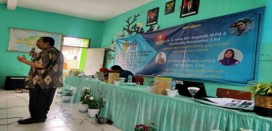
This community service activity aims to enhance the competence of teachers at SMP and SMK Putra Juang in designing mathematics literacy questions aligned with the demands of the Merdeka Curriculum and the national assessment. The training was initiated due to the teachers’ limited understanding of the characteristics of mathematics literacy questions, which emphasisis on critical thinking skills, contextual problem-solving, and conceptual interconnections. The activity was implemented using a participatory approach through workshops, group discussions, and intensive mentoring. The results of the activity indicate an improvement in teachers' ability to develop questions with relevant contexts, diverse representations, and appropriate competency indicators. Furthermore, this activity had a positive impact on teachers’ preparedness for the national assessment and the implementation of literacy-based learning. Based on these findings, this article recommends the continuation of similar training programs as part of efforts to support teachers’ competence development.
References
Brookfield, S. D. (2017). Becoming a Critically Reflective Teacher. John Wiley & Sons.
Deda, Y. N., Disnawati, H., & Daniel, O. (2023). How important of students' literacy and numeracy skills in facing 21st-century challenges: A systematic literature review. Indonesian Journal of Educational Research and Review, 6(3), 563-572.
Hutajulu, M., & Minarti, E. D. (2024). Increasing mathematical literacy and numeracy abilities with problem-based learning model through technological pedagogical content knowledge. Hexagon: Jurnal Ilmu Dan Pendidikan Matematika, 2(1), 55-63.
Kadarisma, G., & Amelia, R. (2018). Epistemological Obstacles in Solving Equation of Straight Line Problems. 3.
Kadarisma, G., Senjayawati, E., & Amelia, R. (2019). Pedagogical Content Knowledge Pre-Service Mathematics Teacher. Journal of Physics: Conference Series, 1315(1), 012068. https://doi.org/10.1088/1742-6596/1315/1/012068
OECD. (2019). PISA 2018 Assessment and Analytical Framework. OECD. https://doi.org/10.1787/b25efab8-en
OECD. (2023). PISA 2022 Results (Volume I): The State of Learning and Equity in Education.
OECD Publishing
Sadler, D. R. (2013). Opening up feedback: Teaching learners to see. In Reconceptualising feedback in higher education (pp. 54-63). Routledge.
Setyaputri, D. V. A., Fadilla, I. N. I., Nurpratiwiningsih, L., & Santika, A. (2022). Pelatihan Literasi dan Numerasi Peserta Didik SD Negeri Kragilan 2. JAMU : Jurnal Abdi Masyarakat UMUS, 2(02), Article 02. https://doi.org/10.46772/jamu.v2i02.642
Stacey, K., & Turner, R. (2015). The Evolution and Key Concepts of the PISA Mathematics Frameworks. In K. Stacey & R. Turner (Eds.), Assessing Mathematical Literacy: The PISA Experience (pp. 5–33). Springer International Publishing. https://doi.org/10.1007/978-3-319-10121-7_1
Sugandi, A. I., Sobari, T., & Nazaretha, R. (2021). Meningkatkan Profesionalisme Guru Melalaui Penulisan Artikel Ilmiah. Abdimas Siliwangi, 4(2), 197-209.
Toropova, A., Johansson, S., & Myrberg, E. (2019). The role of teacher characteristics for student achievement in mathematics and student perceptions of instructional quality. Education Inquiry, 10(4), 275-299.
Widoyoko, E. P. (2018). Teknik penyusunan instrumen penelitian pendidikan kimia. Yogyakarta: Pustaka Pelajar, 15, 62.
Zuhra, F., Nurhayati, N., Safarati, N., Rahma, R., & Jasmaniah, J. (2021). Pelatihan Implementasi Literasi Dan Numerasi Dalam Proses Pembelajaran Untuk Guru MtS. JMM (Jurnal Masyarakat Mandiri), 5(6), 3434–3441. https://doi.org/10.31764/jmm.v5i6.5073
Downloads
Published
How to Cite
Issue
Section
License
Copyright (c) 2025 Masta Hutajulu, Asep Ikin Sugandi

This work is licensed under a Creative Commons Attribution 4.0 International License.