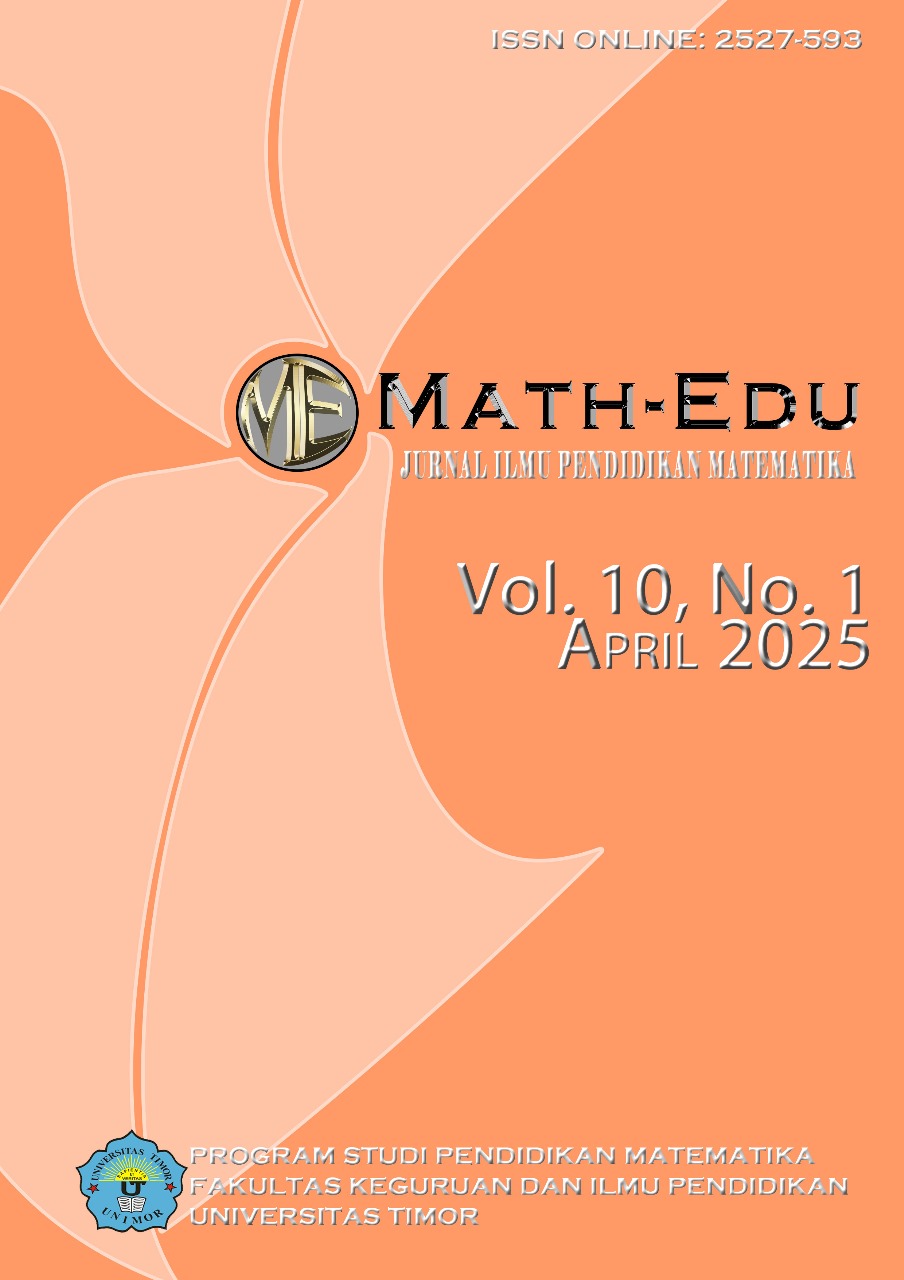
Efforts to Improve Mathematics Learning Outcomes with Ethnomathematics Based Differentiated Learning in Junior High School Students
DOI:
https://doi.org/10.32938/jipm.v10i1.9236Keywords:
Differentiated Learning, Ethnomathematics, Learning StylesAbstract
This study aims to determine the results of mathematics learning with ethnomathematics-based differentiated learning in grade VII students of Maubeli State Junior High School. This research is called Classroom Action Research, and it was carried out at Maubeli State Middle School. The data collection techniques used are tests and observations. The research instruments used were test questions and observation sheets. The data analysis techniques used are data analysis of test results and analysis of observation data. The results of the study showed that there was an increase in students' mathematics learning outcomes with an ethnomathematics-based differentiated learning approach. The average student learning outcomes and the percentage of class completion from cycle I to cycle II have exceeded the specified standard, namely the average student score reached 68.64 with a classical completion percentage of 64% in the first cycle increasing to 80.52 with a classical completion percentage of 84% in cycle II. Learning with an ethnomathematical approach can increase students' understanding of the material because it is related to the activities they do in their daily lives, especially in the Pancasila Student Profile Strengthening (P5) project
References
Agusta, E. S. (2021). Ethnomathematics Learning in Betawi Culture to Increase Students' Activities and Creativity in Geometric Transformation Materials. Journal of Education Quality Circle, 18(1), 53–67. https://doi.org/10.54124/jlmp.v18i1.7
Andriono, Rohim. 2021. "Analysis of the Role of Ethnomathematics in Mathematics Learning." ANARGYA: Scientific Journal of Mathematics Education 4(2).
Aqib, Zainal, et al. 2016. Classroom Action Research. Bandung: Yrama Widya. https://doi.org/10.24114/jgk.v4i4.19980
Arikunto, S. (2010). Research Procedure A Practical Approach. Jakarta: Rineka Cipta
Bire, A. L., Geradus, U., & Bire, J. (2014). The Influence of Visual, Auditorial, and Kinesthetic Learning Styles on Student Learning Achievement. Journal of Education, 44(2), 168–174.
Cahyani, I. S. (2016). The importance of recognizing students' learning styles in learning activities. Scientific Journal of State University of Malang, 1–9.
Husna, N. M. (2024). Ethnomathematics-based learning to improve learning achievement is reviewed from the acquisition of student learning outcomes. 7, 442–448.
Iskandar, D. (2021). Improving Student Learning Outcomes in Report Text Materials Through Differentiated Learning in Class IX. A State Junior High School 1 Sape Academic Year 2020/2021. Indonesian Journal of Education and Learning (JPPI), 1(2), 123-140
Kamal, S. (2021). Implementation of Differentiated Learning in an Effort to Improve Mathematics Learning Activities and Outcomes of Grade XI Students of MIPA SMA Negeri 8 Barabai by. Title: Journal of Learning and Educators. 1(1), 89-100.
Machali, I. (2022). How to Conduct Classroom Action Research for Teachers? Indonesian Journal of Action Research, 1(2), 315–327. https://doi.org/10.14421/ijar.2022.12-21
Nurdini, D. H. (2021). Differentiated Learning in Islamic Religious Education and Ethics Subjects. Asaatidzah: Scientific Journal of Islamic Religious Education. 1(2), 124-138.
Pane, R. N., Lumbantoruan, S., & Simanjuntak, S. D. (2022). The implementation of differentiated learning to improve students' creative thinking skills. BULLET: Journal of Multidisciplinary Science, 1(3), 173–180.
Siregar, Ahmad Rifai et al. 2024. "Ethnomathematics as a means of strengthening local culture through the Independent Learning Curriculum." Proceedings of the Symposium III: 44–57.
Syarifuddin, S., & Nurmi, N. (2022). Differentiated Learning in Improving Mathematics Learning Outcomes for Grade IX Students in the Even Semester of SMP Negeri 1 Wera for the 2021/2022 Academic Year. JagoMIPA: Journal of Mathematics and Science Education, 2(2), 35–44. https://doi.org/10.53299/jagomipa.v2i2.184
Trianto, A. (2014). Designing Innovative, Progressive and Contextual Learning Models. Surabaya: Prenadamedia Group.
Tomlinson, C. A. 2001. How to differentiate instruction in mixed-ability classrooms. ASCD. Tomlinson. (Modul 2.1 PGP, 2021)
Wahyuni, A., Aji, A., Tias, W., & Sani, B. (2013). P – 15 The role of ethnomathematics in building the character of the nation. Proceedings, November, 978–979.
Downloads
Published
How to Cite
Issue
Section
License
Copyright (c) 2025 Adelvina Mei, Stanislaus Amsikan, Maria Naimnule

This work is licensed under a Creative Commons Attribution 4.0 International License.