Teaching English for Children at Budi Mulia Orphanage with Interactive Games - Flashcard
DOI:
https://doi.org/10.32938/jpsh.v5i1.10361Keywords:
Flashcard, Interactive Game, Ponunciation, Teaching English VocabularyAbstract
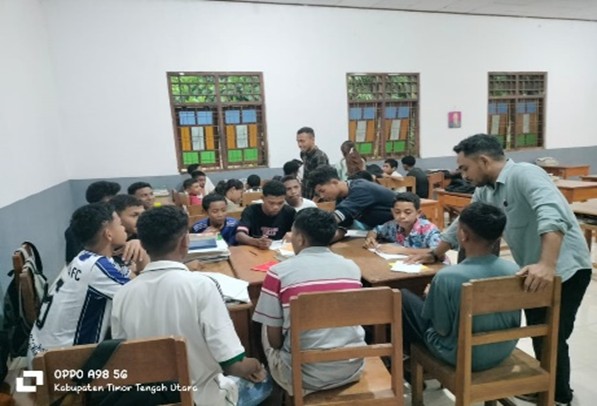
The urgency of this community service lies in the persistent difficulties faced by children in comprehending English, particularly in mastering vocabulary. Therefore, the objective of this community service was to teach children with interactive and interesting games and provide vocabulary mastery. The method used in this activity was interactive games – flashcard. Vocabulary test was given at every meeting to evaluate participants’ vocabulary mastery. The result of this activity showed that the participants were very enthusiastic and they fully took part and in every session of this activity. They obtained more new vocabulary and learned pronunciation of plenty of new vocabulary. The average score of the first meeting was 42% for transportation vocabulary and 58% for body part vocabulary. On the second day, the average score was 24% for vegetables vocabulary and 46% for tools for eating and drinking. The score improved on the third day where 94% for transportation, 96% for body part, 100% for vegetables, and 98% for tools for eating and drinking. The score also got significantly improved on the fourth day where 94% for transportation, 98% for body part, 100% for vegetables, and 98% for tools for eating and drinking. The fifth meeting created a good result where participants score was 91% on average. This overall result proved that participants obtained significant vocabulary achievement.
References
Borghi, A. M., & Binkofski, F. (2019). Words as social tools: Language, cognition, and social interaction. Cambridge University Press.
Brown, H. D., & Lee, H. (2025). Principles of language learning and teaching: A course in second language acquisition (7th ed.). Routledge
Freeman, S., Eddy, S. L., McDonough, M., Smith, M. K., Okoroafor, N., Jordt, H., & Wenderoth, M. P. (2019). Active learning increases student performance in science, engineering, and mathematics. Proceedings of the National Academy of Sciences, 116(19), 20032–20035. https://doi.org/10.1073/pnas.1821936116
Harmer, J. (2015). The practice of English language teaching (5th ed.). Pearson Education ESL.
Lee, J., & Reinders, H. (2020). Writing in language learning: Research insights and pedagogical implications. Routledge.
Mayer, R. E. (2021). Multimedia learning (3rd ed.). Cambridge University Press.
Murti, F. K., Dewi, A., Dewi, H. S., & Atmoko, D. (2024). Perspektif Mahasiswa Tentang Penggunaan Grammar Dalam Komunikasi Berbahasa Inggris. Journal of Global and Multidisciplinary, 2(1), 1006-1015.
Nakata, T. (2023). Effects of retrieval practice and spacing on second language vocabulary learning: A meta-analytic review. Language Teaching Research, 27(5), 1123–1145. https://doi.org/10.xxxx/ltr.2023
Nation, I. S. P. (2013). Learning vocabulary in another language (2nd ed.). Cambridge University Press.
Nation, I. S. P. (2022). Learning vocabulary in another language (2nd ed.). Cambridge University Press.
OECD. (2018). Equity in education: Breaking down barriers to social mobility. OECD Publishing. https://doi.org/10.1787/9789264073234-en
Plass, J. L., Mayer, R. E., & Homer, B. D. (2020). Handbook of game-based learning. MIT Press.
Schmitt, N. (2020). Vocabulary in language teaching (2nd ed.). Cambridge University Press.
Schmitt, N. (2023). Vocabulary learning and teaching: Research and practice in the digital age. Annual Review of Applied Linguistics, 43, 45–63. https://doi.org/10.xxxx/aral.2023
Schmitt, N., & McCarthy, M. (2020). Vocabulary: Description, acquisition and pedagogy (2nd ed.). Cambridge University Press.
Storch, N. (2019). Collaborative writing in L2 classrooms. Multilingual Matters.
Webb, S., & Nation, I. S. P. (2017). How vocabulary is learned. Oxford University Press.
Wulandari, I. R., Hadi, M. S., & Arifin, S. (2025). Analisis Tantangan Guru dalam Meningkatkan Keterampilan Membaca pada Siswa Sekolah Dasar di Kota Tangerang. Lingua Rima: Jurnal Pendidikan Bahasa dan Sastra Indonesia, 14(1).
Zhang, R., & Zou, D. (2023). Game-based vocabulary learning in community language programs: Effects on engagement and retention. Computer Assisted Language Learning, 36(4), 789–808. https://doi.org/10.xxxx/call.2023
Downloads
Published
How to Cite
Issue
Section
License
Copyright (c) 2026 Yanuarius Seran, Thresia T. Semiun, Fransiska Densiana Luruk, Delti Yulita, Maria Wihelmina Wisrance,Jose Da Conceicao Verdial, Edmundus Bouk, Antonio Constantino Soares, Maria Fridolin Naben, Petrus Banfoe

This work is licensed under a Creative Commons Attribution 4.0 International License.