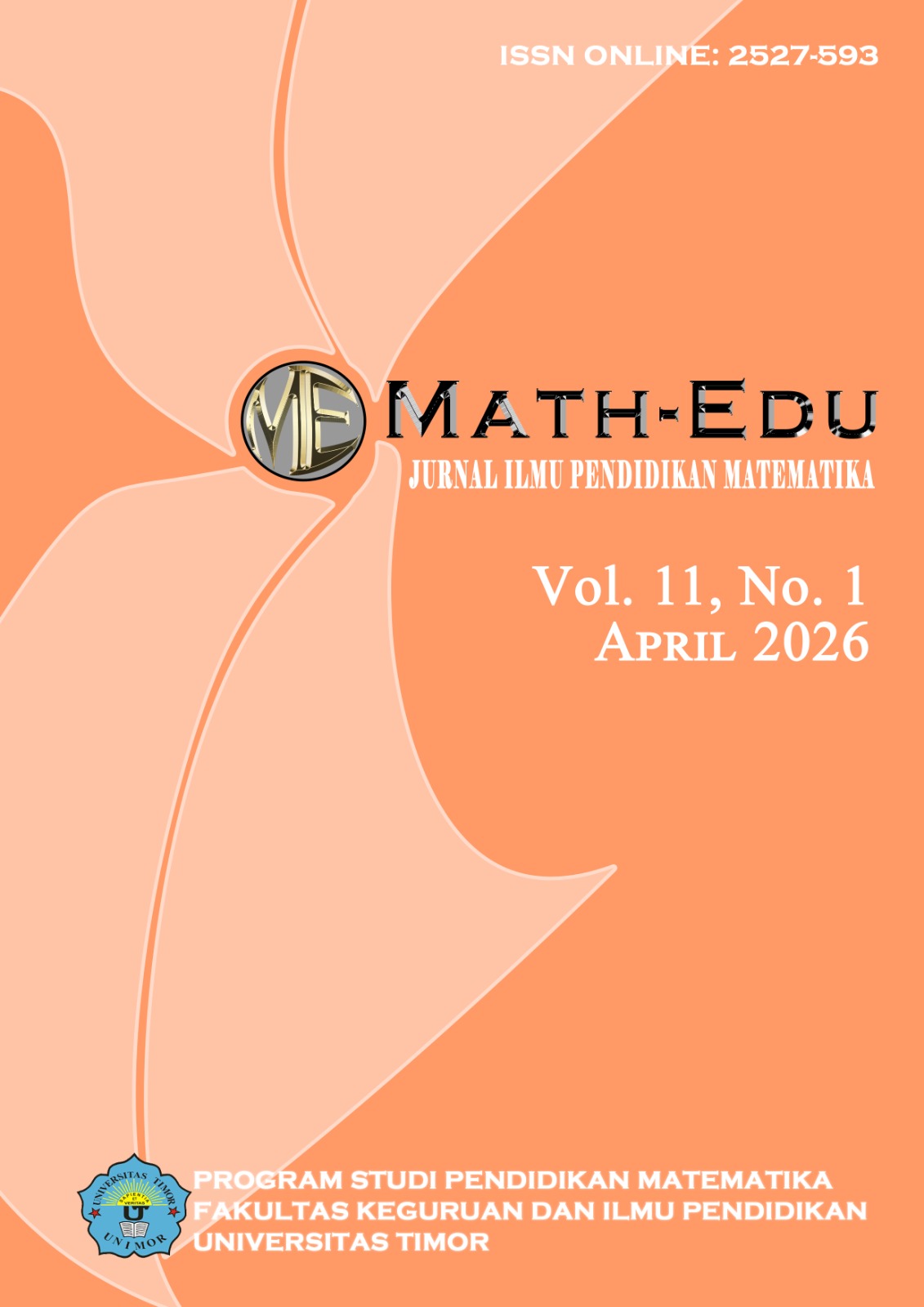
Analysis of Students’ Mathematical Reasoning Ability in Solving Problems on Quadratic Equations at SMP Negeri Bitefa
DOI:
https://doi.org/10.32938/jipm.v11i1.10918Keywords:
mathematical reasoning, quadratic equation, problem solving, junior high schoollAbstract
This study aimed to analyze students’ mathematical reasoning ability in solving problems on the topic of quadratic equations at SMP Negeri Bitefa. The research used a qualitative descriptive approach with 18 eighth-grade students as participants. Data were collected through tests of mathematical reasoning and follow-up interviews with three selected subjects representing high, medium, and low levels of reasoning ability. The results showed that students’ reasoning abilities varied across five indicators: (1) making initial conjectures and predictions based on problem context, (2) performing mathematical manipulations to find patterns and relationships, (3) constructing systematic mathematical arguments and proofs, (4) evaluating mathematical arguments for accuracy, and (5) integrating analysis results to draw logical conclusions. The findings revealed that students generally demonstrated moderate reasoning ability. The strongest performance appeared in the ability to draw conclusions (50.74%), while the weakest was in generating conjectures (44.81%). These results suggest the need for mathematics instruction that emphasizes inquiry-based and problem-solving learning strategies to improve reasoning competence.
References
Cai, J., & Knuth, E. (2018). Computation, reasoning, and sense making: Toward a 21st century mathematics education. NCTM.
Hidayat, W. (2020). Implementation of problem-based learning to improve students’ mathematical reasoning ability. Jurnal Pendidikan Matematika, 14(2), 112–123.
Hiebert, J., & Grouws, D. A. (2007). The effects of classroom mathematics teaching on students’ learning. In F. K. Lester (Ed.), Second handbook of research on mathematics teaching and learning (pp. 371–404). Information Age.
Inayah, R., & Madawistama, D. (2023). Analysis of higher-order thinking skills on quadratic equation material. Jurnal Pendidikan dan Pembelajaran Matematika, 5(1), 25–34.
National Council of Teachers of Mathematics. (2000). Principles and standards for school mathematics. NCTM.
National Council of Teachers of Mathematics. (2014). Principles to actions: Ensuring mathematical success for all. NCTM.
Prasetyo, D. (2017). The effect of discovery learning on junior high school students’ mathematical reasoning ability. Jurnal Pendidikan Matematika Integratif, 3(1), 45–53.
Ratnasri, N. (2016). Students’ mathematical reasoning ability on quadratic equation material. Jurnal Inovasi Pendidikan Matematika, 7(2), 98–106.
Sulistiawati, S. (2014). Improving students’ mathematical reasoning ability through inquiry-based learning. Jurnal Penelitian Pendidikan, 14(1), 33–40.
Sumarmo, U. (2014). Mathematical thinking and disposition: What they are, why they matter, and how to develop them in learners. Jurnal Pengajaran Matematika dan Ilmu Pengetahuan Alam, 19(1), 1–20.
Suryana, A. (2016). Analysis of students’ difficulties in solving mathematical reasoning problems. Jurnal Pendidikan Matematika RAFA, 2(1), 55–66.
Downloads
Published
How to Cite
Issue
Section
License
Copyright (c) 2026 Hendrika Bete, Aprilia Binsasi, Maria Naimnule

This work is licensed under a Creative Commons Attribution 4.0 International License.